Neutralhydrogen refers to hydrogen atoms that have not been ionized, meaning they still possess their single electron. In astrophysics, this term is almost synonymous with the 21-centimeter line, a specific radio wavelength emitted when the electron's spin flips relative to the proton. This emission is a cornerstone of radio astronomy because it allows scientists to map the distribution of hydrogen gas across the universe, revealing the structure of galaxies, the Milky Way's spiral arms, and even the early universe's epoch of reionization.
History
The 21-cm line was predicted by Dutch astronomer Hendrik van de Hulst in 1944 and first detected by Harold Ewen and Edward Purcell in 1951 at Harvard University.
How it works
The 21-cm line arises from a hyperfine transition: the proton and electron in a hydrogenatom have intrinsic spins that can be aligned (parallel) or opposite (antiparallel). The parallel state has slightly higher energy. When the atom spontaneously flips to the antiparallel state, it emits a photon with a wavelength of 21.1 cm. Though this transition is extremely rare (each atom does it once every 10 million years on average), the sheer abundance of hydrogen in space makes the signal detectable.
In practice
Radio telescopes use 21-cm observations to map galactic structure, study the intergalactic medium, and probe the cosmic dark ages before the first stars formed.
Fun fact
Because the 21-cm line is so fundamental, astronomers have proposed using it to communicate with extraterrestrial civilizations, as any advanced species would likely recognize it.
In a village smithy, the blacksmith pumps the bellows, and sparks fly into the darkness. So too in the galaxy AEON-z5, an active nucleus, like a red-hot forge, hurls metal-enriched material far beyond the stellar disk. The James Webb Space Telescope caught this process just a billion years after the Big Bang, when the universe was still in its infancy.
Every morning, a janitor sweeps leaves into a pile. The Sun, as it travels through the galaxy, does something similar: its gravity gathers diffuse interstellar gas into an invisible cone — a giant funnel.
Water is not just a wet substance. On a picosecond scale, it resembles a dance floor where molecules continuously break and form bonds with each other. Usually, this dance is described by one main movement — collective relaxation, as if the whole crowd simultaneously slows down after the music stops.
A stone falls into water, and ripples spread in all directions. Throw a handful of stones at once, and the ripples overlap: you can no longer tell which ripple came from which stone. A neutron beam hitting a detector looks much the same: a bright spot blurred by many causes.
The cosmic microwave background is the afterglow of the Big Bang, which we see at millimeter wavelengths. But it also has a long-wavelength tail extending into the radio range.
According to ordinary mechanics, an electron in an atom should spiral into the nucleus and crash into it, like a surfer losing speed and falling off the board. But atoms live for billions of years. Because space isn’t empty. Even in absolute vacuum, an invisible electromagnetic sea ripples — the zero-point field. Its waves continuously nudge the electron.
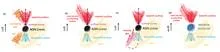
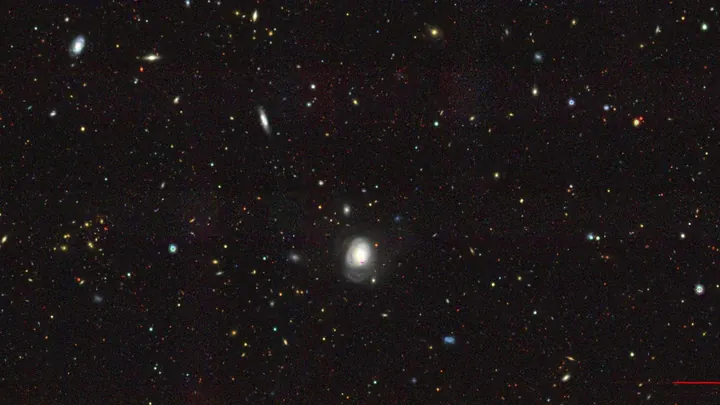
For a long time, astrophysics was dominated by the belief that giant jets of radio emission, radio outbursts blasting from central regions, were the exclusive privilege of elliptical galaxies. It was thought that only their calm, featureless internal environment could allow such colossal fountains of energy, powered by supermassive black holes, to form.
Long before stars appeared, the universe was filled with cold hydrogen. This gas can 'sing'—emitting radio waves with a wavelength of 21 centimeters. When the first stars and galaxies ignited, their ultraviolet light began to strip electrons from hydrogen atoms, turning neutral gas into ionized gas.
Hydrogen is the lightest fuel, and its conversion into electricity on a metal surface resembles a game of ping-pong: hydrogen atoms alternately attach to and detach from the electrode. But the score in this game depends on solution acidity in ways that were unexpected. Classical formulas predict a smooth change, while experiments show jumps and kinks.
In the dense Virgo galaxy cluster, astronomers have spotted six strange clouds of neutral hydrogen — gas that emits no light and is therefore invisible to ordinary telescopes. Radio telescopes can pick it up, but where it came from was unclear.
A short laser pulse strikes the air, and a tiny lightning bolt flashes at the point of impact. It lives longer than you'd think: the bright glow is visible for half a millisecond, and a faint one for nearly twenty milliseconds.