An emission line is a bright feature in a spectrum produced when an atom or molecule transitions from a higher energy state to a lower one, emitting a photon of a specific wavelength. These lines are like fingerprints, unique to each element, and they provide a powerful tool for diagnosing the physical conditions of gas in space, such as its temperature, density, and chemical composition. Emission lines are observed in a wide range of astrophysical objects, from the glowing nebulae around dying stars to the violent outflows from quasars.
History
The connection between emission lines and chemical elements was established in the 1850s by Gustav Kirchhoff and Robert Bunsen, who showed that each element produces a unique set of spectral lines. This laid the foundation for spectroscopy as a tool in astrophysics.
How it works
When a gas is heated or energized, its atoms can absorb energy and jump to excited states. These states are unstable, and the atom quickly falls back to a lower energy level, releasing the energy difference as a photon. Because the energy levels of an atom are quantized, the emitted photons have discrete wavelengths, creating sharp lines in the spectrum. The intensity and width of these lines reveal information about the number of emitting atoms and their motion (via Doppler broadening), while the presence of certain lines indicates the temperature and ionization state of the gas.
In practice
Emission lines are used in astronomy to map the distribution of gas in galaxies, measure the expansion of the universe, and identify the composition of exoplanet atmospheres. In technology, they are the basis for fluorescent lamps and lasers.
Fun fact
The 'forbidden' emission lines seen in nebulae, like the green line of doubly ionized oxygen, are so named because they are extremely unlikely to occur in laboratory conditions on Earth, but in the near-vacuum of space, atoms can stay in these metastable states long enough to emit them.
In a world locked in a crystal lattice and cooled nearly to absolute zero, matter knows how to hide its deepest secrets. A quantum spin liquid is a state where electron spins never freeze, even at zero temperature, remaining in an eternally flickering superposition.
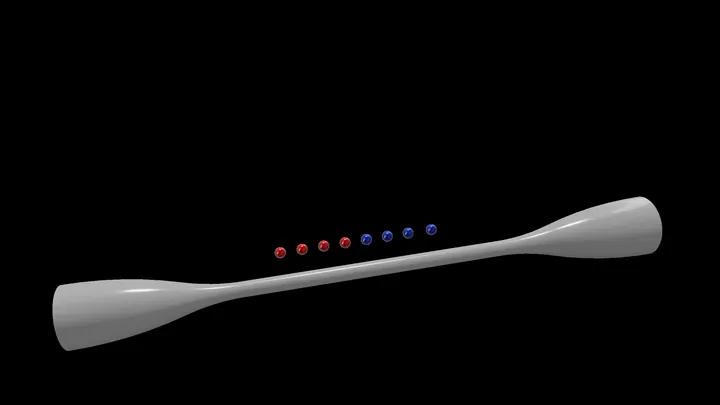
An orchestra without a conductor, where musicians hear each other through a shared wall. That's roughly how the new type of laser works: a few atoms (emitters) sit along a waveguide — a thin track for light on a chip. Light from each atom runs along this track and affects its neighbors.
A world where a year lasts just one and a half Earth days, and the star in its sky is hundreds of times larger than our Sun. This is KELT-9 b — a gas giant heated to temperatures at which iron vaporizes. Its atmosphere is not just hot; it is literally boiling away into space, like steam rising from a giant cauldron.
In a dense cloud of gas and dust where giant stars are born, the ALMA telescope has spotted something familiar. Four thin gas jets shoot out from the same region, each leaving behind a chain of bright knots, like a dashed line.
The light an atom emits is not just a flash. It carries an imprint of the atom's state at the moment of emission. Physicists took a superconducting qubit, an artificial atom the size of a microchip, and made it glow into an open waveguide, like a bulb in a long corridor.
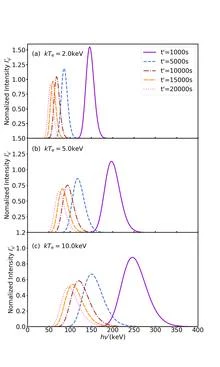
A gamma-ray burst is like a shot from a cosmic cannon: a brief but dazzling flash that outshines an entire galaxy for a few seconds. But when observed in the hardest gamma-ray band (photons with energies above a gigaelectronvolt), the signal often gets lost in the noise, like a whisper in a noisy hall.
On October 9, 2022, detectors on Earth recorded a gamma-ray burst of unprecedented power. GRB 221009A was so bright that its radiation ionized the upper layers of the ionosphere, and satellite instruments were temporarily blinded.