Light from Distant Galaxies: How to Tell the Quiet from the Wild express
A galaxy is not just a sprinkle of stars. At the center of many, something shines brighter than billions of suns: hot gas falling into a black hole. The color of this glow reveals what kind of life the galaxy leads — quietly birthing stars or violently consuming matter.
Previously, astronomers manually removed starlight and separated close spectral lines, like a careful cook separating yolk from white. This is time-consuming and sometimes leads to errors. The new tool works differently: it looks only at a few bright "color stripes"—hydrogen and oxygen lines, and immediately delivers a verdict.
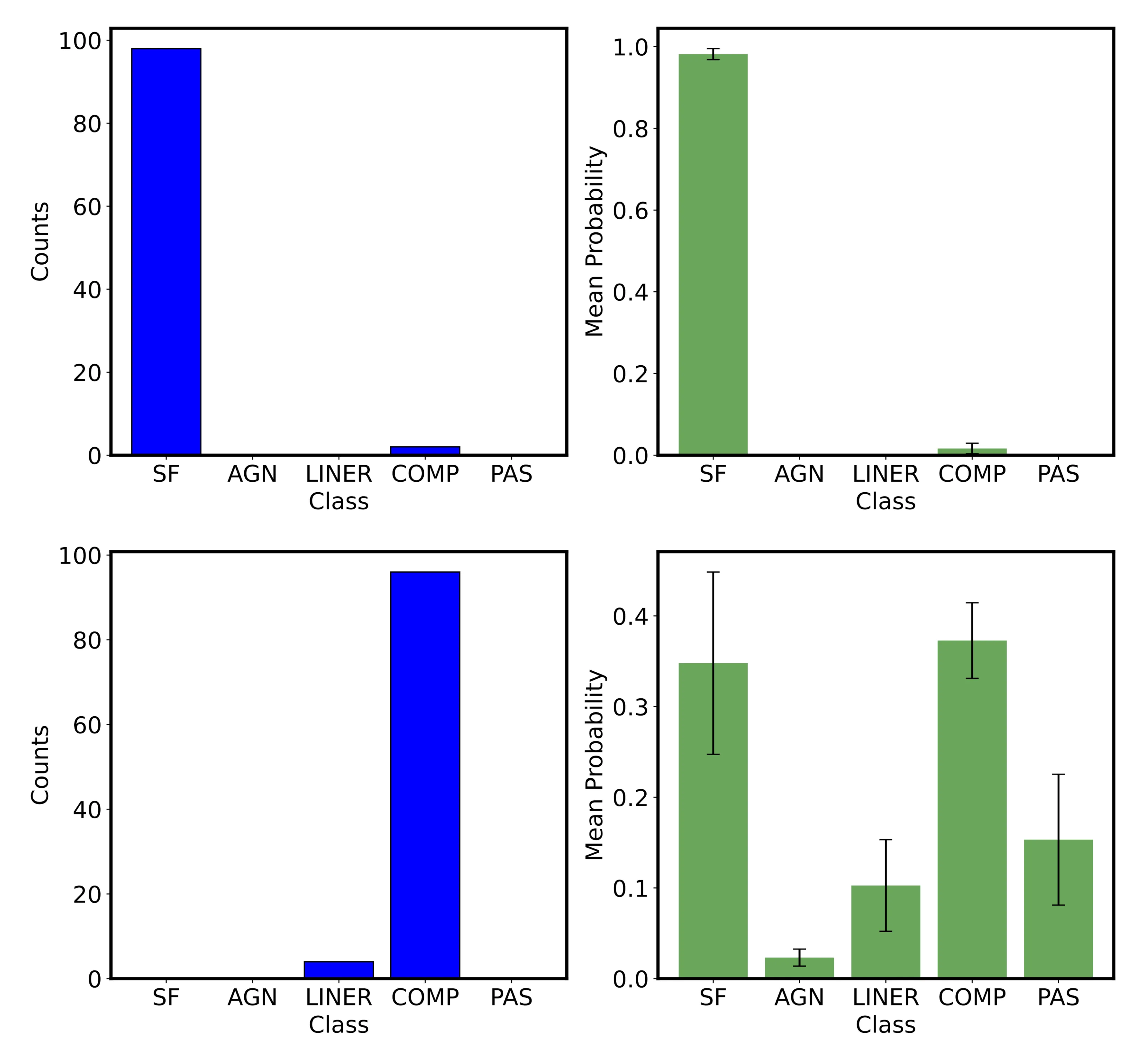
Accuracy is 83%, and for quiet galaxies—96%. Moreover, the instrument doesn't need to know the distance to the galaxy or calibrate brightness. A narrow slice of the spectrum suffices, so the method works even for the most distant objects, which appear as faint dots.
This way, astronomers can quickly sort thousands of galaxies and find rare active nuclei among them, like a sorter who, with a single glance at an apple's color, determines whether it's ripe or not.
Original abstract
as written by the authors arXiv:2602.20343
Reliable, versatile galaxy activity diagnostics are essential for understanding galaxy evolution. Traditional methods frequently necessitate extensive preprocessing, such as starlight subtraction and emission line deblending (e.g., H{\alpha} and [N II]), which can introduce substantial biases and uncertainties due to their model-dependent nature. In this work we developed an automated, diagnostic tool capable of distinguishing between star-forming (SF), active galactic nuclei (AGN), low-ionization nuclear emission-line regions (LINERs), composite, and passive galaxies. We developed a diagnostic tool based on a support vector machine trained on data from optical emission-line ratios and color selection criteria. From literature studies and exploring combinations of discriminatory feature schemes, we found that the equivalent widths of H{\beta}, [O III]{\lambda}5007, and H{\alpha}+[N II]{\lambda}6548,84 as key diagnostic features. Additionally, galaxies classified as AGN can be distinguished into broad- and narrow-line AGN by measuring the full quarter at the half-maximum of H{\alpha} and [N II] complex. We have developed a diagnostic tool that encompasses all activities of galaxies while achieving high performance scores across all of them. Our diagnostic achieves overall accuracy of 83% and recall of 79% for SF, 94% for AGN, 85% for LINER, 77% for composite, and 96% for passive galaxies. Our diagnostic tool significantly improves upon existing diagnostics as it eliminates the need for preprocessing (i.e., starlight subtraction or flux calibration) and spectral line fitting, includes all activity classes under one scheme, and distinguishes the two main AGN types. In addition, omitting starlight subtraction does not significantly reduce performance. Furthermore, Its narrow wavelength requirement enables use across a wide redshift range, making it ideal for high-z studies.
The method works without subtracting starlight — astronomers verified that accuracy barely drops if this step is skipped. This saves hours of manual work.