The 21-centimeter line is a spectral line emitted by neutral hydrogen atoms when the electron's spin flips from being parallel to the proton's spin to being antiparallel. This transition is extremely rare, with a lifetime of about 10 million years, but the vast amount of hydrogen in the universe makes it a powerful tool for radio astronomy. It allows astronomers to map the distribution of neutral hydrogen gas in galaxies and in the intergalactic medium, tracing the structure of the cosmos.
History
The 21-centimeter line was predicted by Hendrik van de Hulst in 1944 and first detected in 1951 by Harold Ewen and Edward Purcell at Harvard University.
How it works
The emission occurs because the parallel spin state has a slightly higher energy than the antiparallel state. When an electron spontaneously flips its spin, it emits a photon with a wavelength of 21.1 cm, corresponding to a frequency of 1420.4 MHz. By measuring the intensity and Doppler shift of this radiation, astronomers can determine the density and velocity of hydrogen gas along the line of sight.
In practice
It is used to map the spiral structure of the Milky Way, to study the gas content of other galaxies, and to probe the epoch of reionization by detecting the 21-cm signal from neutral hydrogen in the early universe.
Fun fact
The 21-cm line is so important that it is protected by international regulations, which allocate the 1420.4 MHz frequency band exclusively for radio astronomy, preventing terrestrial transmitters from interfering with observations.
An aluminum sphere the size of a large globe sits in a neutron beam and answers each hit with a precise note. Inside the sphere there is nothing but nitrogen and eleven tiny steel balls, each the size of a pinhead. When a neutron enters the sphere, it knocks a particle out of a nitrogen atom, and that jolt turns into an electrical signal.
The Sun's edge looks like a fuzzy fringe: thin jets of hot gas, spicules, shoot upward from it. They live only a few minutes and are constantly changing. In 2024, a balloon-borne telescope managed to spot not only the jets themselves but also their faint glow in hydrogen lines that had never been captured there before.
The cosmic dawn is hidden behind a dense veil of time. To see beyond it, you need to catch the radio signal from clouds of neutral hydrogen — the so-called global 21 cm signal. But it is so faint that the receiver's own noise drowns it out.
The cosmic microwave background is the afterglow of the Big Bang, which we see at millimeter wavelengths. But it also has a long-wavelength tail extending into the radio range.
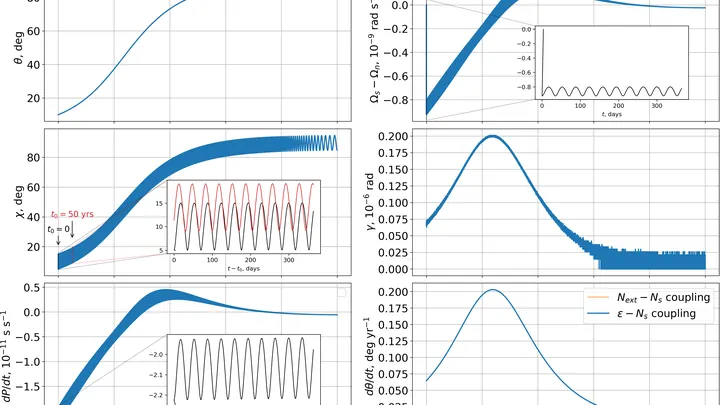
A spinning top that wobbles as it rotates: that's roughly how astronomers picture the neutron star in the binary system Hercules X-1. It completes one full turn on its axis every second, but its axis slowly traces a cone with a period of 35 days.
Radio waves from a gamma-ray burst — the cataclysmic death of a massive star whose flash briefly outshines an entire galaxy — reach Earth polarized. This means their electric field oscillates predominantly in a single plane, like a compass needle frozen in a magnetic field.
An alpha particle is a helium nucleus that flies out when heavy atoms decay. When it hits a gallium nitride crystal, it deposits its energy and creates an electrical pulse. The pulse height tells you how much energy the particle had.
The night sky is no longer as quiet as it used to be. Thousands of satellites are whizzing overhead, and each one can accidentally emit radio waves, interfering with astronomers trying to listen to distant galaxies. To make sense of this noise, scientists pointed the 21CMA radio telescope in China at Starlink satellite passes.
Long before stars appeared, the universe was filled with cold hydrogen. This gas can 'sing'—emitting radio waves with a wavelength of 21 centimeters. When the first stars and galaxies ignited, their ultraviolet light began to strip electrons from hydrogen atoms, turning neutral gas into ionized gas.
For the first few hundred million years after the Big Bang, the universe was dark: there were no stars yet, and space was filled with cold hydrogen. This gas emits radio waves at a wavelength of 21 centimeters — like a quiet whisper that reaches us across 13 billion years.
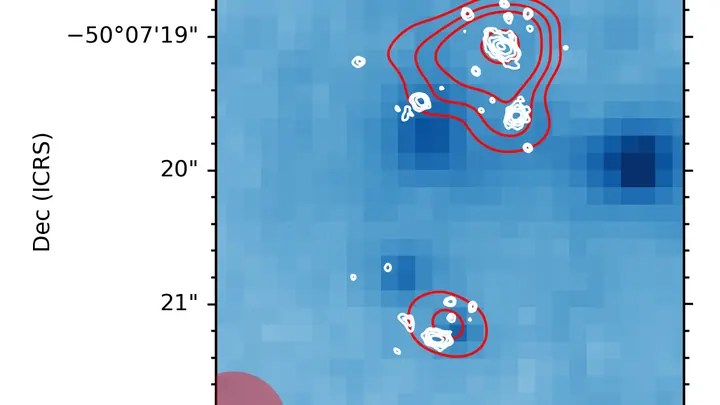
In the Andromeda galaxy, our Milky Way's nearest large neighbor, astronomers have spotted giant cold clouds where stars are born. These clouds are made of gas and dust, but seeing them directly is tricky: they barely shine.
A thin film of silicon nitride is stretched over a frame like the skin of a drum. The slightest nudge from gas molecules makes it tremble. A laser beam delivered through a glass fiber picks up that trembling and turns it into a pressure reading. The whole setup fits in a pocket, not on an optical table.
In the cold clouds between the stars, where new suns are born, invisible chemical work is underway. Simple molecules collide, swap atoms, and assemble into chains that may later become part of planets. One such chain is the NCCO+ ion, made of nitrogen, two carbons, and oxygen.
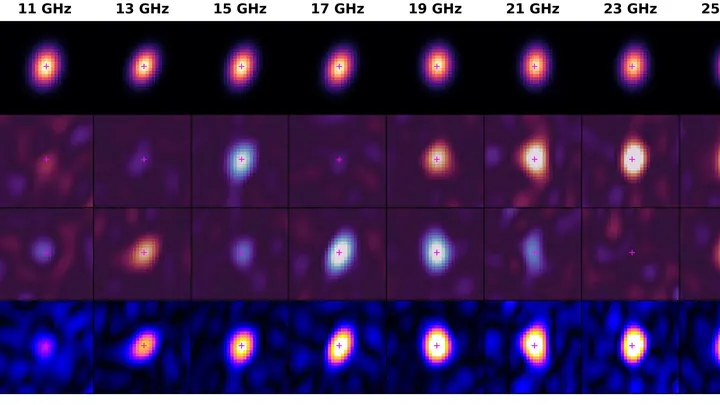
Radio telescopes scattered across the globe pick up waves from distant black holes. But two telescopes placed almost side by side see only a blurry blob — fine details are beyond them. Usually, such pairs are considered useless and discarded. But that's a mistake: even a blurry blob holds clues.
The trace of a short-lived particle is like a signature left in the detector. The particle is born and decays in an instant, but from its trace you can reconstruct its character — whether it's compact like a stone or fluffy like a snowball. That's exactly what this work is about: the authors propose a new way to read such signatures.
They noticed that each particle has an angle that links its mass and lifetime.