cs.DC cs.DC

6 articles

articles

How to Keep a Supercomputer from Gridlock
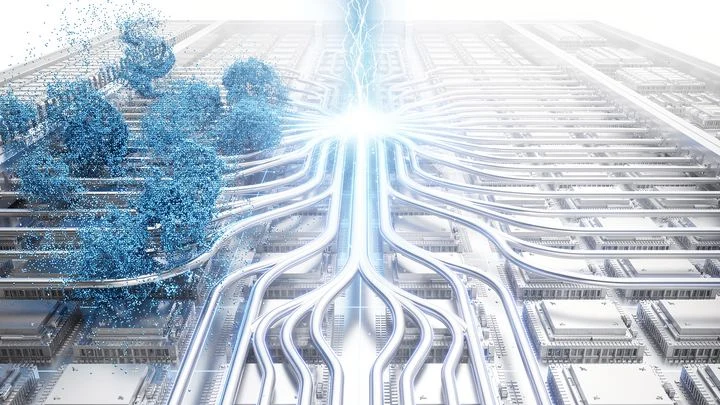
A supercomputer simulating laser plasma is like a kitchen where hundreds of chefs are preparing a single dish. If ten people crowd around one stove while another stands empty, the work grinds to a halt. The same happens in simulations: plasma particles bunch up in certain regions of space, leaving others nearly empty.

Quantum Physics2026-06-181 minarXiv:2606.20344express
The Quantum Secret to Faster AI Training
Training a large neural network across hundreds of compute nodes is like making soup as a team: each 'chef' tastes the dish and tells the others what to adjust.
cs.DC2026-06-303 minarXiv:2607.00151
Kitchen Without a Hitch: How SmoothAgent Seamlessly Stitches LLM Agent Context
During the dinner rush, a restaurant kitchen sizzles with oil, knives clatter, orders fly. The head chef can't wait for a pan to be washed: there's always an assistant who preps a clean one in advance. Modern LLM agents work the same way: they manage code, plan tasks, converse with users, generating long chains of messages. These chains quickly overload the model.
Information Theory2026-07-141 minarXiv:2607.13119express
Dual Hints: How Smartphones Learn Without Glitches
When you type 'salad' and the keyboard suggests 'Caesar,' behind the scenes millions of phones are jointly learning to predict words. They share not your messages, but only improvements to the common algorithm, like a coach who sends athletes only the tweaks to the plan: 'add 5 push-ups to yesterday’s routine.' Information entropy helps send only unexpected, valuable updates.
cs.LO2026-07-151 minarXiv:2607.13531express
Chemical Soup Computes Numbers: How Reactions Became a Computer
In boiling soup, molecules collide chaotically and react. But if you measure how their concentrations change, patterns emerge. This is how carbon chemical networks work — mixtures of molecules that spontaneously 'cook' information, turning each reaction into an elementary computation. Previously they were used only for modeling nature.
Quantum Physics2026-08-112 minarXiv:2608.10576express
Snowflake Decoder on Ordinary Chips
Quantum computers make mistakes. Each qubit is like a ball balanced on the tip of a pencil: a slight tremor in the hand and it rolls off. To keep the balls from falling, you need someone to notice the wobble and correct it in time.