Quantum annealing is a heuristic method for solving integer optimization problems, relying on the principles of quantum mechanics. Unlike the classical analog, where crossing a high barrier requires thermal excitation and is random, here quantum tunneling dominates: the system 'passes' through narrow barriers, effectively leaving local minima and striving for the global one. Programming the problem reduces to setting longitudinal fields and couplings in the Ising model.
History
The idea of quantum annealing dates back to annealing models in neural networks (1989). It was formalized in 1998 by Tadashi Kadowaki and Hidetoshi Nishimori as a quantum version of the simulated annealing method. A practical breakthrough is associated with the development of superconducting circuits: the D-Wave team (founded in 1999) introduced the first commercial 128-qubit annealer in 2011. Theoretical foundations rest on early research on tunneling (Leo Esaki, 1958) and adiabatic evolution.
How it works
Qubits (superconducting loops with Josephson junctions) form an array described by the Ising model with longitudinal fields h_i and couplings J_ij. Initialization is a deep transverse field Γ, creating a superposition of all binary states. Then Γ is smoothly turned off, and h_i and J_ij are turned on. Evolution is governed by the adiabatic condition: τ ≫ max_t |⟨1(t)|∂H/∂t|0(t)⟩| / (E_1(t)−E_0(t))^2, requiring the annealing time τ to be much larger than the inverse square of the minimum energy gap. The tunneling amplitude is exponentially suppressed with increasing barrier width, so for wide barriers, classical algorithms can compete.
In practice
D-Wave's hardware quantum annealers solve routing, financial forecasting, and material cutting problems, finding optimal combinations faster than conventional servers for special classes of problems.
Fun fact
The D-Wave Advantage processor with 5000+ qubits solves some quadratic optimization problems in milliseconds, while a classical supercomputer would take hours for the same — but only for specially crafted instances.
Inside an ultracold chamber, two atomic clouds collide: a few dozen cesium atoms acting as the working fluid, and thousands of rubidium atoms serving as the heat reservoir.
Quantum computers make mistakes. Each qubit is like a ball balanced on the tip of a pencil: a slight tremor in the hand and it rolls off. To keep the balls from falling, you need someone to notice the wobble and correct it in time.
A superfluid gas is like a crowd of people marching in step: each atom knows where to go and doesn't fall out of the common rhythm. But this crowd has three 'valleys'—three different directions it can take. In a new experiment, physicists made one valley slightly more 'favorable' than the others and watched how the crowd darted between them.
A quantum annealer is like a smart oven: it searches for the lowest point in an energy landscape to find the answer. But many constrained problems, like "pick exactly three items"—can't be loaded directly into such an oven. They have to be translated into unconstrained quadratic formulas, usually by adding penalties.
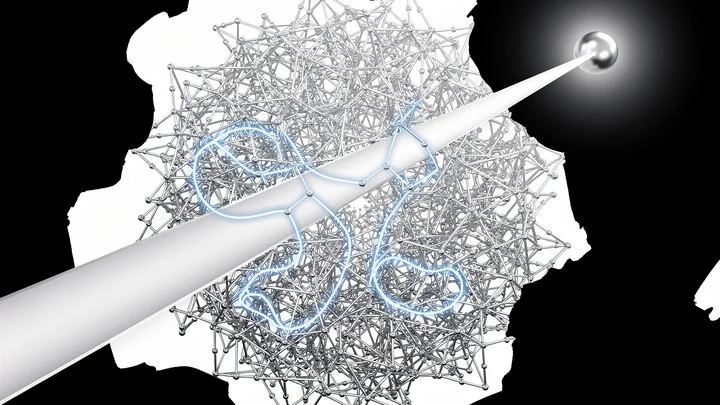
Searching for the global minimum in the Sherrington–Kirkpatrick spin glass model resembles climbing a glacier, where every crevasse is a treacherous local optimum, and the true bottom lies buried beneath a chaos of ice blocks. A classical climber, trudging along the gradient, would almost certainly freeze in the nearest crevice.
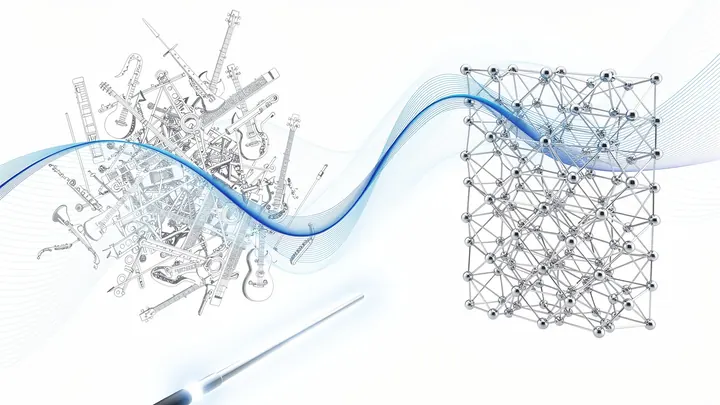
A metallurgical workshop piled high with aluminum scrap looks like an orchestra out of tune before a concert: each instrument is off-key in its own way. Offcuts of airplane wings, crushed cans, shavings from milling machines: each 'instrument' has its own metallicity, nonlinearly influencing the final 'melody' of strength and thermal conductivity.
A network of tiny magnets seeks the state with the lowest total energy: that's roughly what the quantum Max Cut problem looks like, one of the toughest in physics. Scientists have been hunting for its solution since the days of Werner Heisenberg.
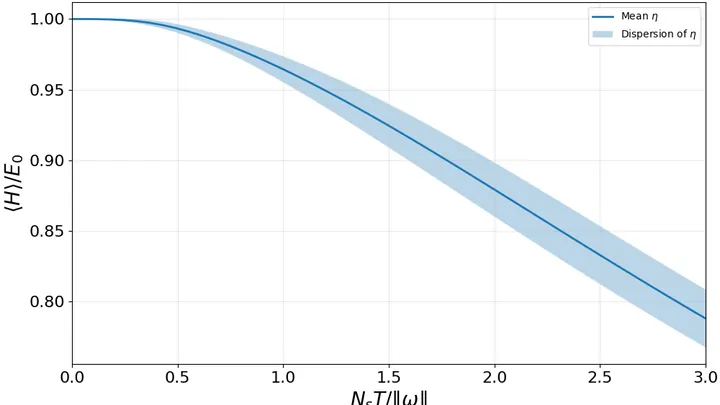
Quantum computers make mistakes. Each step of a computation introduces a tiny inaccuracy, and if left uncorrected, the result degenerates into noise. One of the main challenges is rotating a phase by an arbitrary angle. The standard approach is to assemble the desired rotation from a set of simple operations, like a mosaic.
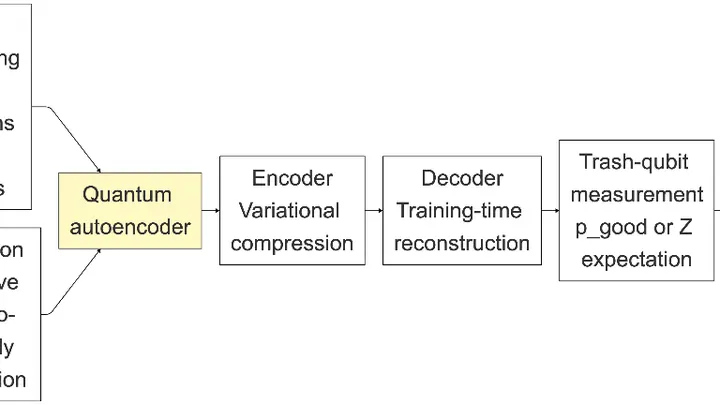
A cook spends years honing the skill of reducing a recipe to three or four essentials and recreating the dish from them. If the ingredients are familiar, the expected meal lands on the plate. A foreign ingredient disrupts compression, and you get something unrecognizable. The Quantum Compressor does the same with medical scans.
We're used to thinking that noticing only confirmations of our guesses is a mistake. But recent calculations, inspired by wave behavior, flip that view. It turns out that the habit of seeking the familiar is the best way to reduce information noise (scientists call it entropy).
In the world of atoms and particles, everything tends toward rest: particles lose energy, just as a swing slows down due to energy loss (friction). But many devices — from hydrogen masers to atomic clocks — live by repetitive cycles.
Picking out a single faulty microchip from a million, without any clue what the fault looks like, is a classic needle-in-a-haystack problem. A classical computer would test each chip one by one.
The familiar metronomes placed on a movable platform eventually start to swing in sync. In the quantum world, this trick long eluded scientists. But now physicists have synchronized even the most exotic state — a Fock state, where the number of light particles is precisely defined, like in a counter.
In the ocean of bank transactions, fraud is rarer than neutron stars in space, just 0.1% of all operations. A conventional detector gets used to the clean flow and loses vigilance.
Enter Q-SYNTH, a hybrid system with a quantum generator. It creates plausible fake transactions itself, drawing on scraps of real data.
A tiny magnet levitates in a magnetic trap, like a weightless needle. Its magnetized axis is like a stubborn compass needle that is prevented from turning. An invisible wall rises before it. But in the quantum world, particles can seep through barriers — this trick is called tunneling.
Dip your finger into water once, and from that single sensation, try to guess its temperature. In the quantum world, such one-shot measurements happen all the time, except you have to guess invisible parameters: say, the squeezing strength of a laser beam.
An optical tweezer is a laser beam that holds an atom in place, much like fingers holding a pea. Arrays of these tweezers form the basis of future quantum computers. But there's a catch: not every tweezer catches an atom. Typically, only half of the traps get filled, and for molecules, even fewer. Empty spots break the whole setup.
Imagine an orchestra where each musician plays their own part, and the conductor directs everyone at once. In a neutral-atom quantum computer, the laser beam plays the conductor, needing to hit its target precisely without wavering for a split second.
Quantum annealing works like a smart way to find a path through a maze: instead of checking every dead end, it uses quantum effects to find the exit faster. But this maze has a quirk: the numbers that describe the walls and corridors must be roughly the same size.
A piece of metal heated at one end produces a weak electric current: this has been known for nearly two hundred years. But what if, instead of a simple metal, you take a layered "sandwich": a superconductor, a thin insulator, and a flat layer of electrons?
Magnetic monopoles are like halves of a magnet that cannot exist alone in ordinary materials. But in spin ice, they appear in pairs connected by an invisible thread — a Dirac string. Previously, such monopoles were only seen in artificial systems at room temperature, but their quantum motion remained a mystery.
Magnetic materials can sometimes behave like a group of people who just can't agree: some bonds between atoms pull one way, others the opposite. When such conflicts pile up, the system becomes 'frustrated'—it can't settle into a single state of rest.
A superfluid flows without friction, like water in a perfectly smooth pipe, but the moment it hits an obstacle, the picture changes. In a new study, researchers looked at how a superfluid stream flows around rectangular walls and pits with sharp corners.
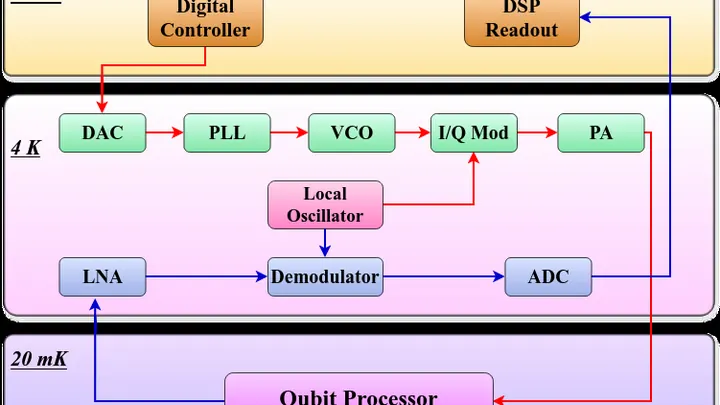
Quantum computers promise to solve problems beyond the reach of classical machines, but their heart, the qubits, requires ultra-low temperatures near absolute zero. Controlling qubits and reading out their states typically means working from a warm room, running many cables through the refrigerator.
Quantum computers promise to describe molecules with perfect accuracy, but their main nemesis is noise. Every extra qubit and every extra operation add errors. Chemists and physicists have now devised a way to compute molecules with half the qubits: the HSQD method.
Quantum communication via satellite is like a roll call between two distant lighthouses: the beam must hit the detector exactly, or the message can't be read. But in space, everything shakes — sunlight heats the hull, thrusters cause vibrations, and delicate optics drift off-axis.
When making popcorn, a microwave uses electricity only to heat the kernels. A gas stove heats the entire burner and the air around it. The same difference applies between a photonic quantum chip and a classical supercomputer when solving a problem devised by Scott Aaronson.
Turning CO₂ into fuel is like finding the one perfect way to pack billions of items into a suitcase. A classical computer tries options one after another, taking decades, while a quantum computer sees all combinations at once.
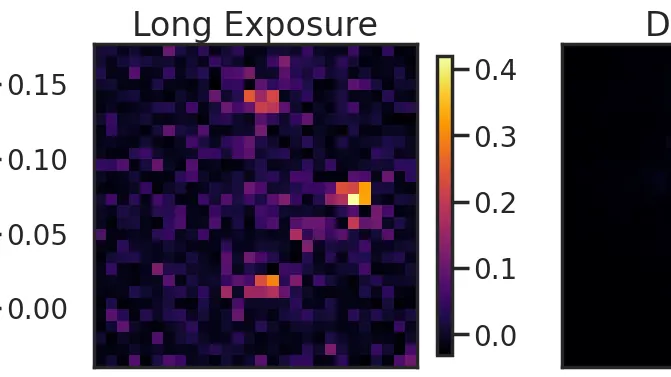
Atomic qubits 'snap' computations in microseconds, but capturing the result with a light-sensitive camera stretches out to milliseconds — thousands of times longer.
Quantum batteries lose energy due to entropy — the tendency toward disorder. Just as parallel wires pick up interference, the battery's contacts with the environment create leakage channels. The solution: braid the giant atoms, which act as both charger and storage, into a braid.
A lone ion in a trap jitters like a swing, and each oscillation introduces an error into quantum calculations. Traditionally, jitter is suppressed by cooling almost to absolute zero: this is bulky and expensive.
Three thousand meters above sea level, a sheer cliff face. A classical climber picks a single route and crawls up step by step, often getting stuck in a local minimum: a small niche with no upward path. A quantum climber acts differently: it can leap across a canyon and land in a neighboring energy basin where the route is better.
Two qubits, quantum bits, two-level systems, glide through hot and cold thermal baths. One moves at 0.8 times the speed of light. At that moment, familiar thermodynamics cracks: a moving qubit senses temperature differently than a stationary one. For it, the cold bath can feel hotter, and the hot bath colder.
Light is a finicky guest. It flies into a cavity but doesn't stay: part of the pulse inevitably reflects and carries away quantum information. Classical single-pass capture schemes hit this limit no matter how much you improve control. Reflection was considered a loss, but the authors of a new study suggest looking at it differently.
Every day, the power grid faces a puzzle: which power plants should be switched on to reliably meet demand without breaking the bank? For 15 generators and 24 hours, the number of possible schedules exceeds 2.3×$$10^{108}$$, more than the number of atoms in the visible universe. No classical supercomputer can sift through all of them, so dispatchers settle for a compromise.
A quantum computer is an orchestra where every qubit must come in exactly on cue. But instead of a conductor with a baton, we have an arbitrary waveform generator (AWG) that delivers microwave signals lasting tens of nanoseconds.