Cuando el medio pierde estabilidad exprés
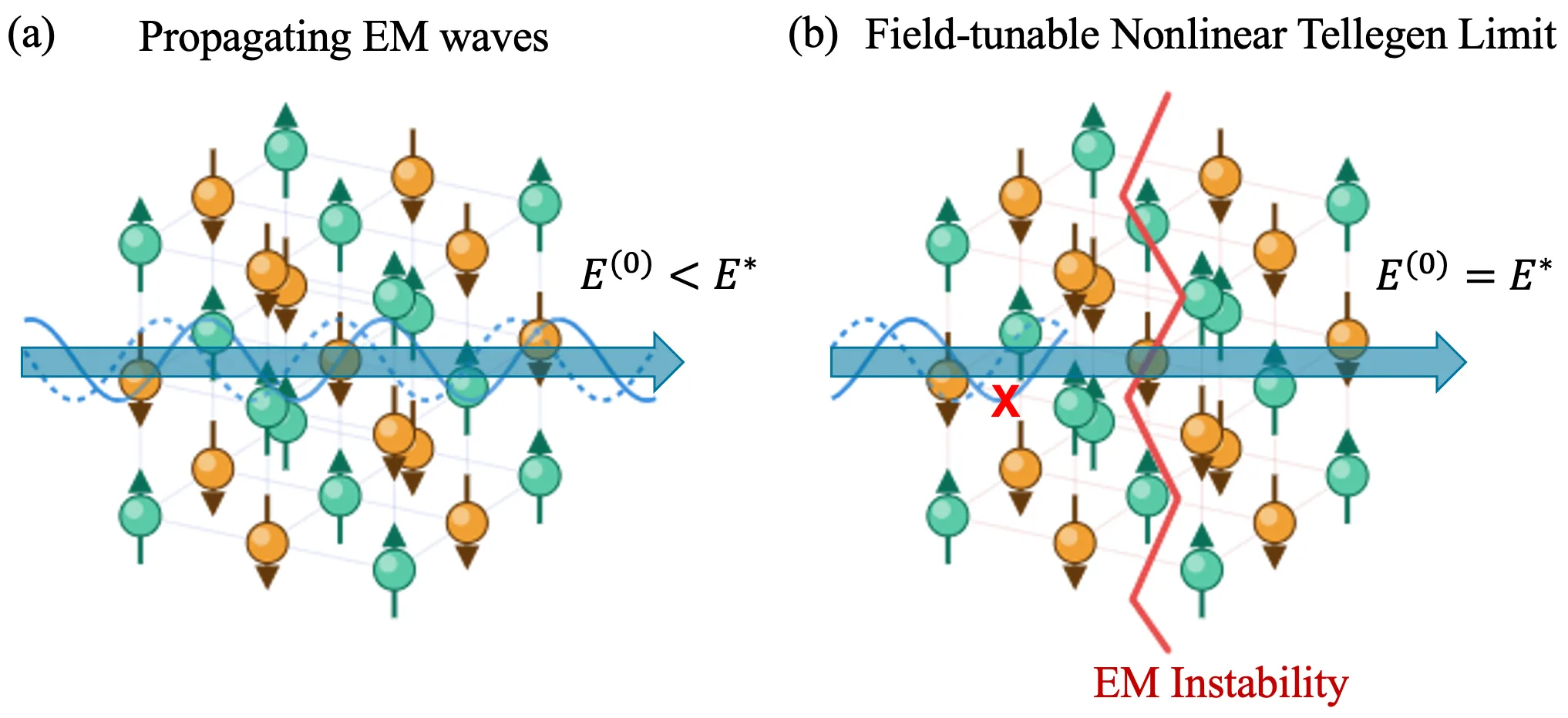
La bobina de Tesla chisporrotea y un rayo de luz comienza a girar a su alrededor. El medio por el que atraviesa aún es estable, pero el campo crece y la rotación se intensifica. Esto no es un truco, sino el comportamiento de materiales especiales que acoplan electricidad y magnetismo. Para tal acoplamiento existe un límite fundamental: el límite de Tellegen. Si se cruza, el medio pierde estabilidad electromagnética.
Antes se pensaba que este límite estaba rígidamente fijado por las propiedades del propio material. Ahora los autores han demostrado que en medios no lineales se vuelve ajustable por campo. Aplique un campo estático y el sistema se mueve hacia la inestabilidad. El punto crítico depende de la simetría de la estructura magnética del cristal. En el trabajo esto se probó en dos materiales: un altermagneto de onda d y una ferrita hexagonal tipo M. Su simetría dicta la forma del tensor magnetoeléctrico no lineal y el camino hacia la ruptura.
En la práctica, esto significa que, variando el campo externo, se puede controlar suavemente la respuesta óptica hasta el borde de la estabilidad. Y más allá, o bien la destrucción o bien la transición a un nuevo estado. Los autores construyeron un diagrama de fases en el espacio de campos: en él se ve dónde el material funciona y dónde se "rompe". Esta herramienta será útil para ajustar con precisión dispositivos que utilizan efectos magnetoeléctricos, desde sensores hasta elementos de aislamiento óptico.
Resumen original
tal como lo escribieron los autores, en inglés arXiv:2607.10584
The Tellegen limit is the fundamental electromagnetic stability bound on magnetoelectric media. We show that nonlinear magnetoelectric coupling gives rise to a new Tellegen limit, which we term the nonlinear Tellegen limit. Unlike the linear Tellegen limit, which is fixed by material parameters, the nonlinear Tellegen limit is field-tunable -- a static electric or magnetic field drives the system toward electromagnetic instability at a material-specific critical field determined by the magnetic point group symmetry. The approach to this limit is accompanied by a field-tunable Faraday rotation that grows linearly with the applied field and is bounded from above by a universal maximum set by the nonlinear Tellegen limit -- beyond which the medium becomes electromagnetically unstable. We demonstrate the nonlinear Tellegen limit and the field-space stability phase diagram in two magnetically ordered material systems -- a d-wave altermagnet and an M-type hexagonal ferrite -- showing that the symmetry of the magnetic point group governs both the structure of the nonlinear magnetoelectric tensor and the resulting electromagnetic instability.
El límite de Tellegen lleva el nombre del ingeniero neerlandés Bernard Tellegen, quien en 1948 propuso un elemento hipotético de circuito eléctrico: el girador. Solo más tarde su nombre se asoció con la limitación fundamental para los medios magnetoeléctricos.