Signal-to-noise ratio (SNR) is a fundamental measure in any system that transmits, detects, or processes information. It compares the power of the desired signal to the power of background noise, usually expressed in decibels. A higher SNR means the signal is cleaner and easier to distinguish from noise, while a low SNR means the signal is buried and hard to extract. This concept is central to fields as diverse as audio engineering, radio astronomy, medical imaging, and particle physics.
Histoire
The concept emerged with early radio engineering in the 1910s–1920s, where engineers like Ralph Hartley at Bell Labs formalized the idea of signal versus noise in communication channels.
Comment ça marche
The ratio is calculated as the power of the signal divided by the power of the noise. In practice, improving SNR involves either boosting the signal, reducing the noise, or both. Techniques include signal averaging (repeating measurements to cancel random noise), filtering (removing frequency bands where noise dominates), and using more sensitive detectors. In the context of the listed articles, SNR improvements come from clever design—like optimizing scintillator materials to emit more light per event, or using feedback algorithms in hearing aids to cancel acoustic feedback while preserving the intended sound.
En pratique
SNR is used to evaluate and improve everything from hearing aids and speech recognition systems to radio telescopes and particle detectors, guiding design choices for maximum sensitivity.
Anecdote
In some experiments, increasing the measurement time by a factor of four only doubles the SNR, because noise averages out as the square root of the number of samples.
La caméra d'un smartphone capte la lumière avec de minuscules capteurs, mais ceux-ci ne distinguent pas les couleurs par eux-mêmes. C'est pourquoi on place devant eux des filtres colorés : rouge, vert, bleu — comme des vitraux dans une fenêtre. Chaque capteur ne voit que sa couleur, puis un logiciel assemble ces fragments pour former une image complète.
La fusion de deux étoiles à neutrons n'est pas qu'une simple collision. Avant même de se toucher, elles se déforment mutuellement sous l'effet des forces de marée, et cette déformation dépend de la « souplesse » ou de la « rigidité » de la matière à l'intérieur. La matière rigide résiste davantage, la matière souple change plus facilement de forme.
Un émetteur radio à plusieurs antennes, c'est un peu comme une baignoire alimentée par plusieurs robinets. Si les jets partent dans des directions différentes ou avec des pressions inégales, une partie de l'eau s'écoule par le trop-plein – de même, le signal se disperse sans atteindre le récepteur.
Un panneau intelligent pour contrôler les ondes radio qui se déplacent à la vitesse de la lumière fonctionne comme un orchestre : des centaines d'éléments miniatures, véritables « instruments », modifient leur phase (le moment où ils entrent en jeu) sur commande via une tension.
Apprendre une langue étrangère, c'est comme accorder un instrument de musique. La nouvelle technologie agit comme un accordeur intelligent : elle prend votre enregistrement et la parole de référence d'un natif, les étire ou les compresse dans le temps (comme on tend une corde) pour les aligner précisément, puis évalue trois paramètres clés : la pureté des sons, la…
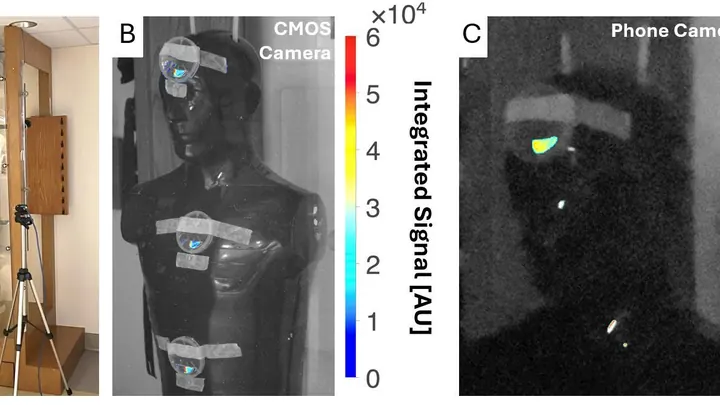
Un cristal de la taille d'une boîte d'allumettes a été placé sous le faisceau d'un accélérateur clinique. La moitié de sa surface a été recouverte d'un motif de nano-aspérités, minuscules, plus petites que la longueur d'onde de la lumière. L'autre moitié est restée lisse. La différence était frappante : la partie recouverte a produit un signal 4,1 fois plus lumineux.