Why El Niño Arrives Irregularly but Always by Year-End
Original: "A Non-Gaussian Stochastic Model for the El Niño Southern Oscillation"
arXiv:2012.09858 · 2020-12-18 · CC BY 4.0 · 1 min
The warm Pacific current behaves like a pendulum that random wind gusts swing harder in spring.

The warm El Niño current does not follow a schedule, but it has a habit: the peak warmth almost always occurs in November or December. Why is that? Scientists compared ocean temperature to a pendulum. A pendulum swings on its own, but random wind gusts can push it harder or, conversely, stop it. In the tropics, short, intense bursts over the western Pacific play that role.

In spring, these bursts are especially strong, which is why forecasts made six months ahead in March and April often miss the mark. This is known as the spring predictability barrier.

Another detail: when the ocean is already warm, wind gusts become even stronger. This effect is called multiplicative noise, meaning randomness whose strength depends on the system's state. Thanks to this, the model reproduces not only El Niño's average behavior but also its rare, intense outbursts. Previously, such outbursts seemed purely random, but now they have an explanation.

Wind bursts in the western Pacific last only a few days, but their cumulative effect is comparable to the energy of an entire season.

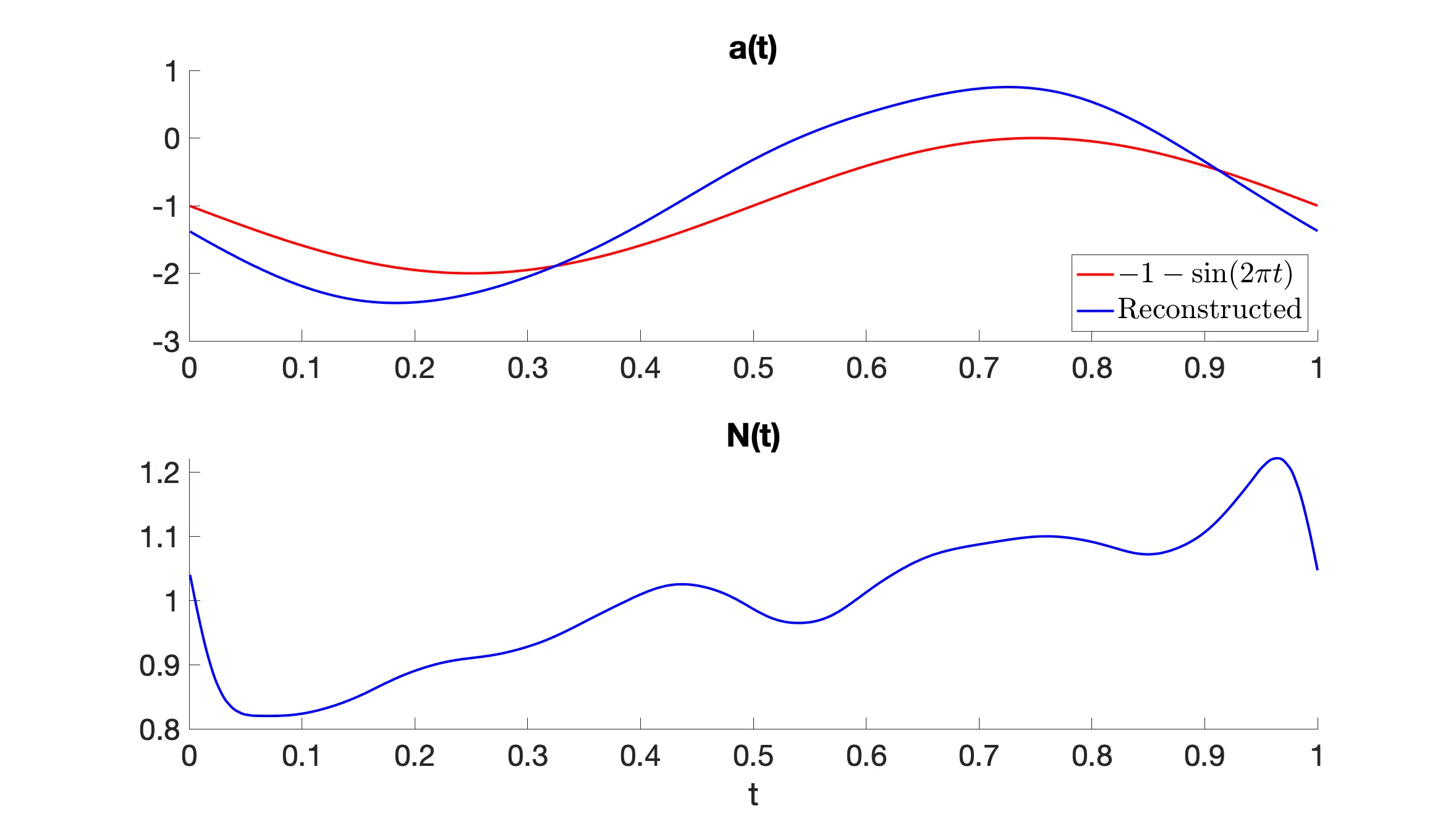
\dot{x}(t) = a(t)x(t) + \omega(t)h(t) + \alpha_1\tau(t) + N(t)\xi_x(t)
The rate of temperature change depends on seasonal feedback, thermocline depth, wind bursts, and random noise.
\dot{h}(t) = -\omega(t)x(t) + \lambda h(t) + \alpha_2\tau(t) + \sigma\xi_h(t)
The thermocline responds to ocean temperature, its own damping, wind bursts, and noise.
\dot{\tau}(t) = d_{\tau}\tau(t) + \rho(x)\xi_{\tau}(t)
Wind bursts decay over time and are excited by noise whose amplitude grows with ocean temperature.
Concepts
ENSO El Niño-Southern Oscillation Multivariate ENSO Index Jin-Timmermann model El Niño index recharge oscillator model Southern Oscillation spring predictability barrier ERSST La Niña natural variability stochastic dynamical system TAO/TRITON moorings Westerly wind burst interannual variability seasonal cycle nonlinear laplacian spectral analysis equatorial wave propagation NOAA CPC relative ONI