El Niño: A Pendulum Rocked by Seasonal Gusts
In the tropical Pacific Ocean lives a pendulum. Its position is the water temperature in the Niño 3.4 region, and gravity is the annual cycle that pulls the system toward warm or cold extremes. Random wind gusts strike the pendulum, and each hit either amplifies the swing or damps it. Sometimes the kicks align so that the pendulum swings high, and El Niño arrives: a warm current that reshapes weather from Indonesia to Peru.
For a long time, it remained a mystery why this pendulum swings irregularly. It is tied to the calendar: the warmth peak almost always falls in November or December. But the strength and duration of each El Niño vary from event to event. In spring, forecasts are especially unreliable, a phenomenon known as the spring predictability barrier. The authors set out to rebuild the pendulum from scratch to see which details produce this mix of order and chaos.
Then a third equation is added for wind gusts, short bursts of strong wind in the western Pacific. Their strength is not constant: when the ocean is already warm, the gusts become stronger. This is multiplicative noise, randomness whose amplitude depends on the state of the pendulum itself. This nonlinear coupling turns the ordinary Gaussian temperature distribution into an asymmetric one with heavy tails, just as in real observations.
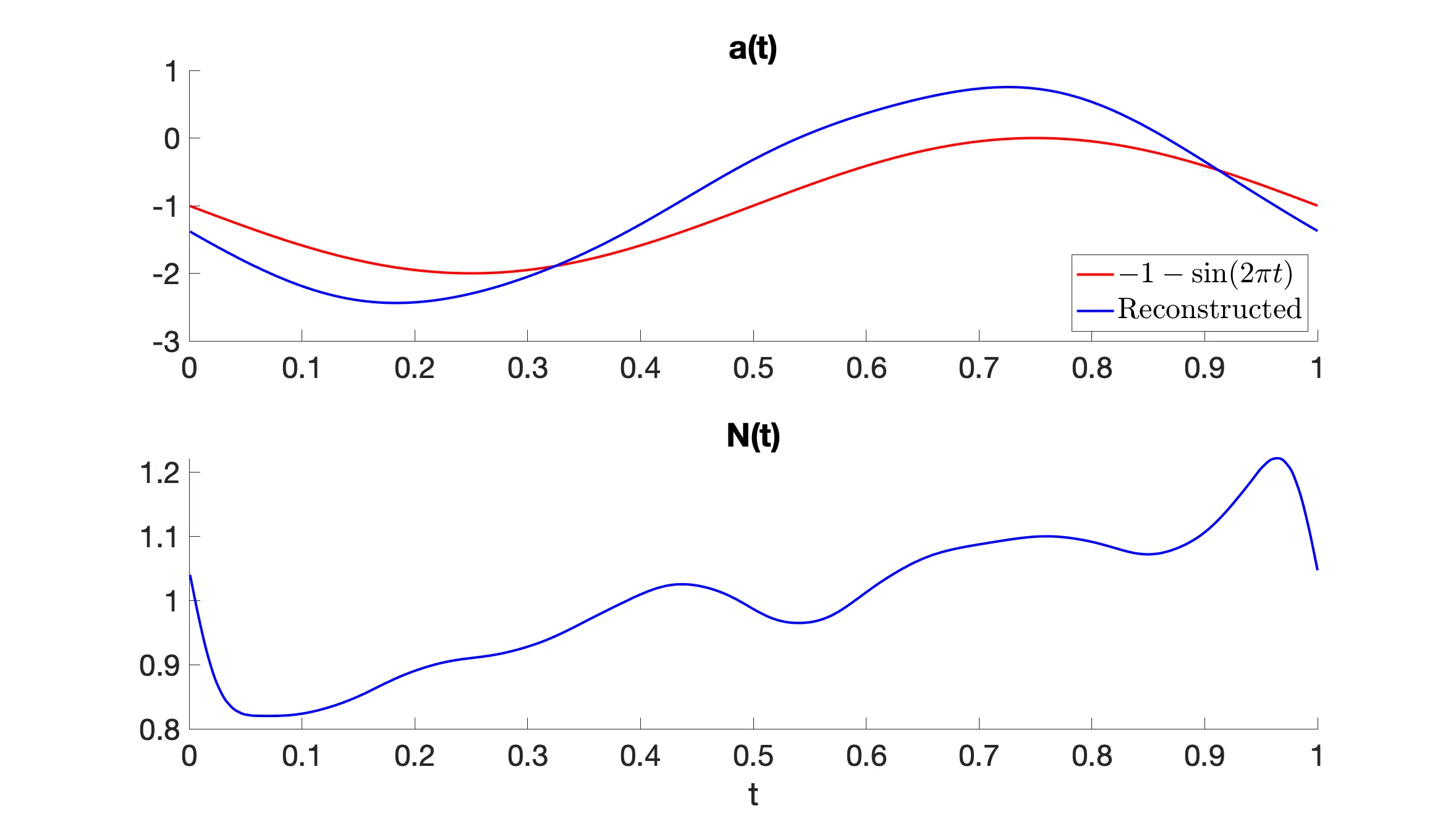
The result is striking: the reconstructed thermocline depth correlates with direct measurements at 0.9. The model reproduces monthly standard deviations of temperature and its autocorrelation over times up to three years. The phase locking to year's end emerges naturally because noise amplitude grows in spring and damping is strongest in autumn. The spring predictability barrier is also explained: in March and April, random kicks are so strong that predicting the pendulum's fate six months ahead is nearly impossible.
Previously, it was unclear how to combine three things in one simple model: seasonal timing, non-Gaussian statistics, and hidden-variable recovery. Now it is clear that the key lies in multiplicative wind-gust noise and periodic coefficients. This hybrid of physics and statistics achieves higher accuracy than global climate models at nearly zero computational cost. The pendulum rocked by seasonal gusts turned out not to be a metaphor but a working tool.
Wind bursts in the western Pacific last only a few days, but their cumulative effect is comparable to the energy of an entire season.