El Niño as Conductor: Why Winters in Transbaikalia Don't Follow the Pacific
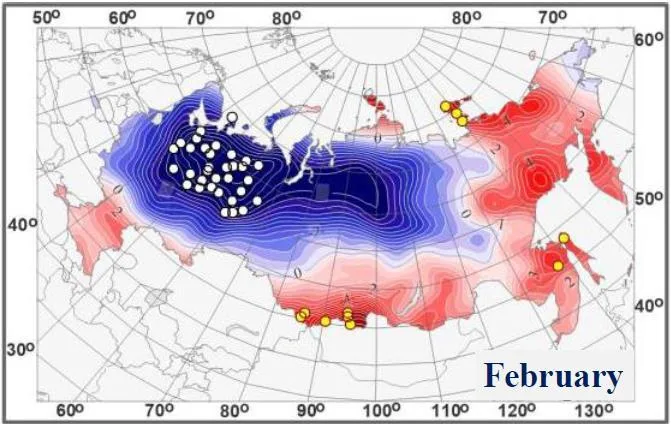
A conductor in a concert hall waves a single baton, yet violins and timpani respond differently. Likewise, the warm patch in the Pacific Ocean known as El Niño makes different corners of Russia experience completely different winters under the same phase. Somewhere snow melts in January, while elsewhere frosts intensify to the limit.
Meteorologists took observational data spanning 79 years, from 1936 to 2014, and split ten regions of Northern Eurasia along the 60-degree latitude into northern and southern. They compared each month's temperature to the norm and then examined how often winters turned out mild or cold depending on what the Pacific was doing: warming (El Niño), cooling (La Niña), or staying neutral.
Transbaikalia behaves differently. When the Pacific warms, cold winters arrive with a frequency of 0.75, while mild ones occur only 0.25 of the time. So the same oceanic anomaly brings warmth to western Russia but chill to the east. During La Niña, when the ocean cools, Transbaikalia saw no extremely cold winters in all 79 years. The winter of 2020/2021, which began with La Niña, confirmed this pattern: the region was warmer than normal.
Previously, it was unclear how strongly the El Niño phase affects the probability of mild and cold winters across different regions of Northern Eurasia, especially when considering El Niño type. Now quantitative estimates are available: for example, in Transbaikalia during La Niña, extremely cold winters never occurred in 79 years. This result was obtained by comparing the frequencies of different winter categories between El Niño phases identified by two indices, Niño3 and Niño4, over a long observational record. These estimates can be used for regional seasonal forecasts and for assessing the risks of anomalous winters in agriculture, energy, and urban planning.
A conductor cannot make timpani sound like violins, but he knows when each instrument will come in. So it is with El Niño: it does not determine the weather entirely, but it hints at what to prepare for. And if in Transbaikalia during La Niña you can skip the frost worries, then in southern European Russia during El Niño, it's umbrellas rather than boots that you should stock up on.
In Transbaikalia, over 79 years of observations, not a single extremely cold winter occurred during La Niña, even though La Niña is usually associated with cold. In the winter of 2020/2021, which began during La Niña, the region indeed experienced warmer-than-normal conditions, confirming the prediction.