El Niño as a fortune teller: predicting warm and cold winters in Northern Eurasia
Context
This work stands apart: there is almost nothing nearby, with the nearest neighbor at a distance of 0.496. Around it in the archive lie studies on axions, dark matter, pulsars, and dark photons, as well as several works on weather and climate, from old chronicles to stratospheric effects. None of them examines the connection between winter anomalies in Northern Eurasia and El Niño phases. This article fills that niche, relying on long meteorological records and distinguishing El Niño types by the Niño3 and Niño4 indices.
Methods
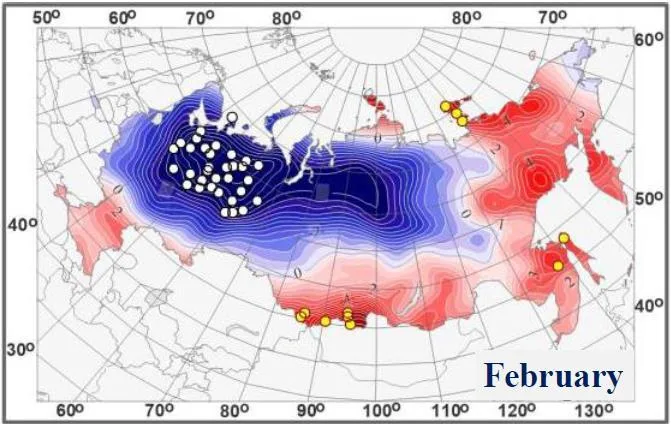
We analyzed monthly surface air temperature anomalies for January and February from 1936 to 2014 for ten regions of Russia, divided by the 60°N latitude. The anomaly was normalized by the standard deviation for 1961–1990, yielding an index I. Winters were classified as extremely warm, significantly warm, moderately warm, and similarly cold based on index thresholds. El Niño and La Niña phases were identified using a five-month running mean of sea surface temperature anomalies in the Niño3 (eastern equatorial Pacific) and Niño4 (central Pacific) regions. The threshold for a phase is an anomaly of at least 0.5°C or at most –0.5°C for six consecutive months. We counted the frequencies of different winter types in each phase.
Results
For the south of European Russia during El Niño, the frequency of warm winters was 0.69 according to the Niño3 index, more than twice the frequency of cold winters (0.31). In Transbaikalia, the pattern is opposite: during El Niño, cold winters occurred with a frequency of 0.75, while warm ones only 0.25. Moreover, during La Niña, no extremely cold or significantly cold winters were recorded in Transbaikalia over 79 years. For the Amur region and Primorye, the highest frequencies of extremely warm and significantly warm winters occurred during La Niña, while extremely cold winters were most frequent during El Niño. Estimates based on the Niño3 and Niño4 indices sometimes differed markedly, indicating the importance of the El Niño type.
Implications
This work differs from neighboring studies in that it is the first to systematically link regional winter anomalies in Northern Eurasia to different types of El Niño phases based on long observational records. Neighboring works either address other regions and processes (axions, dark matter) or consider weather and climate in other aspects, such as stratospheric effects or distinguishing noise from signal. Here, specific frequency estimates are obtained for ten regions, providing a basis for seasonal forecasting.
Future development
The topic could develop toward a more detailed account of combined effects of key modes of climate variability, namely the North Atlantic Oscillation, the Atlantic Multidecadal Oscillation, and the Pacific Decadal Oscillation. It is also promising to use ensemble model simulations to verify and refine the statistical estimates. With global warming, El Niño may intensify and become more frequent, increasing the importance of such forecasts.
Impact
The results may be useful for agriculture, energy, and planning in Russian regions sensitive to winter anomalies. They also provide material for improving seasonal weather forecasts.
Next steps
Verify the obtained estimates against data after 2014, including the winters of 2017/2018, 2020/2021, and subsequent ones. Conduct ensemble model experiments to assess the potential predictability of winter anomalies under different El Niño phases.
Key open problems
In climatology, the question remains open as to how predictable regional seasonal anomalies are against the backdrop of global warming and increasing climate variability. This work shows that even a simple statistical relationship with the El Niño phase provides a useful signal, but for more reliable forecasts, it is necessary to account for the interaction of several modes of variability and the non-stationarity of the relationships.
In Transbaikalia, over 79 years of observations, not a single extremely cold winter occurred during La Niña, even though La Niña is usually associated with cold. In the winter of 2020/2021, which began during La Niña, the region indeed experienced warmer-than-normal conditions, confirming the prediction.
Key numbers
- frequency of warm winters in southern European Russia during El Niño: 0.69
- frequency of cold winters in Transbaikalia during El Niño: 0.75
- number of years without extremely cold winters in Transbaikalia during La Niña: 79
- threshold for sea surface temperature anomaly for El Niño phase: 0.5°C
- rate of warming in Russia: 0.5 K per decade