How to Predict Chaos When Data Is Scarce?
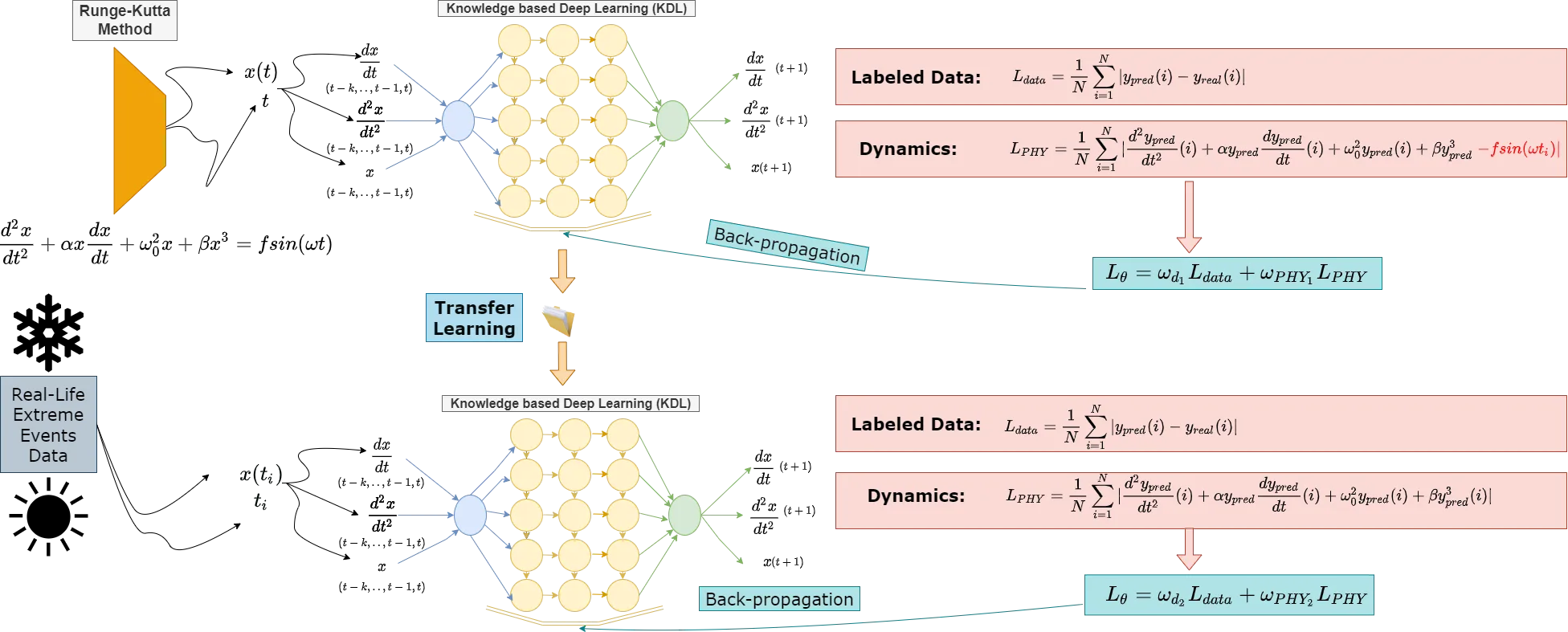
Think of a translator who learned a language's grammar from textbook examples and now understands live speech with its accents and noise. That's how the new method KDL works: first, the neural network is trained on artificial data generated by the Liénard equation, then it is transferred to real time series where extreme events are rare and unpredictable.
The secret of KDL lies in physical regularization: the network predicts not only the quantity itself but also its derivatives, and the loss function includes a term that enforces the differential equation. It's as if the translator didn't just memorize phrases but learned the grammar, enabling recognition of even unfamiliar constructions. On El Niño data, KDL achieved the lowest RMSE error (0.428 vs. 0.433 for LSTM with 20% training data) and the smallest physical residual (276.654 vs. 283.340). When the training fraction is increased to 80%, the advantage persists but narrows.
The Liénard equation, used to generate synthetic data, was introduced by French physicist Alfred Liénard in 1928 to describe oscillatory circuits and has since become a classic in the theory of nonlinear oscillators. Interestingly, extreme events in such systems arise as rare but recurring amplitude spikes, similar to rogue waves in the ocean.
The idea of predicting chaos with hybrid knowledge echoes Isaac Asimov's novel "Foundation," where psychohistory combines statistics and deterministic laws to forecast the future of large systems. Unlike Asimov, here physics is embedded in a neural network rather than in equations for masses, but the spirit of the hybrid approach is similar.