Computational reaction analysis uses computer simulations to study chemical reactions at the molecular level, providing details that are difficult or impossible to obtain experimentally. It involves calculating the energies of molecules, transition states, and reaction pathways to predict how fast a reaction will proceed, what products will form, and how to control it. This is especially valuable for complex systems like enzymes, catalysts, or reactions in extreme conditions.
History
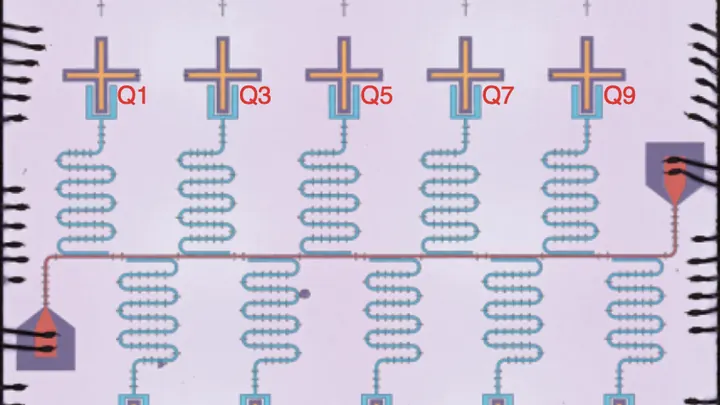
The field began in the 1970s with semi-empirical methods, but became practical in the 1990s with the rise of DFT and affordable computing power. Recent advances include quantum computing algorithms for chemistry, as noted in the article 'Квантовое превосходство в химии'.
How it works
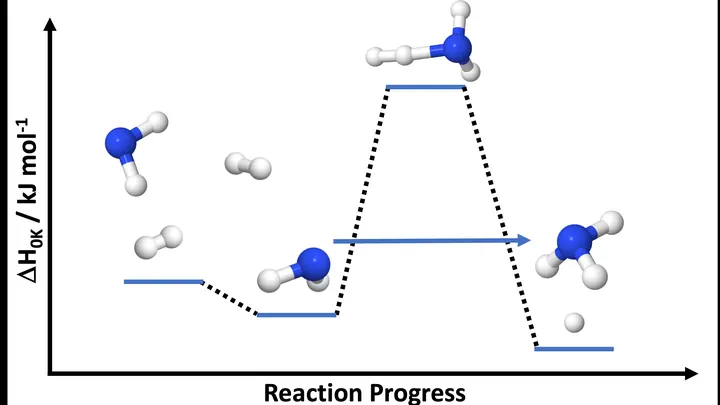
The methods are based on quantum mechanics, primarily density functional theory (DFT) or more accurate wavefunction methods, which solve the Schrödinger equation for the electrons in a molecule. From these calculations, one obtains potential energy surfaces — maps of how energy changes as atoms move. By locating minima (reactants, products) and saddle points (transition states), researchers can compute reaction rates using transition state theory. Machine learning is increasingly used to speed up these calculations by learning from large datasets of quantum chemical results.
In practice
It is used in drug discovery to predict how drugs bind to proteins, in catalysis research to design more efficient industrial catalysts, and in materials science to screen for new molecules with desired properties.
Fun fact
Modern neural networks trained on millions of molecular collisions can predict reaction outcomes faster than traditional quantum chemistry, as highlighted in the article 'EveNet: как нейросеть учится на 500 миллионах столкновений'.
When sugar goes into tea, it dissolves. But why doesn't it just fall back out? It's all about chemical potential — a quantity that shows how 'favorable' it is for a substance to be in a given place and state. For a pure substance, it's easy to calculate, but for a mixture of several components, it's a real puzzle.
A cookbook without a shopping list: that's what a scientist faces when looking at a scheme of chemical reactions. The arrows and formulas on paper look neat, but once you start hunting in the lab for molecules that will actually behave that way, a real quest begins.
Predicting the yield of a chemical reaction is a bit like trying to guess the harvest knowing only the soil composition. Traditionally, chemists have relied on long columns of numbers, quantum descriptors, that describe electron energies but say nothing about molecular shape.
A kitchen mixer runs at a single speed, but start jabbing the button and the mixture whips up differently. Chemical reactions behave much the same way when the rates of their individual steps are not constant but pulse over time.
The Sun continuously scribbles magnetic fields across its surface. These patterns are not mere ripples but a handwriting in which nature has encoded warnings of flares. A flare is an explosion that releases the energy of billions of nuclear bombs in minutes, ejecting streams of plasma and radiation into space.
A cloud of atoms cooled to near absolute zero suddenly starts behaving like a brain. One excited atom triggers a chain reaction — neighbors light up in turn, and an avalanche of activity sweeps through the gas. Physicists call this Rydberg facilitation: atoms are easier to excite when an excited one is nearby.
Cooking a complex dish requires a clear recipe: first chop, then sauté, add spices at just the right moment. Chemical transformations also follow step-by-step recipes — mechanisms where atoms of carbon and hydrogen rearrange in a strict order.
Previously, neural networks often invented nonexistent steps, like a whimsical cook swapping salt for sugar.
Hybrid perovskites are the rising stars of photovoltaics: their efficiency is growing so fast it feels like we're on the brink of a solar revolution. But these materials, like intricate atomic mosaics, are extremely vulnerable — moisture, heat, and light quickly turn them to dust.
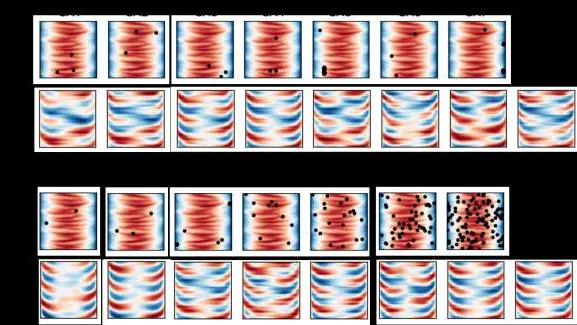
Inside a fusion reactor, plasma rages — a gas heated to millions of degrees. There are no direct windows, and cameras and sensors quickly fail. Engineers see only fragments of information: a few sensors at scattered points. It's like trying to grasp a symphony from the sound of three microphones in a vast hall.
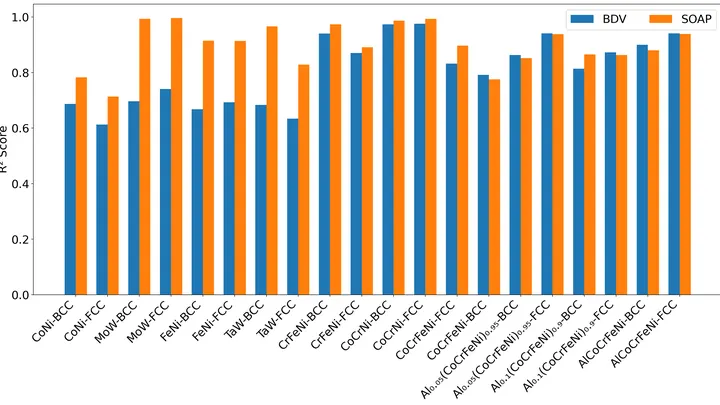
Creating an alloy from several metals is like cooking a soup from mysterious ingredients: guessing the final texture without trial and error is nearly impossible. Conventional models often get it wrong when there are more than three different kinds of atoms.
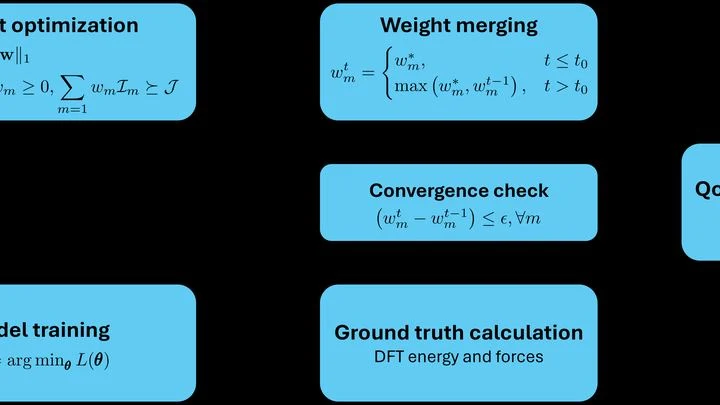
A chef doesn't waste ingredients cooking the whole dish to check the taste: they just taste a drop of sauce. The same logic underlies the "information matching" method for predicting metal strength. Instead of expensive calculations of every atom's behavior, scientists "taste" only simple indicators linked to plasticity — a metal's ability to bend without breaking.
Molecules float in a test tube. Their abundance (say, the concentration of some protein) becomes the input signal. And the output isn't just a cloudy solution but a clear yes-or-no answer.
The authors build a chemical cascade that does exactly that.
Energy transfer in photosynthesis is like a children's slide: it bends under the weight of one, reshaping the path for the next. That's what happens in a leaf: an excited molecule instantly reshapes the 'landscape' of its neighbors.
Physicists reproduce this effect using ions suspended in a vacuum trap.
Inside every cell, life is bustling: tiny protein machines tirelessly haul cargo, read genes, and fix errors. But their work is far from perfect: they often 'spin their wheels,' take backward steps, or get stuck in futile cycles. It's like a city traffic jam where cars dart around aimlessly, burning fuel.
Imagine a factory where hundreds of tiny assembly lines run nonstop. Each line is a molecular motor that converts chemical fuel into motion. To make the motor go faster or in the right direction, an engineer tweaks the settings — the shape of parts, the strength of interactions.
A pot of boiling soup bubbles away, and you'd love to know how hot individual droplets are inside. But you can only dip your thermometer at the edge, where things are calmer. Laser fusion is a bit like that: a powerful laser pulse hits a target, creating a cloud of fast protons.
Every carbon atom in a molecule carries a passport — the energy with which its deepest electrons sit in their orbitals. This energy is sensitive to neighbors: add an oxygen nearby or a double bond, and the number in the passport changes. Chemists have long measured such energies with X-rays, but calculating each new molecule takes hours of machine time.
The light bulb turns on only in the room where you need it. That's roughly how photoactivatable drugs work: they 'switch on' only where light is directed, leaving the rest of the body untouched. This is especially important in cancer treatment: conventional chemotherapy hits all dividing cells indiscriminately, causing severe side effects.
A ball rolls up a hill, but it doesn't have enough energy, so it rolls back down. That's classical mechanics for you. But in the quantum world, a tiny particle can sometimes pass right through the hill, as if the barrier weren't there. This trick, tunneling, is business as usual for a light atom like hydrogen.
A chemical reaction resembles passing through a turnstile: a crowd creates chaos and gets stuck, while an orderly line moves. In the quantum world, however, when the jostling subsides, the barrier can become ghostly — a particle passes through it as if the turnstile has vanished.
Qubits in a superconducting quantum computer are like tightly stretched strings. When a particle from space or from a radioactive decay flies by, it strikes these strings and they start to vibrate. This vibration disrupts the fragile quantum states, and computations go awry.
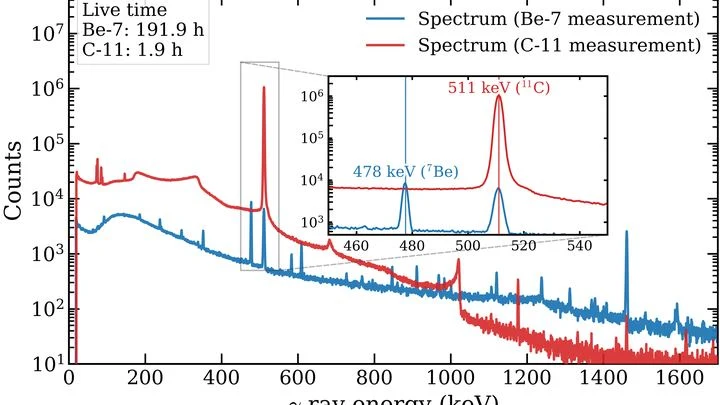
Inside the Sun, invisible nuclear transformations occur every second. One of them is the birth of boron-8: a beryllium-7 nucleus captures a passing proton and momentarily becomes a new element. This step kicks off a chain that ends with the emission of a neutrino — a particle capable of passing straight through Earth.
When two atomic nuclei collide, the outcome depends on their energy and the angle at which the fragments fly apart. Typically, such calculations demand enormous computing power, and accuracy hits a wall due to approximations.
A seven-metal alloy is like a team where every player is pulling the blanket their own way. Atoms of iron, cobalt, nickel, aluminum, titanium, tantalum, and vanadium can either fall into a strict pattern or scatter into random positions. This determines whether the material will be as strong as steel or as light as aluminum.
Strike a tuning fork, and it rings with a single pure note. But if the fork is trembling and people are chattering nearby, the sound won't be perfect. Same with molecules: each one absorbs light of a specific color, but due to its own vibrations and the jostling of neighbors, that color gets smeared out.
The authors of the paper figured out how to show this to students without complex formulas.
A water molecule resembles a tiny dumbbell: two hydrogen atoms attach to an oxygen atom at an angle. This dumbbell doesn't stay still: it stretches, compresses, and rotates. Each such motion has its own energy, like steps on a ladder.
A pot of water on the stove is just water, but inside each molecule, a continuous dance goes on. Hydrogen and oxygen atoms jitter, even at absolute zero, because that's how the quantum world works. These jitters change how much heat water stores and how it flows.
When chemists see how concentrations of substances change, they need to figure out which reactions are behind those changes. It's like trying to reconstruct a recipe from photos of plates at different stages of a meal. Previously, this often involved derivatives — instantaneous rates of concentration change.
In a heart-lung machine, blood flows through narrow tubing and past rapidly spinning pump blades. Sometimes red blood cells can't take it: their membranes rupture, and hemoglobin spills into the plasma. For a patient, this is like pouring sand into a car's fuel system — small damages accumulate and wreck the whole mechanism.
In a collider detector, each proton collision leaves a trail of dozens of particles, like the splash from a stone thrown into water. Making sense of that splash and understanding what exactly happened at the moment of impact is a task that humans can no longer handle alone.
Inside every cell, chemical reactions are constantly underway, like a tiny kitchen where protein chefs whip up essential compounds. But seeing exactly how a chef prepares a dish is tricky when you're surrounded by a crowd of other molecules.
A cell hit by a proton beam is like a city after a pinpoint bombing: some blocks are leveled, others just have broken windows. Whether the city survives depends on which buildings are hit and how the strikes are distributed.
An ordinary chemical reaction is like a ball rolling down a hill: it has one natural path. But if you place molecules in a tiny mirrored box, an optical microresonator, the light inside starts to interfere with the ball's motion. It can nudge it, hold it back, or even split its trajectory.
In a new study, physicists traced exactly how this happens.
In every handful of fertile soil, there are bacteria that do something no factory can: they take nitrogen straight from the air and turn it into fertilizer. The secret lies in the enzyme nitrogenase, and its working core, a cluster of iron and molybdenum atoms, looks like a tiny factory floor.
Chemists have long tried to understand how this factory works from the inside.
Electrons — tiny particles in molecules — constantly maneuver, avoiding collisions like passengers during rush hour. To calculate their behavior, scientists set a personal distance rule: a mathematical function that indicates how close one electron can get to its neighbor.
Six barium ions lined up in a flat hexagon inside a Paul trap, a device that holds charged particles with oscillating electric fields. But a slight change in the shape of the trapping potential made the crystal rearrange: one ion moved to the center, and the other five formed a ring around it.
Imagine a translator who learns the grammar of a chaotic language from textbook examples and then becomes fluent in real speech, complete with accents and noise. That is how the new KDL method works: first, a neural network is trained on synthetic data generated by the Liénard equation, then it is transferred to real time series where extreme events are rare and unpredictable.