Four Rooms of Winter: How Air Chooses the Weather ✛
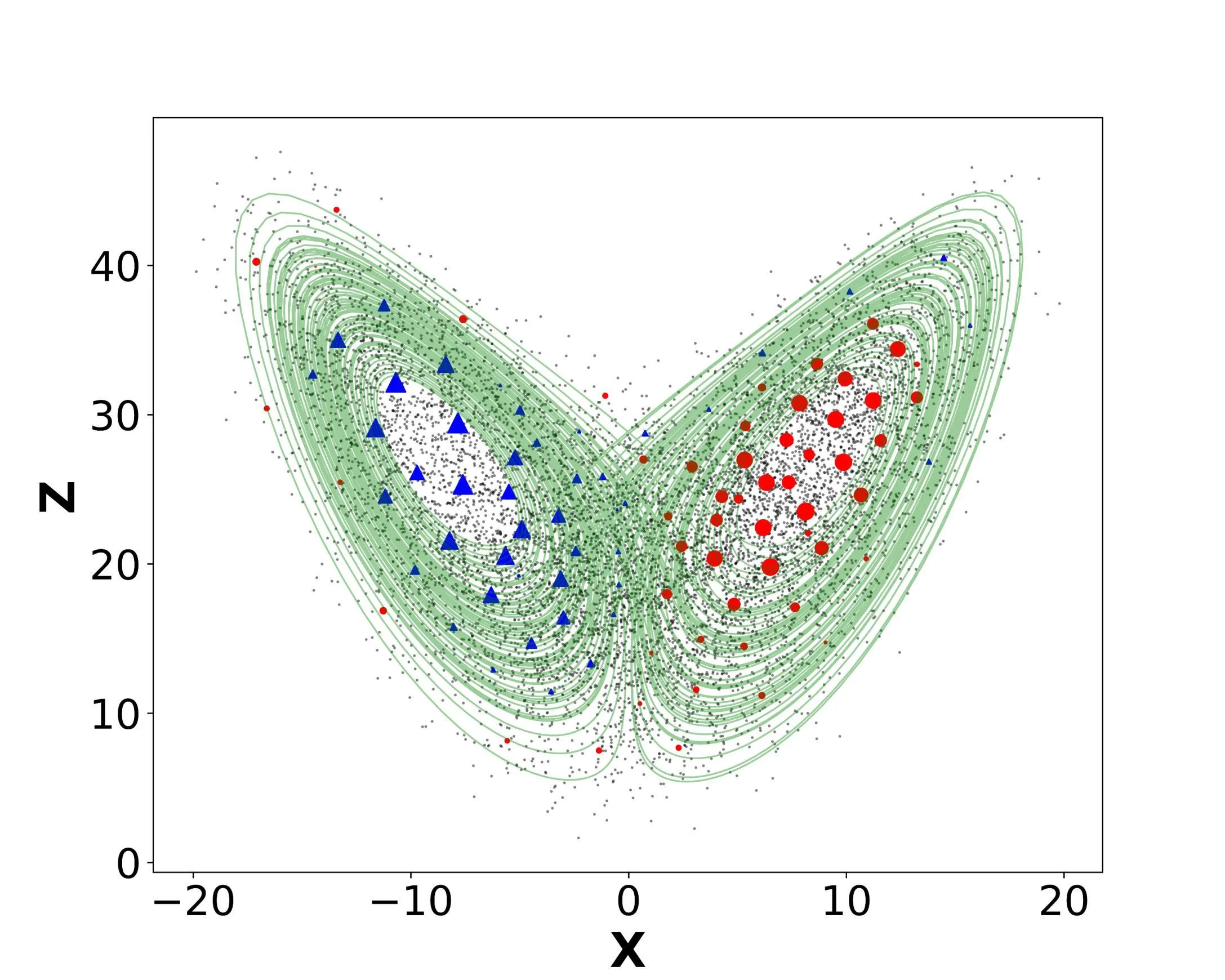
In winter, the air above us doesn't move randomly. It lingers for several days in the same pattern, like a person who stays in one room before moving to another. There are four such rooms, each with its own weather: one over Europe is warm and humid, another over Siberia is frosty and clear.
Scientists gathered data on air flows over many winters and applied a mathematical technique that finds these rooms and shows how often air moves from one to another. It turns out that transitions are not random: air typically moves in a cycle, from room one to room two, then back, then to room four and three. In each room, it lingers for about a week, but sometimes, especially in room three, it can stay for a whole month.
Previously, it was hard to tell which recurring air patterns were real and which were just random coincidences. Now we have a way to find the real rooms and predict transitions. It's like learning to read the blueprint of the maze that winter air wanders through.
Regime 3, corresponding to the negative phase of the North Atlantic Oscillation, sometimes lasts up to a month, causing abnormally cold winters in Europe, as in 2009–2010.