Metastable Circulation Regimes: The Hidden Structure of the Atmosphere ✛
Context
This work stands somewhat apart: its nearest neighbors investigate neural network forecasting, distinguishing noise from signal in climate, quantum effects, and electricity in disordered materials. There are no direct analogues on the metastability of atmospheric regimes nearby, but the overarching theme, the search for stable structures in complex dynamical systems, connects this paper to studies of critical transitions and quantum order. Within meteorology itself, the task of identifying circulation regimes remains contentious due to nonlinearity and the lack of a clear conceptual framework. Traditional methods based on probability density decomposition or similarity networks do not account for temporal connections between states, which is crucial for detecting metastable regions of phase space.
Methods
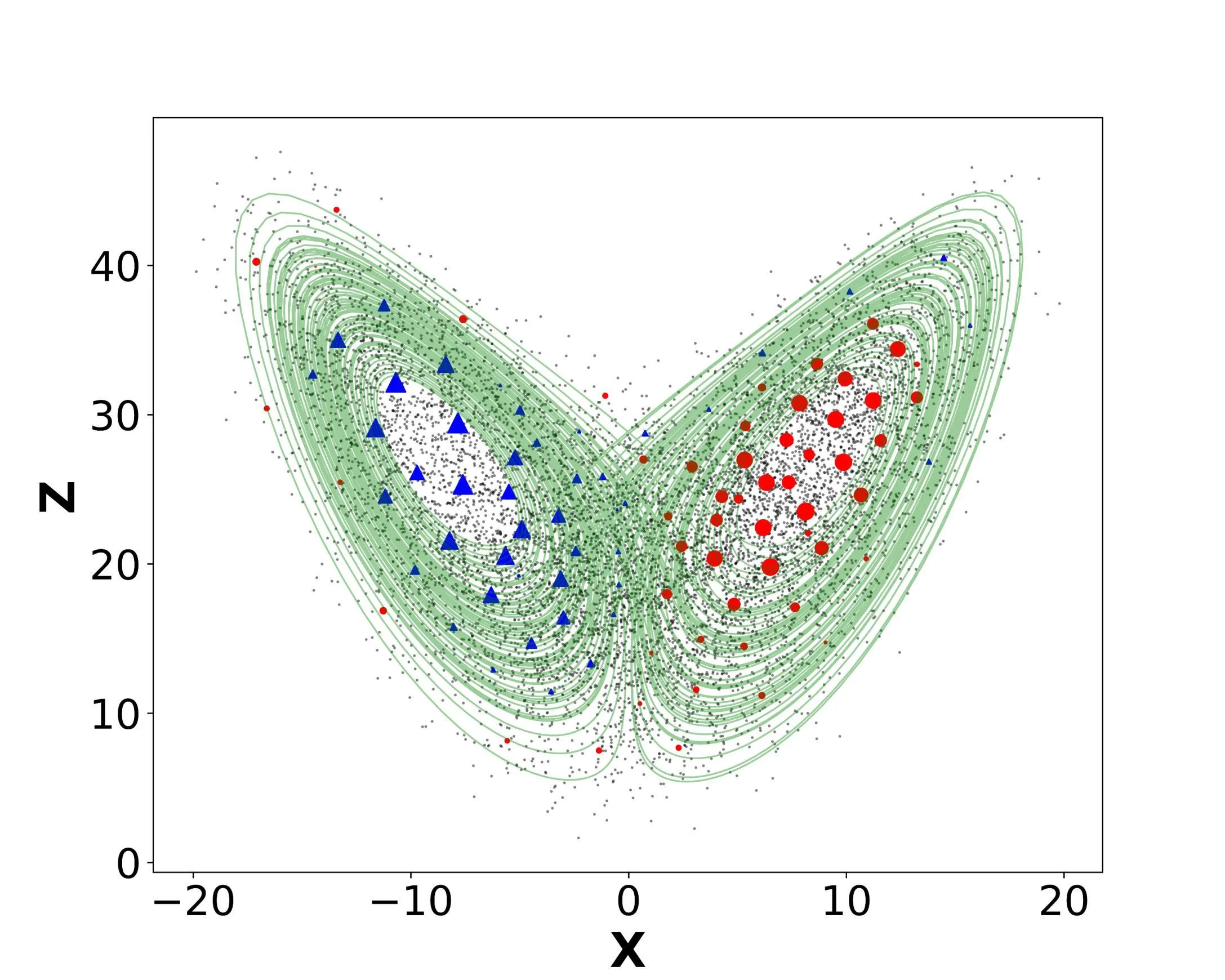
The authors build a hidden Markov model (HMM) on wintertime geopotential height time series at 500 hPa from the NCEP/NCAR reanalysis for 1950–2023. For dimensionality reduction, they use the nonlinear kernel principal component analysis (KPCA), mapping the data into the space of the three leading components. The HMM transition probability matrix is then partitioned into weakly interacting blocks (communities of hidden states) using an algorithm based on modularity maximization from graph theory. Each partition is tested for significance using surrogate data that preserve spectral properties. The choice of the time step L (the power of the transition matrix) allows separating stable regimes from noise; the optimal range was found to be 5 < L ≤ 9 days.
Results
The method identified four persistent circulation regimes that are well reproduced for various L within the specified range. The first regime corresponds to the positive phase of the Arctic Oscillation; the second combines the positive phase of the North Atlantic Oscillation and the negative Pacific–North American pattern; the third corresponds to the negative phase of the North Atlantic Oscillation; and the fourth is a blocking anticyclone over the Barents Sea. The average lifetime of the regimes is 7–8 days, but for the third regime, rare episodes lasting up to 25–30 days are observed. Transitions between regimes are not random: there is a preferred loop r1 → (r2 ↔ r1) → (r4 ↔ r3) → r1. Analysis of surface temperature shows that regimes 1 and 2 bring warm and wet winters to Europe and Siberia, while regimes 3 and 4 bring cold ones. Surprisingly high correlations were found between regime frequencies and indices of El Niño (up to 0.33) and the Pacific Decadal Oscillation (up to -0.8 with a 1-year lead for regime 2).
Implications
Unlike neighboring works, which either focus on forecasting without explicitly identifying regimes or use linear methods, this paper offers a rigorous probabilistic approach to defining metastable states of the atmosphere. It is the first work to link the concept of metastability to communities of HMM hidden states and to use modularity from graph theory for their identification. The resulting regimes are not merely statistical clusters but dynamical structures with predictable transitions, paving the way for improved subseasonal forecasts. High correlations with the Pacific Decadal Oscillation point to a possible mechanism of teleconnections between the Pacific Ocean and the midlatitude atmosphere.
Future development
The method could be extended to continuous year-round modeling, including the interaction of regimes with the annual cycle. This would require a nonstationary HMM with external forcing from teleconnections. It could also be applied to other regions and atmospheric levels, as well as to climate models to test their ability to reproduce regimes. Further investigation of the link with the Pacific Decadal Oscillation may clarify mechanisms of decadal climate variability.
Impact
The results could improve subseasonal and seasonal weather forecasts, especially for Europe and North America, where regimes strongly influence temperature and precipitation. The identified links with El Niño and the Pacific Decadal Oscillation could be used in statistical long-range forecasting models.
Next steps
Test the reproducibility of regimes in modern climate models and assess their predictive value for subseasonal forecasts. Investigate the physical mechanisms linking the Pacific Decadal Oscillation to regime frequencies.
Key open problems
This work directly addresses the unresolved problem of identifying and dynamically interpreting atmospheric circulation regimes. It offers a new perspective on metastability as a fundamental property of the atmosphere's nonlinear dynamics, which may help understand predictability on subseasonal timescales. The connection with decadal ocean modes raises the question of the ocean's role in shaping regimes, which remains open.
The knowledge machine's view
This section is addressed to the author of the paper and their colleagues. Neighbouring works were found by meaning-based search across our archive, not by word overlap. We do not review: we show the field around the work.
What the work does
You have developed a method for identifying metastable regimes of atmospheric circulation by combining a hidden Markov model with nonlinear dimensionality reduction (kernel principal components). Applying it to winter geopotential heights from 1950 to 2023, you found four persistent regimes with characteristic lifetimes and transitions, as well as correlations of their frequency with El Niño and Pacific Decadal Oscillation indices.
Where its strength is
The strong point is the probabilistic approach, which explicitly accounts for temporal links between states, allowing the identification of metastable regions in phase space rather than just density clusters. This yields a more physical interpretation of regimes as dynamical objects with lifetimes and preferred transitions.
Where it could go next
- It might be interesting to compare your method with the approach in the work on dark energy, which also seeks stable structures in time series using hidden variables. Their technique for assessing state stability could be useful for testing the robustness of regimes.based on: Dark Energy: The Actor Changes Its Mask arXiv:2509.17124
- Closely related is a study on hidden phases in unstable systems, which proposes a formula for retaining unstable states. Transferring this idea to atmospheric regimes might help understand which conditions favor long episodes (e.g., rare 25–30-day blocks).based on: How to Stabilize the Unstable: The Formula of Hidden Phases arXiv:2606.08004
- You could also look at the work on chaos in giant chemistry, which analyzes how chaotic dynamics generates large-scale structures. Comparing it with your method of extracting regimes from a chaotic background may yield new selection criteria.based on: How Chaos Governs the Chemistry of Giants arXiv:2604.21005
Worth trying
- Test the method on data from other seasons or levels to check the universality of the regimes.
- Use surrogate data that preserve not only the spectrum but also nonlinear correlations to tighten the significance test.
- Try incorporating external forcings (El Niño, PDO) as covariates for transition probabilities to assess their influence on regime changes.
Why this may matter
If the regimes are indeed metastable and predictable from slow oceanic indices, this paves the way for improving seasonal weather forecasts in mid-latitudes.
Nearby works in our archive
- The Fourth Spring of Climatesimilarity 0.50
- The Climate Swings of Ancient Marssimilarity 0.49
- A Dance of Two Stars 57 Light-Years Awaysimilarity 0.49
- Seven Planets March in Lockstepsimilarity 0.49
- Dark Energy: The Actor Changes Its Masksimilarity 0.49
- How to Stabilize the Unstable: The Formula of Hidden Phasessimilarity 0.49
- How Chaos Governs the Chemistry of Giantssimilarity 0.48
The archive is sparse around this work: the closest review is only 0.50, against a usual 0.64. It looks like few have drilled nearby.
Regime 3, corresponding to the negative phase of the North Atlantic Oscillation, sometimes lasts up to a month, causing abnormally cold winters in Europe, as in 2009–2010.
Key numbers
- number of regimes: 4
- average regime lifetime: 7–8 days
- maximum correlation with PDO: -0.8 (with 1-year lead)
- data period: 1950–2023
- number of HMM hidden states: 50