Rooms of the Winter Sky: How the Atmosphere Chooses the Weather ✛
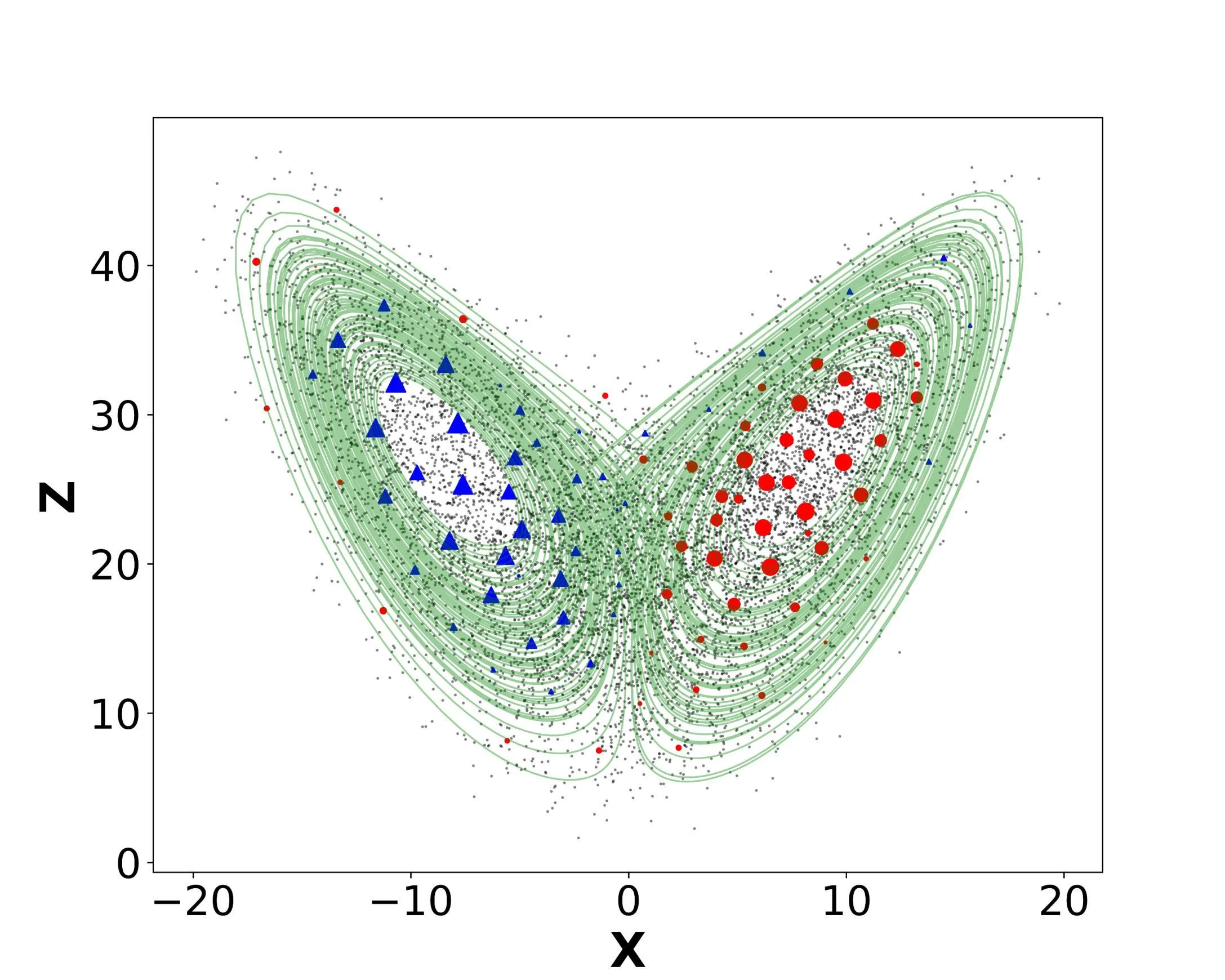
In winter, air over the Northern Hemisphere does not move haphazardly; it spends days at a time in the same pattern before rearranging itself. These patterns are like rooms in a maze: the system enters, lingers, then finds a door to another room. Each room has its own weather: somewhere over Europe it is warm and humid, while over Siberia it is frosty and clear.
To find these rooms, scientists took data on the altitude where air pressure is about half of that at the surface, spanning more than 70 winters. They applied a mathematical technique that first compresses the vast data into three principal axes, then looks for recurring states while accounting for their sequence in time. This is important: if you simply cluster similar patterns, you might mistake a random coincidence for a regime, but the temporal link helps filter out noise.
Transitions between rooms are not random. The system prefers to move in a cycle: from the first to the second, back to the first, then to the fourth and third, and again to the first. The average stay in a room is about a week, but the third room sometimes holds the atmosphere for a month, as happened during the anomalously cold winter of 2009–2010 in Europe.
The most unexpected finding involves the Pacific Ocean. The frequency of the second room turned out to be linked to slow oscillations in ocean surface temperature that last for decades. The correlation coefficient reaches 0.8 with a one-year lead. This means that by looking at the state of the Pacific, one can predict how often the atmosphere will enter a given room the following winter.
Previously, it was unclear how to rigorously separate true regimes from random clusters of similar patterns. Now it has been shown that regimes are not just statistical clusters but dynamic structures with predictable transitions. This approach can be applied to climate models to test whether they can reproduce the rooms of the real atmosphere, and to forecasts several weeks ahead, where there is currently much uncertainty. The maze of the winter sky has become a bit clearer, and we can now learn to predict which room it will enter tomorrow.
Regime 3, corresponding to the negative phase of the North Atlantic Oscillation, sometimes lasts up to a month, causing abnormally cold winters in Europe, as in 2009–2010.