Simple

Euclid Accidentally Discovers 164 Cosmic Flashes ⚡ экспресс

Original: "Euclid: Quick Data Release (Q1) -- Photometric studies of known transients"
· C. Duffy, E. Cappellaro, M. T. Botticella, I. M. Hook, F. Poidevin, T. J. Moriya, A. A. Chrimes, V. Petrecca, K. Paterson, A. Goobar, L. Galbany, R. Kotak, C. Gall, C. M. Gutierrez, C. Tao, L. Izzo, N. Aghanim, B. Altieri, A. Amara, S. Andreon, N. Auricchio, C. Baccigalupi, M. Baldi, A. Balestra, S. Bardelli, A. Basset, P. Battaglia, A. Biviano, A. Bonchi, E. Branchini, M. Brescia, J. Brinchmann, S. Camera, V. Capobianco, C. Carbone, J. Carretero, R. Casas, S. Casas, M. Castellano, G. Castignani, S. Cavuoti, A. Cimatti, C. Colodro-Conde, G. Congedo, C. J. Conselice, L. Conversi, Y. Copin, F. Courbin, H. M. Courtois, M. Cropper, A. Da Silva, H. Degaudenzi, G. De Lucia, A. M. Di Giorgio, C. Dolding, H. Dole, F. Dubath, C. A. J. Duncan, X. Dupac, S. Dusini, A. Ealet, S. Escoffier, M. Farina, F. Faustini, S. Ferriol, S. Fotopoulou, M. Frailis, P. Franzetti, S. Galeotta, K. George, B. Gillis, C. Giocoli, P. Gómez-Alvarez, A. Grazian, F. Grupp, S. Gwyn, S. V. H. Haugan, J. Hoar, H. Hoekstra, W. Holmes, F. Hormuth, A. Hornstrup, P. Hudelot, K. Jahnke, M. Jhabvala, E. Keihänen, S. Kermiche, B. Kubik, K. Kuijken, M. Kümmel, M. Kunz, H. Kurki-Suonio, Q. Le Boulc'h, A. M. C. Le Brun, D. Le Mignant, P. Liebing, S. Ligori, P. B. Lilje, V. Lindholm, I. Lloro, D. Maino, E. Maiorano, O. Mansutti, S. Marcin, O. Marggraf, M. Martinelli, N. Martinet, F. Marulli, R. Massey, E. Medinaceli, M. Melchior, Y. Mellier, M. Meneghetti, E. Merlin, G. Meylan, M. Moresco, P. W. Morris, L. Moscardini, C. Neissner, R. C. Nichol, S. -M. Niemi, J. W. Nightingale, C. Padilla, S. Paltani, F. Pasian, K. Pedersen, W. J. Percival, V. Pettorino, S. Pires, G. Polenta, M. Poncet, L. A. Popa, F. Raison, R. Rebolo, A. Renzi, J. Rhodes, G. Riccio, E. Romelli, M. Roncarelli, R. Saglia, Z. Sakr, D. Sapone, B. Sartoris, J. A. Schewtschenko, M. Schirmer, P. Schneider, T. Schrabback, A. Secroun, G. Seidel, S. Serrano, P. Simon, C. Sirignano, G. Sirri, J. Skottfelt, L. Stanco, J. Steinwagner, P. Tallada-Crespí, A. N. Taylor, I. Tereno, R. Toledo-Moreo, F. Torradeflot, I. Tutusaus, L. Valenziano, T. Vassallo, G. Verdoes Kleijn, Y. Wang, J. Weller, A. Zacchei, G. Zamorani, F. M. Zerbi, E. Zucca, C. Burigana, R. Cabanac, L. Gabarra, V. Scottez, D. Scott, M. Sullivan
arXiv:2503.15334 · 2025-03-19 · CC BY 4.0 · ⏱ 1 min · Stellar Galaxies
Euclid is a dark energy hunter, but its nets snagged 164 supernovae and their secrets.
Abstract

The Euclid telescope accidentally caught 161 already-known flashes (supernovae or other cosmic explosions) in distant galaxies. It observed them in infrared light, invisible to the eye, sometimes before they were spotted from Earth. It's like finding old photos of fireworks, showing them just igniting. What do you think, how many secrets of the Universe are hiding in already-taken images?

Links in the knowledge graph 1

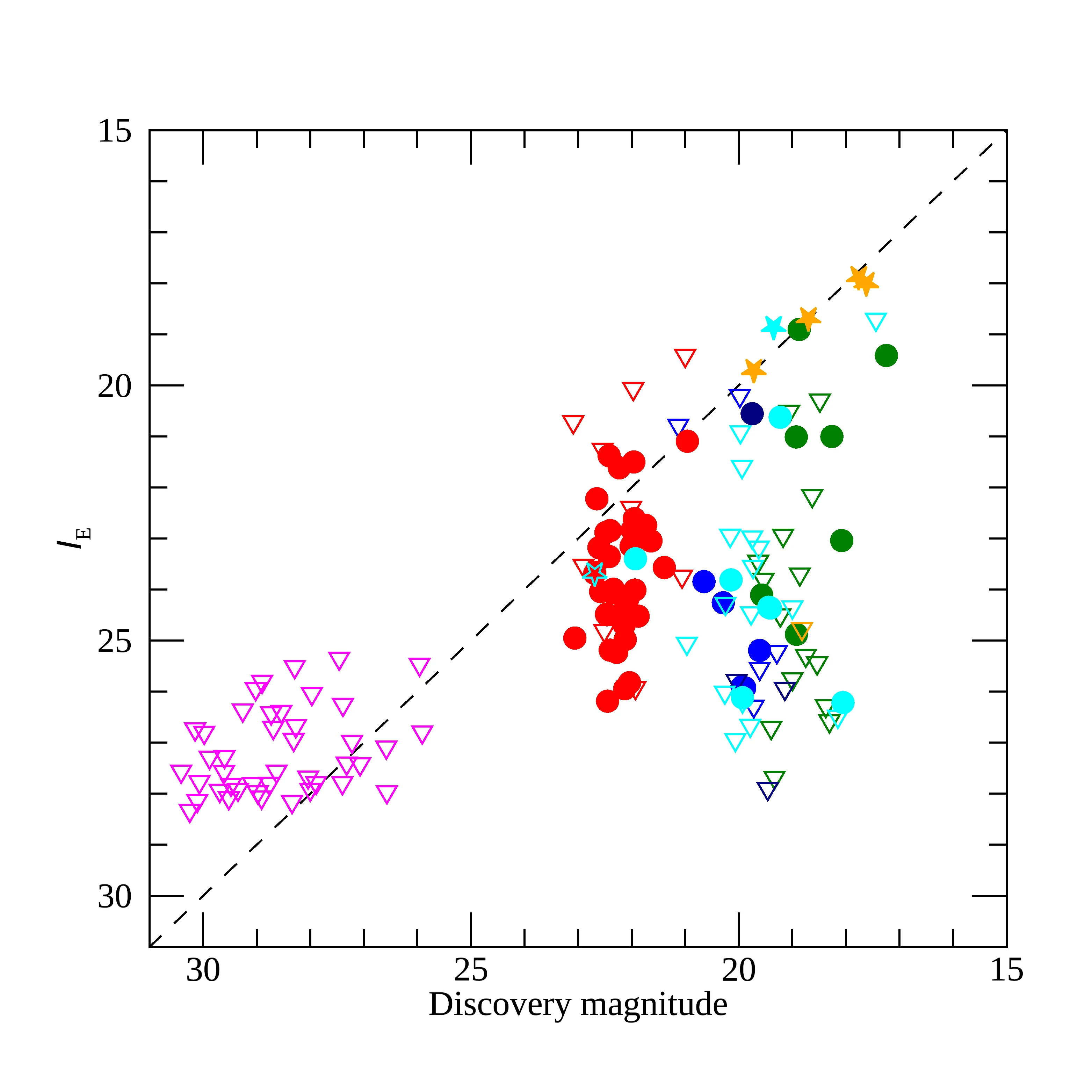
The Euclid space telescope works like a security camera in a dark hangar: its job is to catch traces of an invisible force, тёмной энергии, that warps the universe. But instead, it spotted 164 bright sparks — сверхновые, explosions of dying stars. Scientists measured their glow in different colors (фотометрию) and saw something unexpected.

One supernova was caught 15 days before its peak, in the infrared range, where no one expected it. Another, defying the usual script, shone 436 days after the explosion, when other telescopes had already lost sight of it. Euclid’s infrared lens cuts through cosmic dust like a flashlight through fog, revealing галактики that were previously thought invisible — it’s precisely in them that these flashes were hiding.

Now, as the telescope begins surveying vast swaths of sky, the count of discoveries will soar into the thousands. The dark energy hunter is turning into a chronicler of stellar catastrophes.

🎯 Deep images from Euclid reveal galaxies where supernovae exploded, in places where ground-based telescopes saw only emptiness — as if a camera suddenly unveils an invisible house.
Scientists
Alan GuthAndrei LindeGeorges LemaîtreJames PeeblesLudwig BoltzmannFritz Zwicky
Tags
supernova photometry galaxy dark energy
Laws
Friedmann equationsStefan–Boltzmann lawvirial theoremChandrasekhar limitFermi accelerationlaw of conservation of momentum
Original: arXiv:2503.15334 · CC BY 4.0 · bridge42worlds