L. Galbany

4 articles · 30 co-authors · latest: 2026-08-09
1,031 citations · h-index 11 · 58 papersData: Semantic Scholar

We have retold 4 papers by this author. 1 of them with a full read. most often about: EHT, supernova, supernova remnant. 30 co-authors across our retellings.

Links in the knowledge graph
Stellar2025-03-193 minarXiv:2503.15334
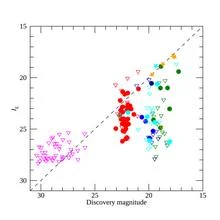
One Frame, and the Flash Is Caught: Euclid Measures Known Transients
In Euclid's deep fields, stars flare up that were not in any catalog. A telescope built to map dark matter has worked like a camera trap: one frame, and a cosmic explosion is already on record.
Stellar2026-01-302 minarXiv:2602.00389express
A Star's Death in a Layered Cocoon
A star similar to our Sun but several times heavier sheds its outer layers before dying. The gas expands outward, forming something like onion rings around the star. When the star finally explodes as a supernova, the light of the explosion passes through these rings and illuminates them, like a flashlight shining through layers of fog.
High Energy2026-05-082 minarXiv:2605.07827express
Helium in the Thermonuclear Fire of a Supernova
A match flares from both ends. First the head ignites, and a moment later the flame engulfs the wooden stick. Something similar may happen in some Type Ia supernovae — except the match is a white dwarf (a star the size of Earth), and the flame is a thermonuclear explosion.
Galaxies2026-08-091 minarXiv:2608.08380express
Where Giant Stars Explode
The explosion of a massive star is not just a flash: it's a blow to the surrounding gas. But until now, no one had looked at how the gas itself moves at the sites of such explosions. Now astronomers have gathered data on 33 nearby supernovae and for the first time measured the turbulence of the cold molecular gas around them.