One Frame, and the Flash Is Caught: Euclid Measures Known Transients ✛
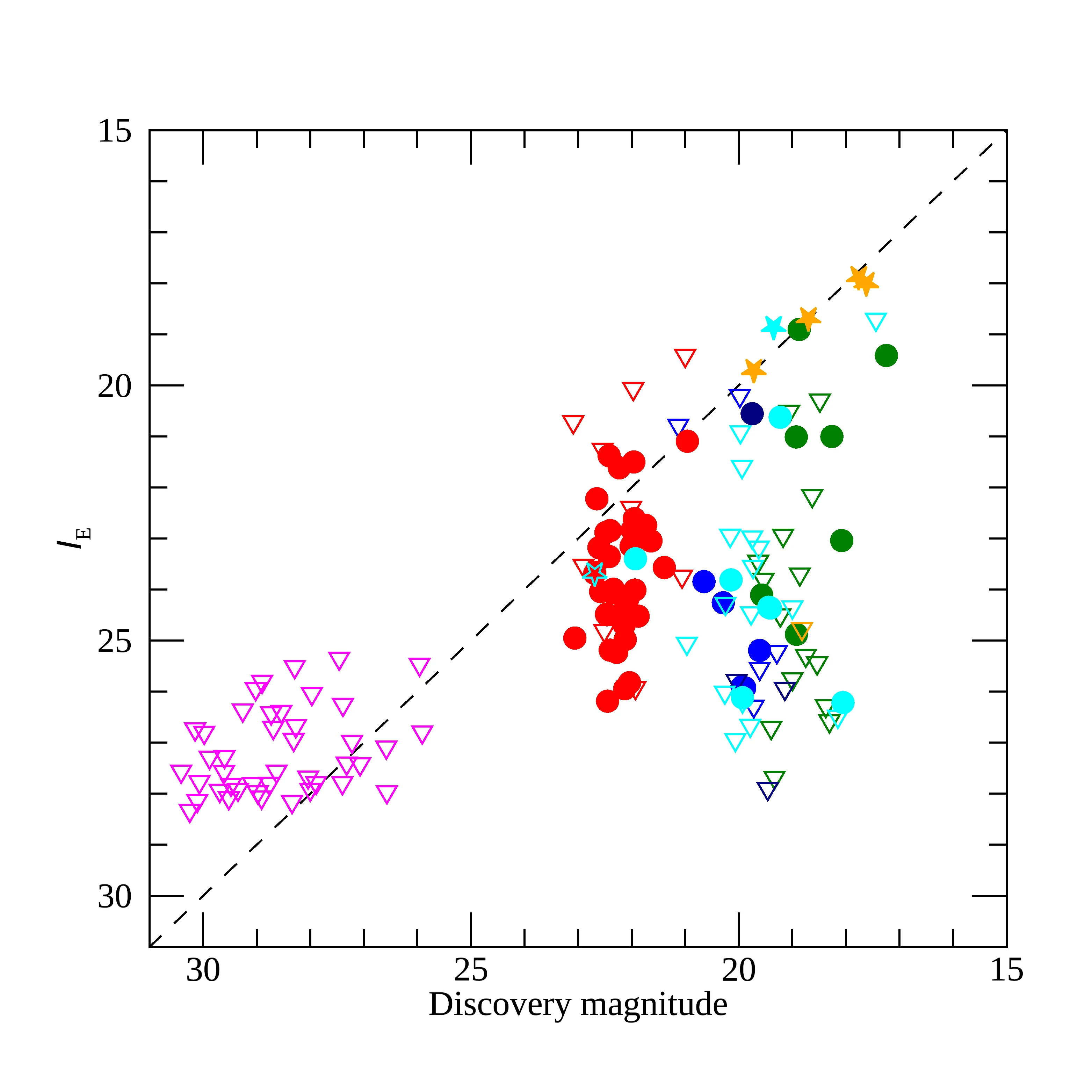
In Euclid's deep fields, stars flare up that were not in any catalog. A telescope built to map dark matter has worked like a camera trap: one frame, and a cosmic explosion is already on record. In the Q1 quick release, each patch of sky was imaged only once, so the classic difference-imaging search for transients (temporary sources in the sky) is impossible. But even single exposures carry information; you just need to carefully extract it for known objects.
The authors took mosaic images of Euclid's three deep fields: Fornax, North, and South. They selected 164 transients from the TNS database that fell within these areas by coordinates and observation time. For 161 objects, they managed photometry via point-spread function (PSF) fitting in four filters: IE (optical) and YE, JE, HE (near-infrared). Since no template images were available for background subtraction, the local background was estimated by interpolation around the source. Detection significance required a signal-to-noise ratio above 2.5 and coordinate coincidence within uncertainty. For faint or offset sources, they provided upper brightness limits.
Euclid detected 59 transients in the IE filter, 40 in YE, 36 in JE, and 30 in HE. Upper limits were obtained for 93, 91, 88, and 93 objects, respectively. The average brightness of detections was 23.0 in IE and 21.7 in JE. The limiting depth for an isolated source in IE reached magnitude 28. The recovery fraction for transients discovered within six months before Euclid's observation and brighter than magnitude 24 was 69%, and within 100 days it was 82%. Among the bright examples are the Type Ia supernova SN 2024pvw, captured 15 days before peak in all four filters, and SN 2023aew, whose light curve was traced to 436 days after maximum. For 11 previously "homeless" transients, Euclid revealed likely faint host galaxies.
The work aligns with neighboring studies: all use Euclid's deep images to study transients. The difference here is that the authors, for the first time, applied PSF photometry on a large scale to single Q1 frames rather than difference images. This allowed them to extract useful information even without repeated observations. Such an approach is important for Euclid's future wide survey, where each patch of sky will be imaged only once. With the first major data release DR1, the coverage area will grow from 63 to 1900 square degrees. Under the same selection criteria, this will yield more than 5500 transients for follow-up study. In the deep fields, repeated epochs will become available, enabling image subtraction and direct discovery of new transients. Joint products with the Vera Rubin Observatory will improve light curves and supernova statistics.
A single camera-trap frame already helps refine the nature of cosmic explosions. Early infrared observations, like those of SN 2024pvw, directly constrain Type Ia supernova models. Late light curves, like those of SN 2023aew, help distinguish radioactive decay from other energy sources. And the faint host galaxies found by Euclid refine the map of explosion distribution across the universe. The camera trap keeps working, and each new frame brings us closer to the answer.
Euclid captured SN 2024pvw 15 days before its peak, one of the earliest near-infrared observations of a Type Ia supernova. For comparison, in the CSP-II cosmological sample, such early points occur 2–3 days later.