Hot Water Freezes Faster? A Quantum Answer ✛ ✎ ✦
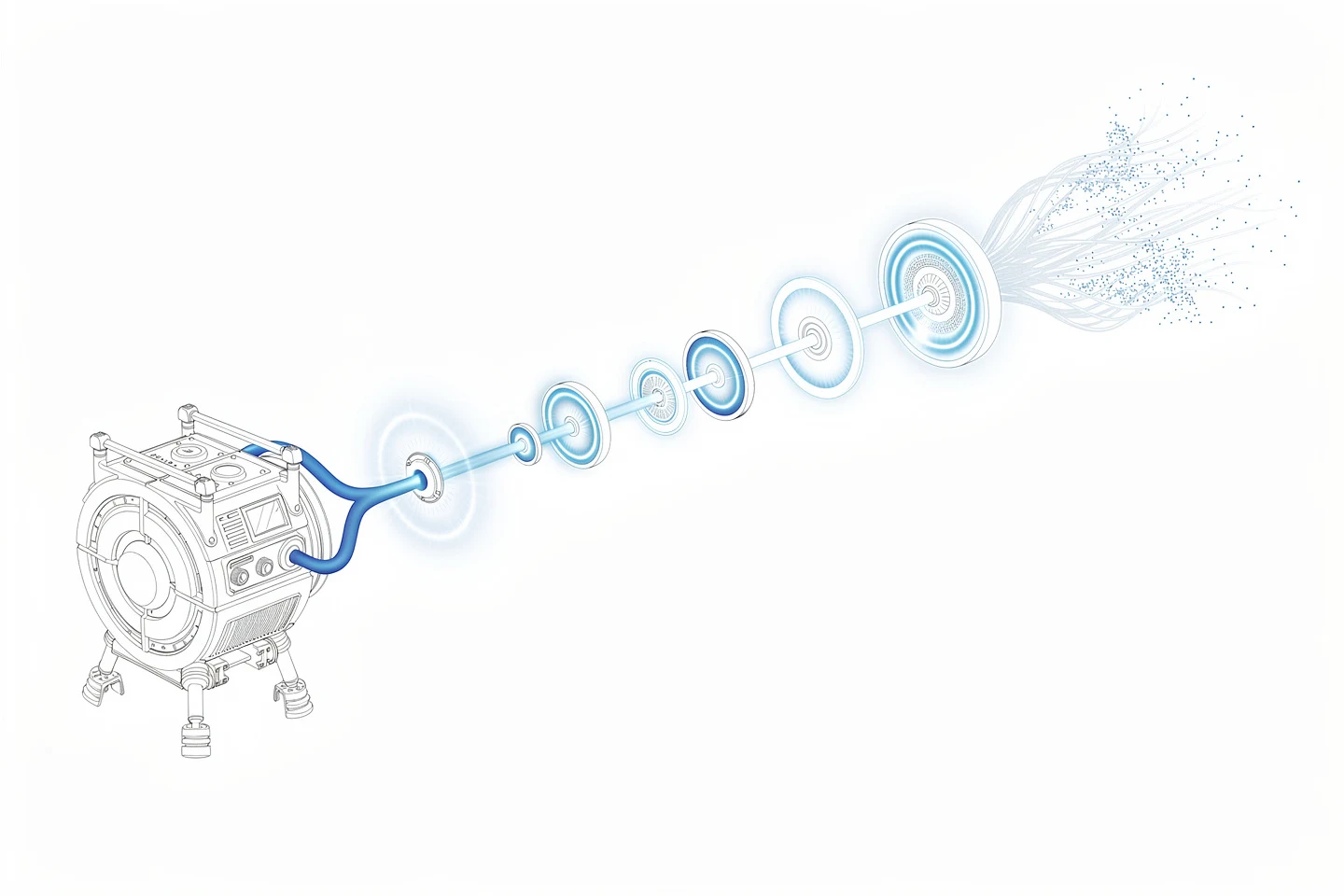
Hot water sometimes freezes faster than cold — this paradox, called the Mpemba effect, also shows up in the quantum world, where the laws discovered by John von Neumann reign. Only instead of water, we have tiny magnets (spins), whose ordered state dissolves into chaos.
The reason lies in how the environment is prepared. Like sugar in tea: sprinkled in a thin layer, it melts instantly; dropped in a lump, it takes time. The same goes for quantum particles: if the environment is 'scattered' across many states, the main system loses its superposition — the ability to be in many states at once — faster. Scientists confirmed this on a chain of 15 spins linked by quantum entanglement, tracking the disappearance of disequilibrium through measurements. The result: the wider the spread of the environment, the more rapidly entropy — the measure of disorder introduced by Boltzmann — grows.
This discovery is not just a curiosity. It shows how to control quantum decoherence — the process that destroys fragile states and hinders the operation of quantum computers, dreamed up by Feynman. Now engineers will be able to speed up or slow down the loss of properties, preserving quantum information. And the most unexpected conclusion: sometimes, to make a system 'cool down' faster, you need to 'heat it up'.
The classical Mpemba effect was noticed by Aristotle, and in 1963 it was rediscovered by Tanzanian schoolboy Erasto Mpemba while making ice cream.
Controlling the speed of thermal equilibrium echoes the idea of 'slowing down entropy' from Greg Egan's novel 'Permutation City'.