In 1984, British physicist Michael Berry generalized an old idea about a phase accumulated during adiabatic (slow) changes of parameters. It turned out this phase is geometric: its magnitude is determined not by time or speed but by the curvature of parameter space. Earlier partial manifestations had been noticed before Berry, but he showed their universality and connection to gauge fields.
History
Predecessors: in 1956, S. Pancharatnam studied the phase of light under cyclic polarization changes. In 1984, Michael Berry gave a rigorous quantum-mechanical formulation for general adiabatic processes. Later, Frank Wilczek and others generalized the Berry phase to non-adiabatic processes and degeneratestates, linking it to topological invariants.
How it works
The Berry phase is widely used to describe quantum transport, topological insulators (materials conducting only on the surface), molecular dynamics (e.g., predicting forbidden transitions), and quantum computing (topological qubits). Limits of applicability: adiabatic approximation—the rate of parameter change must be small compared to the energy gap between levels.
In practice
Explains electron behavior in crystals and is used to create topological quantum computers resistant to noise.
Fun fact
The famous Foucault pendulum, which rotates its swing plane due to Earth's rotation, is a classical analogue of the Berry phase: the pendulum 'senses' geometry, not just forces.
At 359.8 K (about 87 °C), a substance made of bent, banana-shaped molecules transitions into a liquid crystal phase where the molecules assemble into layers. But unlike ordinary layers where all the 'bananas' lie the same way, here they are tilted in two directions at once, like cherry pits in a jar that can point both up and sideways.
Take two thin sheets of a semiconductor. One is saturated with free electrons, like a packed café where every table is taken. The other, by contrast, is full of empty spots—'holes' eager to be filled. When these sheets are brought close together, a spark of attraction jumps between them: electrons and holes begin to feel each other across the thin gap.
Take two thin sheets of a semiconductor. One is saturated with free electrons, like a packed café where every table is taken. The other, by contrast, is full of empty spots—'holes' eager to be filled. When these sheets are brought close together, a spark of attraction jumps between them: electrons and holes begin to feel each other across the thin gap.
Cut a spin chain, and particles without an energy gap appear at the edges. They are called zero modes, and they live only at the boundary. Previously, they were counted using complex topological invariants, but now there is a simpler way.
For a long time, the event horizon behaved like a cosmic dictator: everything that crossed its boundary vanished irretrievably from our Universe. But quantum mechanics, like a dissident's voice, whispered: information cannot simply disappear.
Crystals fascinate us with their perfect spatial order: atoms frozen at lattice points, like beads on an invisible string. But what if the same symmetry unfolds in time? Time crystals are systems that, without any external cue, start repeating their states cyclically — clocks wound by nature itself. Inside this tireless rhythm, disorder seems to have no place.
A black hole resembles a safe that slowly gives up its contents, energy and information, through a faint glow known as Hawking radiation. But if the safe opens too quickly, a 'firewall' may flare up at its boundary — a region where the familiar laws of physics break down.
In the new work, physicists complicated the model of this safe.
In the quantum world, particles can merge into a single liquid that flows without friction. One of its most mysterious forms is the fractional quantum Hall liquid. In it, electrons or atoms move as a single vortex, and their charge splits into fractions, like a pie cut into perfectly equal slices.
A quantum computer measures a molecule's energy much like an old tape measure that only has markings every meter. If the actual length of a table is 2.37 meters, the tape shows “two and a bit,” and you can't do better. Physicists call this resolution: the step of the grid, finer than which you cannot go.
The authors of the new work turn this flaw into an advantage.
If you carry a cup of coffee slowly and steadily around a room and then return to the same spot, nothing happens to the drink. But in the quantum world, things are different: a particle that makes such a loop comes back not quite the same. It picks up an elusive 'extra'—the geometric phase, which physicists call the Berry phase.
Sunlight hits a silicon wafer, and a current flows in the circuit. That's the familiar work of a solar cell: light knocks out electrons, and a p–n junction (the boundary between two layers with different conductivities) forces them to move in one direction. But in some crystals, current arises differently — without any junctions, purely from the material's internal structure.
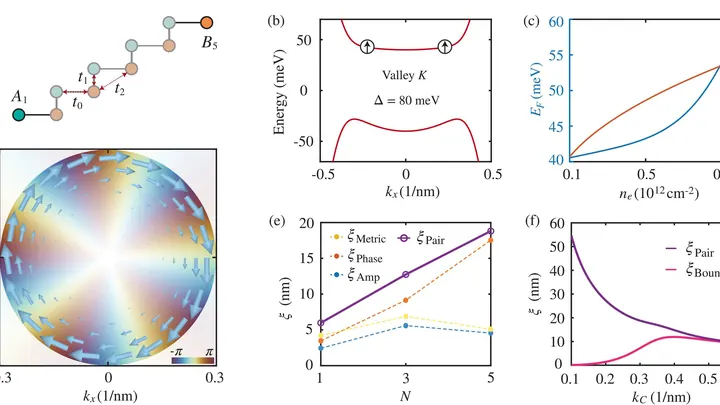
In a superconductor, electrons pair up like dancers holding hands. Usually, the distance between them, the pair size, depends on how fast they move and how strongly they are bound. But sometimes the dance floor almost disappears, and there's nowhere to move. This happens in materials with flat electronic bands: electrons nearly freeze, and the usual rules stop working.
A tiny ring of superconductor, cooled to near absolute zero, could feel the touch of a particle billions of times lighter than an electron. We're talking about the axion — a hypothetical particle that might make up the dark matter filling the universe.
A spinning black hole drags spacetime with it, like a spoon swirling thick honey. This vortex is a manifestation of curved spacetime. But the key point: it can change the quantum rhythm of matter, even where there are no forces.
A chain of red phosphorus atoms is like a train where the cars are atoms and the couplers are chemical bonds. Sometimes the couplers are stronger, sometimes weaker, and that affects how electrons run through the train.
An electron inside a crystal is like a traveler walking through a city with winding streets. Its direction of motion constantly changes depending on where it is. Physicists call this feature the geometric Berry phase, and it determines how a material conducts electricity or responds to a magnetic field.
Electrons in a conductor behave like a crowd on an escalator: each one moves on its own, but together they create a flow. If you make them circle around a ring, their angular momentum (a measure of rotation) can couple to a magnetic field, like gears in a clock.
Light trapped in a tiny cavity is like a pendulum that gets pushed harder and harder. At first, it swings smoothly and predictably, like an ordinary clock. But if you push it hard enough, the motion becomes strange: the pendulum seems to be in two extreme positions at once.
To tell one protein from another, you need to describe its shape and composition. There are dozens of such descriptions: molecular length, charge, solubility. But not all are equally useful. A method called Differentiable Information Imbalance (DII) can pick out the most informative features while discarding the rest.
The Penrose tiling, assembled from two types of tiles, covers a plane without a repeating pattern — a mathematical marvel discovered by Roger Penrose that has found physical embodiment in the quantum world. Researchers modeled a chain of particles interacting according to a rule reminiscent of Fibonacci numbers and the golden ratio.
Imagine a soloist trying to blend their voice with a choir. If the choir sings in unison, the soloist's voice stands out for a long time; but if the choir scatters across a wide range — from deep basses to ringing sopranos — the soloist dissolves almost instantly. In quantum physics, the role of such a choir is played by a thermal bath — a massive environment.
Quantum walking is not a series of random steps, but a musical score where the piano of space sounds under the conductor's baton of the internal state. The coin sets the tone. Until now, it was believed that detuned keys (phase disorder) mute any melody, leading to Anderson localization — a ringing silence.