Conductor of Heat Death: The Charge Palette of a Quantum Bath ✛ ✎ ✦
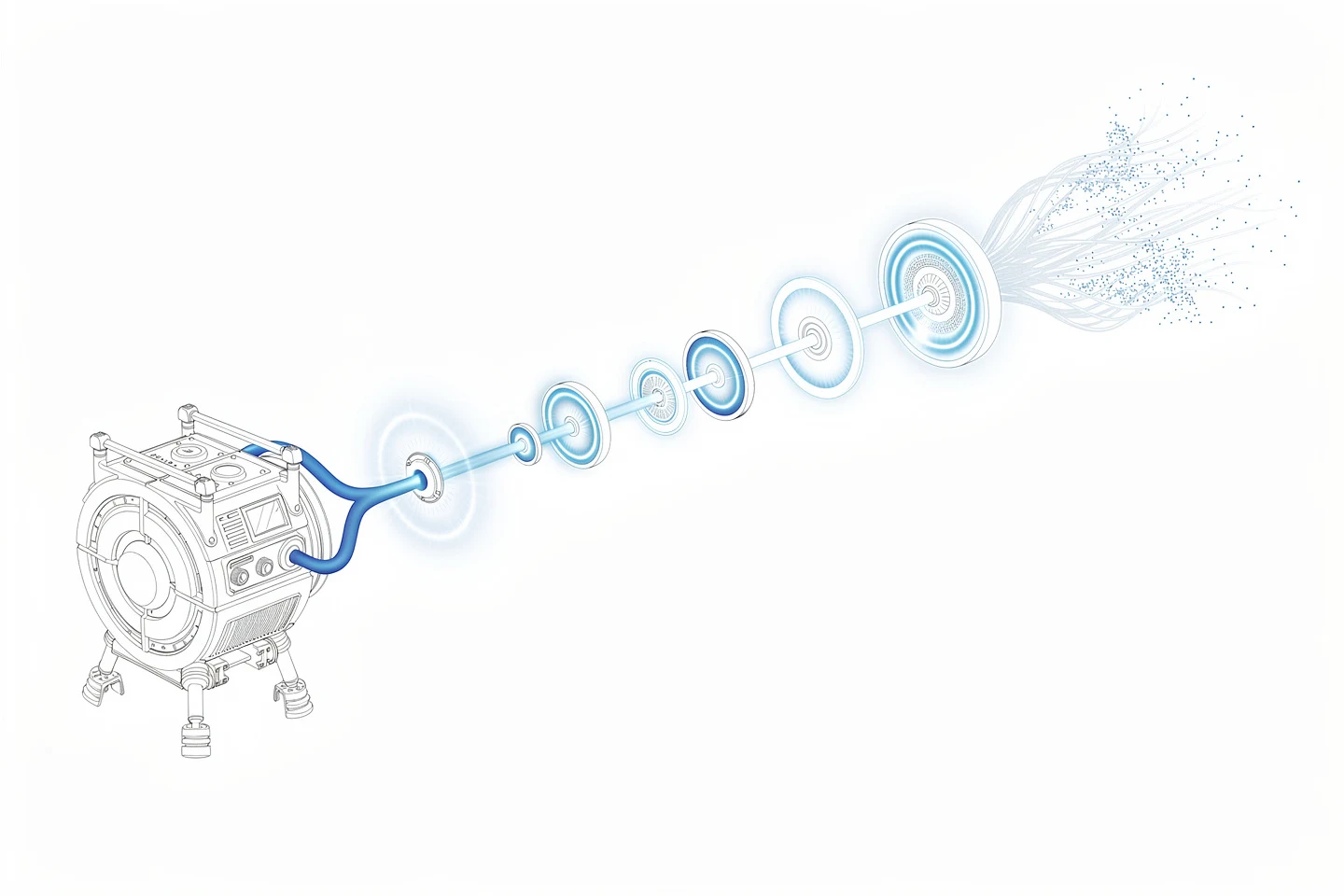
Imagine a soloist trying to blend their voice with a choir. If the choir sings in unison, the soloist's voice stands out for a long time; but if the choir scatters across a wide range — from deep basses to ringing sopranos — the soloist dissolves almost instantly. In quantum physics, the role of such a choir is played by a thermal bath — a massive environment. It absorbs information about the state of the observed system and threatens fragile quantum information. New research shows: to speed up quantum forgetting, you don't need to heat the system, but to control the bath's charge — its symmetry landscape.
Consider an isolated chain of fifteen spins. Three spins form the open system, twelve — the thermostat. The total spin along the z-axis is analogous to electric charge, and it is conserved. The main focus is the initial state of the bath. By varying its charge dispersion — the spread of filled sectors with different total spin — researchers control the width of the energy spectrum available for interaction. The wider the spectrum, the more densely packed the energy levels, the more rapidly entropy grows — in exact agreement with the iconic formula of Boltzmann S = k ln W. The dense palisade of states acts as a lubricant for dynamics, facilitating decoherence.
The measure of deviation from equilibrium is entanglement asymmetry — an elegant measurement tool, originating from the works of von Neumann. It captures how much the subsystem's density matrix breaks charge symmetry. Numerical simulations showed: with small charge dispersion in the bath, relaxation speeds up by thirty percent; with large dispersion, it slows down. Thus a 'time rheostat' is born — by simply choosing the initial charge symmetry, we set the pace of erasing quantum memory. Moreover, by simultaneously changing the initial superpositions of the system and the bath, one can turn on and off the quantum Mpemba effect itself. This is no longer just an observation, but genuine engineering of irreversibility.
The discovery links the microscopic structure of symmetries with the macroscopic arrow of time. In perspective — quantum processors, where qubit lifetimes are tuned not by passive shielding, but by an active symphony of charge profiles of the thermostat. For quantum informatics, this means the ability to program the rate of data loss. The next step is taking into account additional symmetries, possibly leading to a complete halt of thermalization in certain subspaces, akin to many-body localization. Quantum thermodynamics gains a tool for controlling flows of heat and information — and with it, a chance to rethink heat death not as doom, but as a score that can be conducted.
The classical Mpemba effect was noted as early as Aristotle, and rediscovered by Tanzanian schoolboy Erasto Mpemba in 1963 while making ice cream.
The ability to conduct the pace of thermalization echoes the concept of 'entropy slowdown' from Greg Egan's novel 'Permutation City'.