A mixed state in quantum mechanics is a statistical ensemble of pure quantum states, representing our incomplete knowledge about a system. Unlike a pure state, which is described by a single wavefunction and contains maximal information, a mixed state is described by a density matrix that encodes probabilities of being in various pure states. This arises naturally when a system is entangled with its environment, or when we prepare it with some classical uncertainty. Mixed states are the standard way to describe thermal equilibrium, where the system is in a Boltzmann-weighted mixture of energy eigenstates.
The density matrix ρ for a mixed state is a positive semi-definite operator with trace 1. Its eigenvalues are the probabilities of the system being in the corresponding eigenstates. The expectation value of any observable is given by the trace of ρ times the operator. Mixed states evolve under the same unitary dynamics as pure states when isolated, but in open systems they follow a master equation that can describe decoherence — the gradual loss of quantum coherence as information leaks to the environment. Entanglement between two subsystems is quantified by the entropy of the reduced density matrix of one subsystem, which is zero for pure states and positive for mixed states.
In practice
Mixed states are fundamental to quantum computing, where qubits inevitably interact with their environment and become mixed. They are also used in quantum cryptography to analyze security, and in condensed matter physics to describe systems at finite temperature.
Fun fact
The quantum Mpemba effect, where a hotter quantum system cools to equilibrium faster than a colder one, was recently observed in experiments and is described entirely in terms of the dynamics of mixed states.
A courtroom interpreter catches every word, every breath, every whisper in the corner. They have no right to miss a detail, because the meaning of the whole conversation depends on it. Quantum state tomography works in much the same way: it reconstructs the full quantum state of a system from a set of measurements, leaving no detail out.
In a glass of water, oil gathers into droplets: that's equilibrium separation dictated by chemistry. But there are systems where order arises not from rest but from a constant flow of energy.
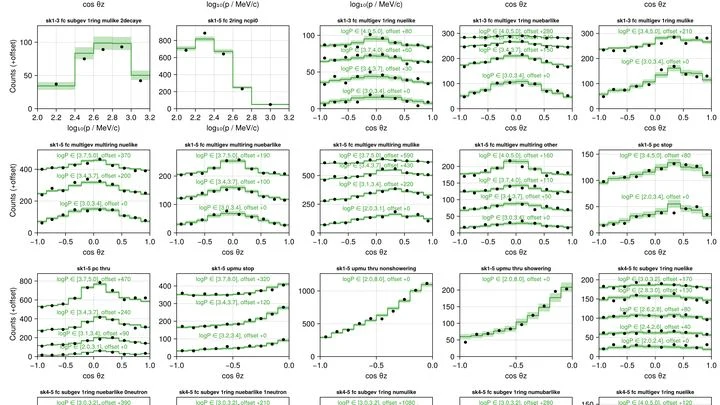
Neutrinos are often compared to a radio broadcast picked up by different receivers. One station sends a signal, but antennas in Japan, Antarctica, and at the bottom of the Mediterranean Sea hear it differently — due to distance, interference, and antenna orientation.
The quantum world is usually drawn with points, but real instruments only see blurry spots. Heisenberg and von Neumann long suspected: precision is unattainable.
A crystal is like a row of soldiers on a parade ground: every atom is in its place, and electrons march through it in neat waves. An amorphous material is like a crowd at a train station, where there is no order, just a jostling throng. In such a crowd, an electron usually gets stuck quickly, like a person trying to push through a dense mass of people.
An infinite chain of atoms spaced at equal intervals. Shift the entire chain by one step, and the picture doesn't change. That's translational symmetry: the world looks the same wherever you look. You'd think such a simple rule would give rise to simple states, like a crystal lattice assembled from identical building blocks.
But the authors counted those blocks anew.
Every isolated quantum system inevitably moves toward thermal equilibrium — a state where all details of the past are erased. It’s like an orchestra: instead of a symphony, it starts playing white noise — random but statistically predictable notes.
Inside a superconductor, a magnetic field typically twists into tubes, vortices, each carrying one quantum of magnetic flux. That's how the classic Abrikosov lattice works. But in LiFeAs crystals, the picture is different.
Muon spectroscopy showed that the field penetrates not as individual vortices but as stripes. Each stripe contains pairs of 'coreless' vortices.
Fireflies flash in a dark forest: you see each flash, but not the flight. A quantum gas microscope can show individual cold atoms, like those fireflies. But until now, it couldn't tell you how fast they're moving.
Now scientists have found a way to fix that.
The quantum world loves order, but reality often brings disorder. In this work, physicists study one-dimensional chains of spins — tiny magnetic arrows that can point up or down. Usually, topological phases (stable states protected by symmetry) are defined for pure states, where each arrow is precisely known.
Physicists have discovered exact laws by which quantum entanglement mixes in chaotic systems. In a model with rhythmic jolts — like a baker kneading dough — they studied the growth of entropy of entanglement, a measure of quantum disorder.
When you stir sugar into a glass, the water seems to move every which way. But inside a chemical reactor with an impeller, the liquid isn't just churning: it forms hidden "islands" that barely exchange their contents. Scientists found a way to see these islands by following the paths of tiny particles.
Hot tea normally takes longer to cool than warm tea, but water sometimes breaks this rule: back in the 1960s, schoolboy Erasto Mpemba noticed that hot ice cream freezes faster than cold. This paradox has moved into the quantum world: a collection of particles can settle down faster if it was initially more excited.
Matter is like a house. In some rooms, there is the strict order of a crystal, where every atom is in its place. In others, the chaos of superfluid helium, where atoms forget about their neighbors.
Imagine a soloist trying to blend their voice with a choir. If the choir sings in unison, the soloist's voice stands out for a long time; but if the choir scatters across a wide range — from deep basses to ringing sopranos — the soloist dissolves almost instantly. In quantum physics, the role of such a choir is played by a thermal bath — a massive environment.