Qubit noise reduction is the set of techniques used to protect quantum bits — the fundamental units of quantum information — from environmental interference. Unlike classical bits, which are robust to small disturbances, qubits are extremely delicate: any interaction with heat, electromagnetic radiation, or even stray vibrations can cause them to lose their quantum state, a process called decoherence. This is the central obstacle to building practical quantum computers, because noise accumulates rapidly and corrupts calculations before they finish.
History
The concept emerged in the mid-1990s with the work of Peter Shor and Andrew Steane, who independently developed quantum error correction codes. Physical isolation techniques have evolved alongside, with superconducting qubits first demonstrated in 1999 by Yasunobu Nakamura and Jaw-Shen Tsai.
How it works
The methods fall into two broad categories: physical isolation and error correction. Physical isolation involves engineering the qubit's environment — cooling it to millikelvin temperatures, shielding it from magnetic fields, or using materials like ultra-pure silicon or diamond with nitrogen-vacancy centers that naturally protect quantum states. Error correction, on the other hand, uses redundancy: multiple physical qubits encode a single logical qubit, and algorithms continuously detect and fix errors without measuring the quantum state directly. Recent advances also include algorithmic tricks, such as the iLQR technique mentioned in the titles, which optimizes control pulses to make qubits more precise.
In practice
Qubit noise reduction is essential for all quantum computing platforms — superconducting circuits, trapped ions, and photonic systems — and is the key factor determining whether quantum computers can outperform classical ones in chemistry simulations, optimization, and cryptography.
Fun fact
Some quantum computers are cooled to temperatures colder than deep space — around 15 millikelvin, just a fraction of a degree above absolute zero.
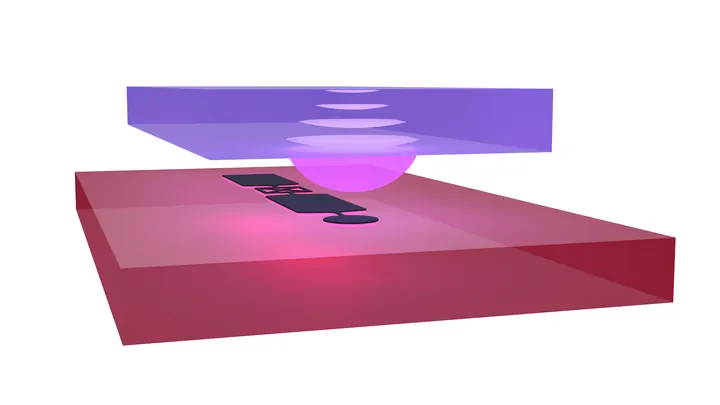
A tiny trap for single charges, a quantum dot, can hold a single hole. But the moment a charge at the material interface twitches, the hole in the trap starts to tremble. Engineers have found a way to calm this jittery charge by replacing a steep staircase with a gentle ramp.
An interpreter in a crowded room tries to make out one person's speech but hears the murmur of hundreds of voices. A molecule storing quantum information in its spin finds itself in a similar situation: its spin is surrounded by the thermal jitter of atoms, and it is this jitter that gradually erases memory.
In 1996, physicists asked: how much noise can a quantum channel withstand before it stops transmitting information? A phone call where every third word is replaced by random noise is still understandable. Up to what level of interference can the listener still grasp the meaning?
A quantum computer is like an orchestra where each musician, a qubit, plays their part but keeps hitting wrong notes. To keep the music from turning into cacophony, you need a conductor who instantly hears the off-key notes and corrects them.
A quantum computer is like an orchestra where each musician-qubit easily loses the rhythm. The slightest noise, and the melody of computation turns into cacophony. To keep the orchestra playing in harmony, you need a conductor who instantly spots wrong notes and corrects them without stopping the performance.
A quantum computer is like an orchestra where every musician must play their part without missing a beat. The musicians are qubits — carriers of quantum information. For the orchestra to sound harmonious, you need qubits that are reliable, controllable, and not too sensitive to noise.
Training a large neural network across hundreds of compute nodes is like making soup as a team: each 'chef' tastes the dish and tells the others what to adjust.
A quantum computer measures a molecule's energy much like an old tape measure that only has markings every meter. If the actual length of a table is 2.37 meters, the tape shows “two and a bit,” and you can't do better. Physicists call this resolution: the step of the grid, finer than which you cannot go.
The authors of the new work turn this flaw into an advantage.
A quantum memory node is a tiny diamond with a defect that can store and emit single photons. But its light has a wavelength of 637 nanometers, the same red as a ruby, and is almost completely absorbed after just a few meters of standard optical fiber.
A quantum computer is like an orchestra where each musician plays their part, but one wrong note can ruin the entire symphony. To prevent this, you need a listener who instantly catches the false note without interfering with the performance.
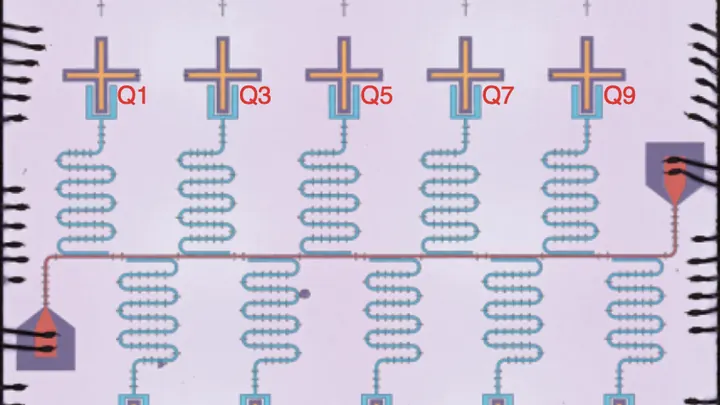
Qubits in a superconducting quantum computer are like tightly stretched strings. When a particle from space or from a radioactive decay flies by, it strikes these strings and they start to vibrate. This vibration disrupts the fragile quantum states, and computations go awry.
A qubit is like a string that must go still before a melody begins. If it vibrates, the music starts on a wrong note. In quantum computers, superconducting qubits play the role of that string. Before each calculation, they need to be calmed into their ground state — otherwise errors are inevitable.
A freshly polished niobium surface shines like a mirror. But within minutes, a dull oxide film, invisible to the eye, forms on it. For a superconducting qubit, this film is like sand in an hourglass: it causes the quantum state to decay prematurely.
Inside every cell, there's a network of thin tubes — microtubules. They act as both scaffolding and rails: they hold the cell's shape and transport cargo. These tubes are built from the protein tubulin and naturally glow faintly under ultraviolet light. Scientists wondered: can we make this glow stronger or weaker on demand?
The key to control is the amino acid tryptophan.
Two pendulums on a stable table swing independently. If you place them on a shaky surface, vibrations synchronize their motion. The same principle worked on a silicon chip with photons.
Scientists created two sources of light that emit pairs of particles.
Quantum annealing works like a smart way to find a path through a maze: instead of checking every dead end, it uses quantum effects to find the exit faster. But this maze has a quirk: the numbers that describe the walls and corridors must be roughly the same size.
Quantum computers promise to solve problems that are beyond the reach of ordinary computers. But their components, quantum bits, are very sensitive. One type of quantum bit is an oscillating circuit that can exist in two states, like a pendulum swinging left or right. These states store information.
A modern hospital sensor is like a sensitive microphone in a noisy hall. It picks up a weak signal from the heart or brain, but along with it comes the hum of machines, footsteps, the breathing of neighbors. Separating the desired sound from the interference is a science in itself.
You can launch sound in a crystal at a frequency so high that the human ear can't hear it, and make that sound run in circles, like a train on a loop track. Engineers took a thin film of silicon nitride, deposited it on a lithium niobate substrate, and carved waveguides for sound waves into it.
In quantum batteries, charging can be accelerated by shuffling the steps in time, like a deck of cards. Instead of a smooth energy climb, you get abrupt efficiency explosions, like microscopic supernovae inside atoms.
A quantum bit (qubit) is like a barely discernible whisper in a hum of voices. A regular amplifier makes the whisper louder, but along with it, the hum as well, making it harder to hear the essence. Physicists have created a clever device that generates two identical signal-whispers at different frequencies — the original and its echo.
Hot tea normally takes longer to cool than warm tea, but water sometimes breaks this rule: back in the 1960s, schoolboy Erasto Mpemba noticed that hot ice cream freezes faster than cold. This paradox has moved into the quantum world: a collection of particles can settle down faster if it was initially more excited.
A quantum computer is like an orchestra where every musician must come in exactly on the beat. The faintest rustle in the hall throws off the violinist, and the melody falls apart. In silicon chips, that rustle is electrical noise: random fluctuations of charge inside the material. They make quantum bits err.
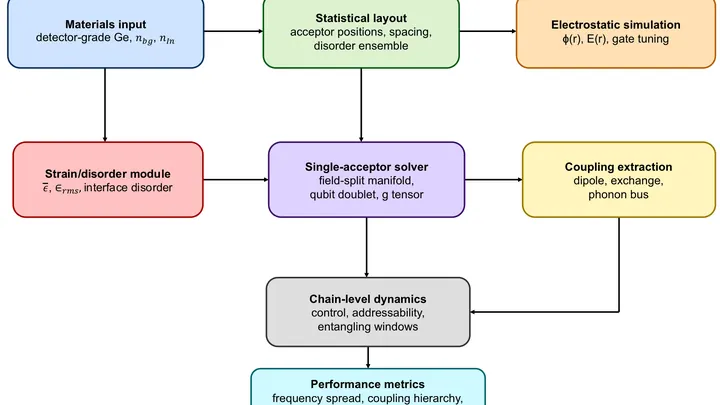
A quantum bit is like a spinning top that must keep spinning steadily for a long time. In germanium, researchers have learned to set such tops spinning, but the floor around them is always trembling: electrical noise knocks the spin off course.
Inside a proton, quarks are held together by gluons, like springs. Let go of one quark — the spring stretches and snaps, creating a new quark. That's the strong force at work, and simulating it in real time on a regular computer is nearly impossible: there are too many possibilities, all tangled together.
Enter the quantum computer.
The universe is expanding, and scientists want to know how fast and what it's made of. To do that, they compare data from distant stellar explosions, sound waves in the early universe, and the faint glow left over from the Big Bang. Each dataset is like a piece of a mosaic, and the goal is to assemble them into a full picture.
A bread recipe written in disappearing ink: while you read, the original fades. That's how qubits behave — any measurement changes them irrevocably. Copying them is forbidden by the 1982 theorem (Вуттерс, Зурек): a qubit contains энтропия — unknown information that can't simply be doubled.
A tossed coin is the simplest source of randomness. But if the coin is shaved, it starts cheating. In the quantum world, light plays the role of the coin: its properties are fundamentally unpredictable. The catch is that the device that “flips” the quantum coin might be faulty or even swapped by an adversary.
Optical fiber transmits light, but along the way it jitters and dims. To ensure that two parties at opposite ends of the line get the same set of random numbers for encryption, the receiver uses a digital corrector, like noise-canceling headphones that subtract the street hum but sometimes also eat the quiet notes of the music.
Quantum computers promise to describe molecules with perfect accuracy, but their main nemesis is noise. Every extra qubit and every extra operation add errors. Chemists and physicists have now devised a way to compute molecules with half the qubits: the HSQD method.
A quantum computer is a machine where qubits replace ordinary bits. A qubit can be not just a 0 or a 1, but both at the same time. One way to make a qubit is to take an electron and make it hover above the surface of liquid helium. The helium is cooled to below two degrees above absolute zero.
Inside the receiver of a telescope aimed at the oldest glow in the universe sits a tiny thermometer chip. It's so sensitive that the heat from a single photon can warm it noticeably. But to hear that whisper of heat, you need a middleman — an amplifier that doesn't add its own noise.
A quantum computer is like an orchestra where each musician plays their own part but sometimes hits a wrong note. To keep the music from turning into cacophony, you need a conductor who corrects mistakes in time. In quantum computing, the role of the conductor is played by error-correcting codes.
The number 551 looks harmless, but finding the two primes that multiply to give it is no easy task. A classical computer tries options one by one, like someone searching for a key on a keyring. A quantum processor works differently: it tries all possibilities at once, but you need a way to steer it toward the right answer.
When making popcorn, a microwave uses electricity only to heat the kernels. A gas stove heats the entire burner and the air around it. The same difference applies between a photonic quantum chip and a classical supercomputer when solving a problem devised by Scott Aaronson.
A quantum computer is like an orchestra, where each qubit is a musician and the control signals are the conductor. If the conductor waves the baton imprecisely, the musicians fall out of sync. In a real device, signals pass through power amplifiers, like loudspeakers that add noise and distortion.
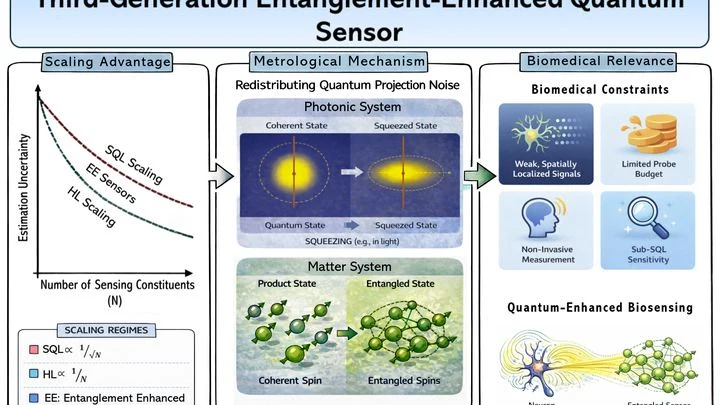
A quantum sensor is like a telegraph line transmitting a hypersensitive message. The slightest disturbance distorts the signal. It used to be thought that accurate measurement required an error-free 'telegraphist' — a perfect error-correction system. But in practice, all elements are noisy. The new approach allows for errors at every step: in sending, verification, and reception.
Detecting a faint signal against a noise background is like trying to hear a distant bell in a storm. Ordinary amplification only makes the din more deafening. Quantum error correction solves the problem in an unexpected way.
Dark matter is an invisible substance, five times more abundant in the universe than ordinary matter. Its particles barely touch atoms, but occasionally they can nudge an electron, like a string brushed by the wind.
Building ultrasensitive sensors for light measurements and spectroscopy starts with tiny chambers where light ricochets like an echo in a canyon. Previously, engineers chased the quality factor — the duration of this echo: the longer it rings, the more noticeable the slightest changes.