A Crushing Crowd: Why Models Fail in Dense Pressures ✛
Context
This work sits at the intersection of several fields: pedestrian modeling, biomechanics, and the analysis of collective phenomena. Nearby in the archive are studies on randomness in evolution, quantum systems, and neural networks—all dealing with complex systems, but this article stands out for its focus on physical interactions under extreme conditions. Unlike its neighbors, which consider abstract or microscopic mechanisms, here the focus is on the macroscopic consequences of bodily contact in a crowd. This places the work in a distinct niche: safety management for mass events.
Methods
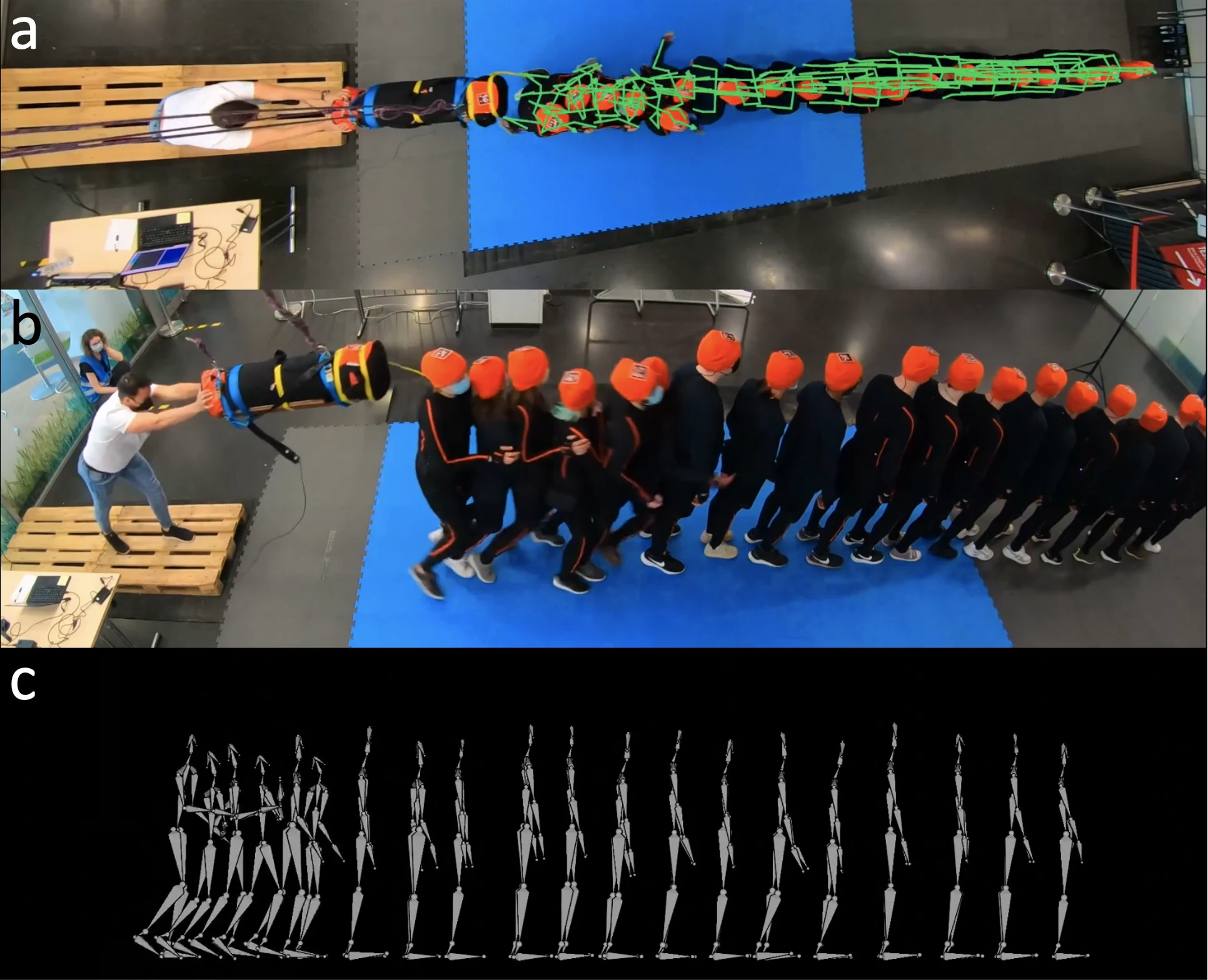
The authors conduct a systematic review of the literature on pedestrian modeling, from classical force-based and velocity-based models to macroscopic approaches using partial differential equations and mean-field theory. They then analyze experimental paradigms from biomechanics: laboratory studies of balance under external perturbations (e.g., using cables or moving platforms) and field observations of real crowds, including data from the San Fermín festival and the MADRAS project. Particular attention is given to new motion capture methods, such as IMU sensors, which allow recording body movements in real-world conditions.
Results
The review reveals a fundamental gap: existing models describe behavior well at densities up to 4–6 people per square meter, but at higher densities, where physical forces dominate, they fail. Classical representations of the body as circles or ellipses cannot reproduce phenomena such as balance recovery, wedging, and force propagation. Experiments show that people in dense crowds use complex strategies, including stepping and arm movements, which are not captured by simplified models. Field data record collective oscillations and chiral oscillations at densities above 4 people/m², indicating emergent phenomena that require new theoretical approaches.
Implications
The work emphasizes that adequate modeling of dense crowds requires a shift from two-dimensional disks to three-dimensional body representations that account for biomechanics. This distinguishes it from neighboring studies, which either remain at the level of abstract agents or focus on individual aspects without integration. The authors propose viewing body representation as a spectrum, from simple shapes to detailed humanoids, and call for a unified multiscale framework that bridges micro and macro levels. Such an approach could become the basis for predicting critical situations.
Future development
Future research should integrate data on physical contacts (force, location, temporal evolution) with balance models and psychological factors. The use of machine learning methods to analyze large movement datasets is promising, as is the development of computationally efficient three-dimensional simulations. The key challenge is to create models that smoothly transition from collision avoidance to physical contact without discontinuities.
Impact
The results will influence the design of safe public spaces, the management of mass events, and the development of early warning systems for crowd crushes.
Next steps
New experimental protocols are needed to measure contact forces in real crowds, and motion capture methods must be improved for the submicroscopic level.
Key open problems
In the field of physics and complex systems modeling, the question of how microscopic interactions give rise to macroscopic collective phenomena remains open. This work connects that problem to a concrete application: crowd safety, where the conditions for wedging and the limits of physiological tolerance to compression are unresolved.
The knowledge machine's view
This section is addressed to the author of the paper and their colleagues. Neighbouring works were found by meaning-based search across our archive, not by word overlap. We do not review: we show the field around the work.
What the work does
The authors reviewed the literature on pedestrian flow modeling, highlighting a gap between classical models and real behavior at densities above 4–6 people/m². They analyzed biomechanical experiments and field data, pointing to the need for a three-dimensional representation of the body and the inclusion of balance strategies.
Where its strength is
The paper clearly marks the shift from abstract agents to biomechanically realistic models, paving the way for integrating micro- and macro-levels to predict critical situations in crowds.
Where it could go next
- It might be interesting to compare the transition from two-dimensional disks to three-dimensional bodies with approaches from the work on a pedestrian looking one step ahead, which accounts for trajectory anticipation; this could add an element of individual motion planning in dense environments to the model.based on: A Pedestrian Who Looks One Step Ahead arXiv:2606.14818
- Closely related is research on how noise can be constructive in quantum systems; here one could draw an analogy with the role of random perturbations in a dense crowd: perhaps stochastic components help reproduce collective oscillations.based on: Quantum Bath: How Noise Does Work arXiv:2602.03764
- In the archive there is work on predicting failure in pumps using critical load modeling; a similar approach to assessing the stability limit of a body under crowd pressure could enrich the biomechanical part of the review.based on: Predicting Blood Damage in Pumps arXiv:2601.19994
Worth trying
- Test the introduction of random perturbations into existing force-based models to see if collective oscillations emerge at high density.
- Try adapting the method for assessing critical loads from engineering mechanics to calculate the threshold of balance loss in a crowd.
- Check how accounting for anticipation of the next step affects agent behavior in simulations with physical contact.
Why this may matter
Developing a multiscale model of dense crowds with a biomechanical core could provide a tool to prevent stampedes at mass events, where existing approaches fail at extreme densities.
Nearby works in our archive
- A Pedestrian Who Looks One Step Aheadsimilarity 0.56
- Plasma without a textbooksimilarity 0.55
- Why Neurons Can't Be Friends with Everyonesimilarity 0.55
- When being together is a choicesimilarity 0.55
- How to See Shape When Data Are Unevenly Sampledsimilarity 0.53
- How to Stop Molecular Motors from Spinning Their Wheelssimilarity 0.52
- Quantum Bath: How Noise Does Worksimilarity 0.52
- Predicting Blood Damage in Pumpssimilarity 0.52
The archive is sparse around this work: the closest review is only 0.56, against a usual 0.64. It looks like few have drilled nearby.
During the crowd crush at the Love Parade in Duisburg (2010), witnesses mentioned falls 32 times, and frequently complained about problems with legs and feet. Yet most dense crowds do not lead to incidents, making the prediction of critical situations particularly challenging.
Isaac Asimov's novel 'The Caves of Steel' describes giant cities with dense pedestrian traffic, where crowd management becomes a matter of life and death. Although there is no direct modeling of physical contacts, the problem of safety in ultra-dense environments resonates with the issues addressed in the article.
Key numbers
- density at which chiral oscillations occur: about 4 people/m²
- maximum local density at the Consistorial square: up to 9 people/m²
- number of fatal falls worldwide in 2019: 684,000
- accuracy of step initiation prediction using Time to Boundary: 80%
- number of trajectories in the MADRAS dataset: almost 7000