Fieldtheory is a mathematical framework in physics where the fundamental entities are not particles but fields—continuous quantities that permeate space and time. Particles are then understood as localized excitations (quanta) of these fields. For example, the electron is an excitation of the electron field, and the photon is an excitation of the electromagnetic field. This approach unifies quantum mechanics and special relativity, providing the foundation for the Standard Model of particle physics, which describes all known fundamental forces except gravity.
History
The modern formulation of quantum fieldtheory was developed in the late 1920s and 1930s by Paul Dirac, Werner Heisenberg, Wolfgang Pauli, and others, with major advances in the 1940s by Richard Feynman, Julian Schwinger, and Sin-Itiro Tomonaga, who introduced renormalization for quantum electrodynamics.
How it works
In fieldtheory, each type of particle is associated with a field that obeys equations of motion derived from a Lagrangian. The field can be quantized, meaning its excitations come in discrete packets. Interactions between particles arise from coupling terms in the Lagrangian, which allow energy and momentum to be exchanged between fields. Calculations often use perturbation theory, expanding in powers of the coupling constant, and are visualized with Feynman diagrams. The theory also predicts phenomena like particle creation and annihilation, vacuum fluctuations, and renormalization, which handles infinite quantities.
In practice
Fieldtheory is essential for designing particle accelerators and detectors, predicting the properties of materials in condensed matter physics (e.g., the Higgs mechanism), and modeling the early universe in cosmology.
Fun fact
The famous 'Higgs boson' discovered at CERN in 2012 is the quantum excitation of the Higgs field, which gives mass to other elementary particles through a process called spontaneous symmetry breaking.
In a pot of boiling soup, light fat droplets rise to the top, while heavy vegetable chunks sink to the bottom. Particles in the tenuous hot gas around the Sun and other stars behave much the same way — except instead of broth, there's a mixture of charged particles: electrons, protons, and alpha particles.
A superconductor pushes out a magnetic field like a sponge squeezing out water. This Meissner effect has been known for nearly a century, but it's usually calculated in a flat world — without gravity. In the strong field of a black hole or at enormous speeds, the picture changes.
Quantum field theory is the language physicists use to describe elementary particles and their interactions. The authors of the work decided to slightly "tweak" this language: they introduced deformations, that is, small changes to the rules of the game.
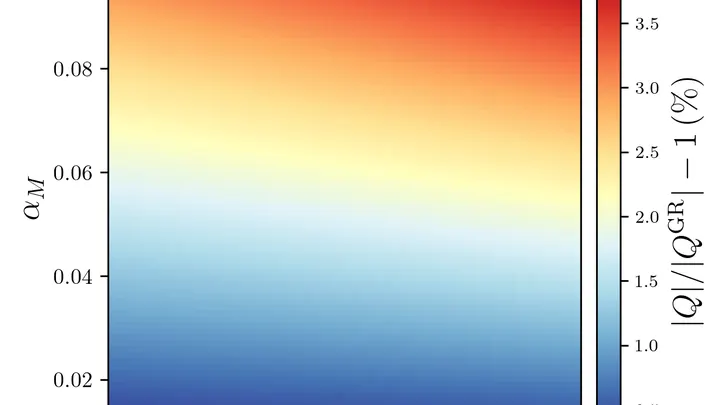
Electric charge is a slippery thing. You can measure how much there is in the entire universe or in a single particle, but try to point your finger and say, 'Right here, in this cubic centimeter, there is exactly this much charge right now,' and you hit a fundamental wall.
The issue is that total charge, which physicists denote by the letter Q, is nonlocal.
The space we live in appears three-dimensional. But when physicists try to reconcile gravity with quantum mechanics, familiar dimensions start behaving strangely. In a new study, scientists showed that to describe a massive particle while accounting for quantum gravitational effects, it is natural to add two more dimensions.
A quantum calculation sometimes resembles an interpreter who gets distracted by every rustle in the hall, and a one-hour meeting turns into two. In physics, such a "rustle" is called the sign problem: it arises when probabilities in formulas become negative or complex, and ordinary computer simulations start to fail.
A kitchen sponge soaked in syrup: in some spots there's more syrup, and your finger sticks right away; in others, it barely touches. That's roughly how a catalyst surface works. Molecules don't react everywhere but at especially sticky points — active sites.
Quantum noise, like the hiss of an untuned radio, filled the infant Universe. Alan Guth showed that superfast expansion (inflation) caused this ripple to freeze, giving rise to clumps of matter — the seeds of galaxies.
A new method extends this picture to any theory of gravity.
A fluffy ball of invisible web envelops a black hole. This web is dark matter, which doesn't shine but, through its weight, governs the motion of stars on the outskirts of galaxies. Astrophysicists have long seen such 'fluffy' clouds around cosmic objects and have mapped their profiles — how density falls from the center to the edge.
The universe is not a solid monolith, but a canvas of countless quantum threads. Spacetime doesn't flow like water, but vibrates like a tapestry in the wind. For a long time, physicists only saw the overall pattern, neglecting the tremor of individual threads.
The weak equivalence principle, silently tested since the time of Galileo and laid at the foundation of general relativity, states: all bodies fall equally, regardless of their internal composition.
A neural network trained on collisions of protons and electrons transferred its skills to a completely different experiment — catching neutrinos. Like a chef who learned French cuisine and then, without preparation, baked an excellent Uzbek plov.
The Social Laser theory describes society by borrowing the inner workings of a laser. People, like atoms in a crystal, absorb streams of information and become charged by it. When the number of those charged with a single idea outweighs the indifferent, even a weak signal (a post, a call to action) makes everyone act as one.
A tiny tungsten tip with a radius of less than a hundred nanometers is the perfect stage for watching a quantum performance. Apply an electric field of a few volts per nanometer, and electrons start flying out of the metal: that’s field emission.
At night, an astronomer points a telescope at the edge of the visible universe and sees not stars but ripples — the imprint of the first moments. He knows these ripples should obey statistics, like the heights of people in a crowd. But he has only one crowd, and nothing to compare it with.
This is cosmic variance.