A Crowd as a Granular Medium: Why Models Fail in Crush Situations ✛
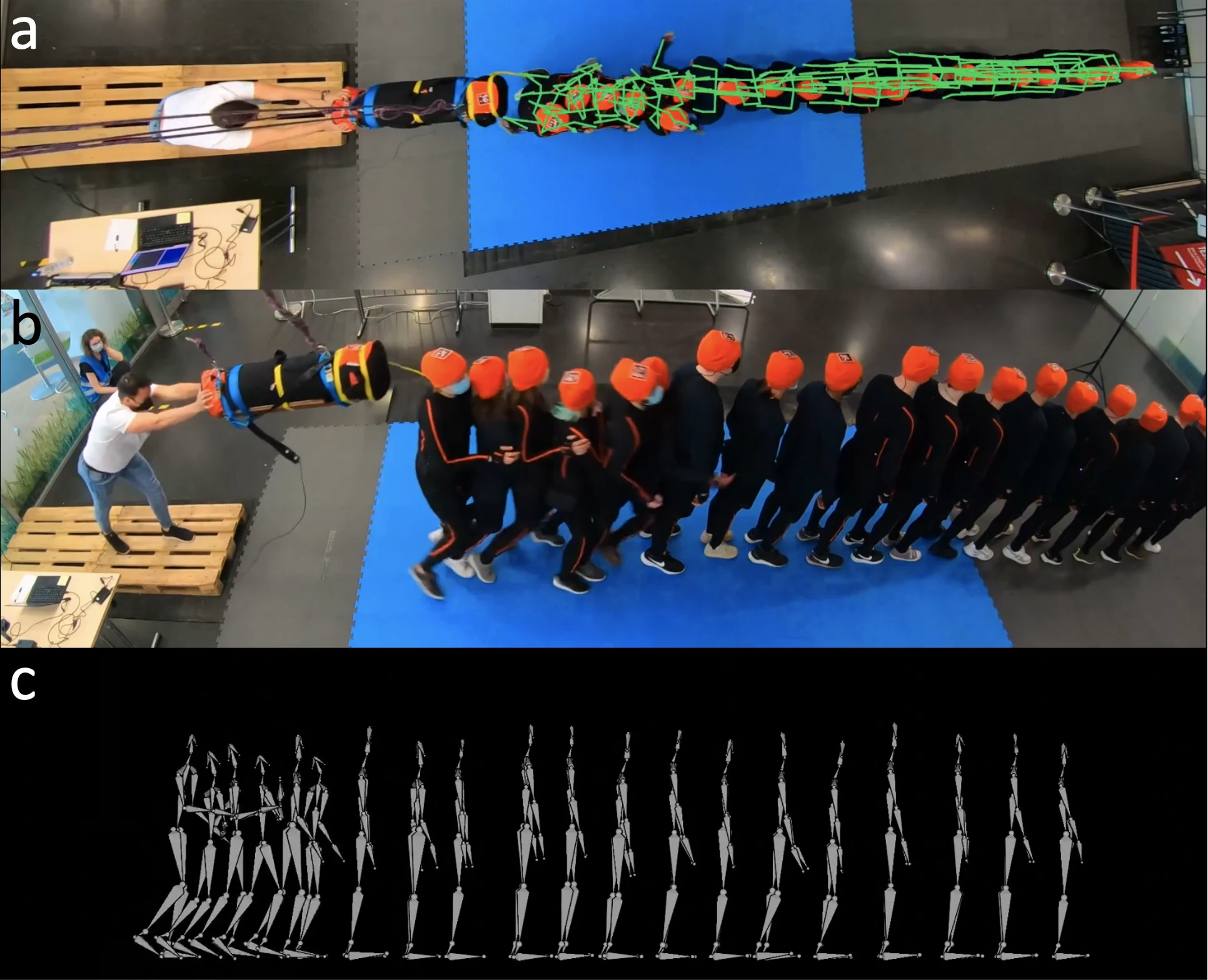
A density of four people per square meter is the threshold beyond which a crowd ceases to be a sum of individual pedestrians and becomes something else. In Pamplona's Plaza Consistorial during the San Fermín festival, local density reached nine people per square meter. In such tight quarters, bodies touch, forces transmit from one to another, and classical pedestrian models, which describe free movement or moderate crowds perfectly, begin to fail. This is not just a technical problem; it is a matter of life and death: in 2019, there were 684,000 fatal falls worldwide, and a significant portion of them occur in crowd crushes.
Classical models represent a pedestrian as a circle or ellipse moving on a two-dimensional plane. They work well as long as people avoid collisions by changing speed and direction. But when space disappears and physical contact begins, this abstraction stops reflecting reality. A person in a crush is not just a point with a velocity vector: they balance, take steps, and wave their arms to avoid falling. Biomechanical experiments show that people use complex balance recovery strategies that are not built into simplified models. For example, the accuracy of predicting step initiation using the Time to Boundary parameter reaches 80%. This means that the human body is not a passive object but an active system that responds to external forces.
Field observations confirm the gap between model and reality. At densities above four people per square meter, chiral oscillations emerge in the crowd: rotational vibrations without external control. People in such an environment form temporary wedge-like structures when bodies get stuck and movement stops. Classical models do not reproduce these phenomena because they ignore the three-dimensional nature of the body and biomechanics. Even advanced approaches based on partial differential equations or mean-field theory hit the same barrier: they describe averaged behavior but lose details critical for survival in a crush.
The review proposes a way forward: move from two-dimensional disks to three-dimensional biomechanical models. The authors introduce a conceptual spectrum of body representation, from simple shapes to detailed humanoids. A multiscale framework is needed, combining the micro level (individual reactions) and the macro level (collective phenomena). Such models should transition smoothly from collision avoidance to physical contact without discontinuities. This would allow predicting critical situations and designing safe public spaces. In the future, integration of data on forces, contact localization, and psychological factors, as well as the use of machine learning to analyze large movement datasets, will be essential.
A grain of sand in a granular medium obeys the laws of physics, but a person in a crowd is also subject to biomechanics and psychology. Models that account for this duality will help us understand not only how crushes arise but also how to prevent them. The question of how microscopic interactions give rise to macroscopic collective phenomena remains open in the physics of complex systems. This work links it to a concrete application: crowd safety. And if we learn to model dense crowds as accurately as we model sand in engineering calculations, we can save thousands of lives.
During the crowd crush at the Love Parade in Duisburg (2010), witnesses mentioned falls 32 times, and frequently complained about problems with legs and feet. Yet most dense crowds do not lead to incidents, making the prediction of critical situations particularly challenging.
Isaac Asimov's novel 'The Caves of Steel' describes giant cities with dense pedestrian traffic, where crowd management becomes a matter of life and death. Although there is no direct modeling of physical contacts, the problem of safety in ultra-dense environments resonates with the issues addressed in the article.