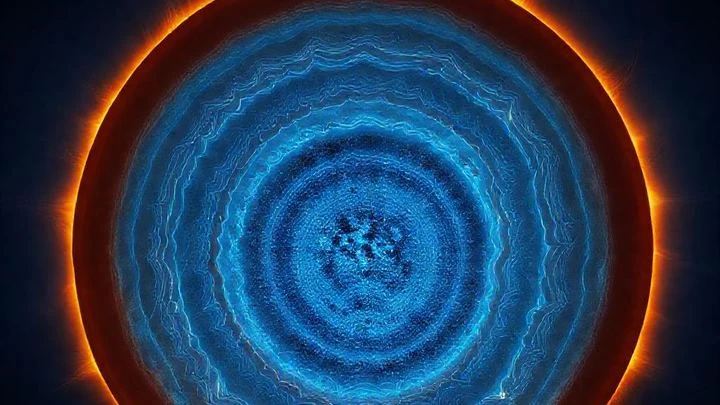
Coherence is the property of waves — whether light, sound, or matter waves — where their phases are locked in a predictable relationship. When waves are coherent, their peaks and troughs align in a way that allows them to interfere constructively, producing a stronger combined wave. Incoherent waves, by contrast, have random phase relationships and tend to cancel each other out, which is why a room full of candles is bright but not laser-like.
History
The concept of coherence was formalized in the early 19th century by Thomas Young, whose double-slit experiment demonstrated that light waves from a single source could interfere, proving their wave nature. The term 'coherence' itself was later refined by physicists like Albert Einstein and Roy Glauber in the context of quantum optics.
How it works
Coherence arises when waves are generated by a single source or by sources that are synchronized. For example, a laser produces coherent light because all photons are emitted in phase. In quantum systems, coherence can also refer to the ability of a particle to be in a superposition of states, where the phases of the different states are well-defined. When coherence is lost, the system decoheres, and quantum effects fade into classical behavior.
In practice
Coherence is essential in technologies like lasers, optical fiber communications, and quantum computing, where maintaining phase relationships between qubits is critical for error-free operations.
Fun fact
The coherence length of a typical laser can be several kilometers, meaning its waves stay in phase over that distance, while sunlight has a coherence length of only a few micrometers.
Three voices merging into a single chord. In the physics of quantum materials, this image takes on a literal meaning: three layers of graphene, separated by thin spacers, force electrons and holes from different layers to move as a single fluid.
A stone drops into a pond, and ripples spread across the water. In the same way, massive bodies generate gravitational waves, except it's space itself that ripples. So far, these waves have been caught by giant detectors that barely flinch as a wave passes through. But what happens on the microscopic scale, inside a tiny piece of matter?
In the microscopic world, noise, random fluctuations, usually destroys fragile quantum states, much like ripples on water break the reflection in a puddle. However, in some systems, collective, coordinated noise from many particles produces the opposite effect: a stable unidirectional flow emerges.
Graphene, a two-dimensional carbon crystal, has long tantalized physicists with the hope of high-temperature superconductivity. Its electrons obey the relativistic equation of Paul Dirac, racing at tremendous speed, barely noticing each other.
A black hole, like a spinning wheel, twists a cloud of light particles, axions, around itself. These particles are the leading candidates for dark matter. The cloud follows the laws of quantum mechanics, resembling a giant atom: there are levels, and there are transitions between them.
A translator records a multi-hour conversation. If they try to hold the entire dialogue in their head, they're bound to garble details by the end. That's roughly how gravitational observatories work: they listen to the 'conversation' of massive bodies spiraling together.
Light from an ordinary bulb seems utterly chaotic: its waves oscillate out of sync, like a crowd where everyone walks in their own direction. Such light is called incoherent. For a long time, it was believed that elegant topological structures (knots, rings, links) could only be created in coherent laser light, where all waves march in step.
The paradox of the young solar wind has long puzzled heliophysicists. Measurements showed that near the Sun, proton beams aren’t smeared out but sharply compressed, as if someone had neatly hammered them into the shape of a hammerhead.
Drop two pebbles into a pond at the same time — the ripples will spread evenly and in sync. The same happens in a quantum interferometer: a particle is split into two waves that travel along different paths and then meet. Ideally, their crests align.
In an ordinary crystal, atoms stand in neat rows like soldiers on a parade ground. Any deviation from this formation is usually considered harmful: disorder scatters waves and quickly dampens collective motions of particles.
A candle flame flickers in a draft but doesn't go out — the tongue of fire briefly changes shape and then returns. Optical skyrmions behave much the same way — tiny vortices in a light beam, reminiscent of swirling eddies. Until recently, they were created only in the perfect, smooth light of a laser.
A laser pointer shines a neat spot: all its light waves march in step, like soldiers on parade. Such light is called coherent. But nature and technology also feature another kind of light—'messy' light, where waves are out of sync, like a crowd at a market. It's called partially coherent.
The ocean is like a layered cake: warm, light water on top, cold, heavy water below. Between the layers, at the interface, invisible waves roam. They don't lift crests like a storm; instead, they slowly rock the entire water column, as if someone were shaking a giant aquarium from within.
The Sun’s gravity creates an invisible goblet, in which dark matter of a special kind — ultralight — doesn’t splash around chaotically, but occupies strict energy steps, like transparent layers of liquid. So around the Sun, a natural spectroscope emerges, sorting the invisible substance into levels, just like electrons in an atom.
Light strikes a metal plate, and electrons fly out. This is the photoelectric effect, and it works only if the light has enough energy to cross the threshold that holds electrons inside.