Noise That Helps: A Quantum 'Pendulum' on a Chip express
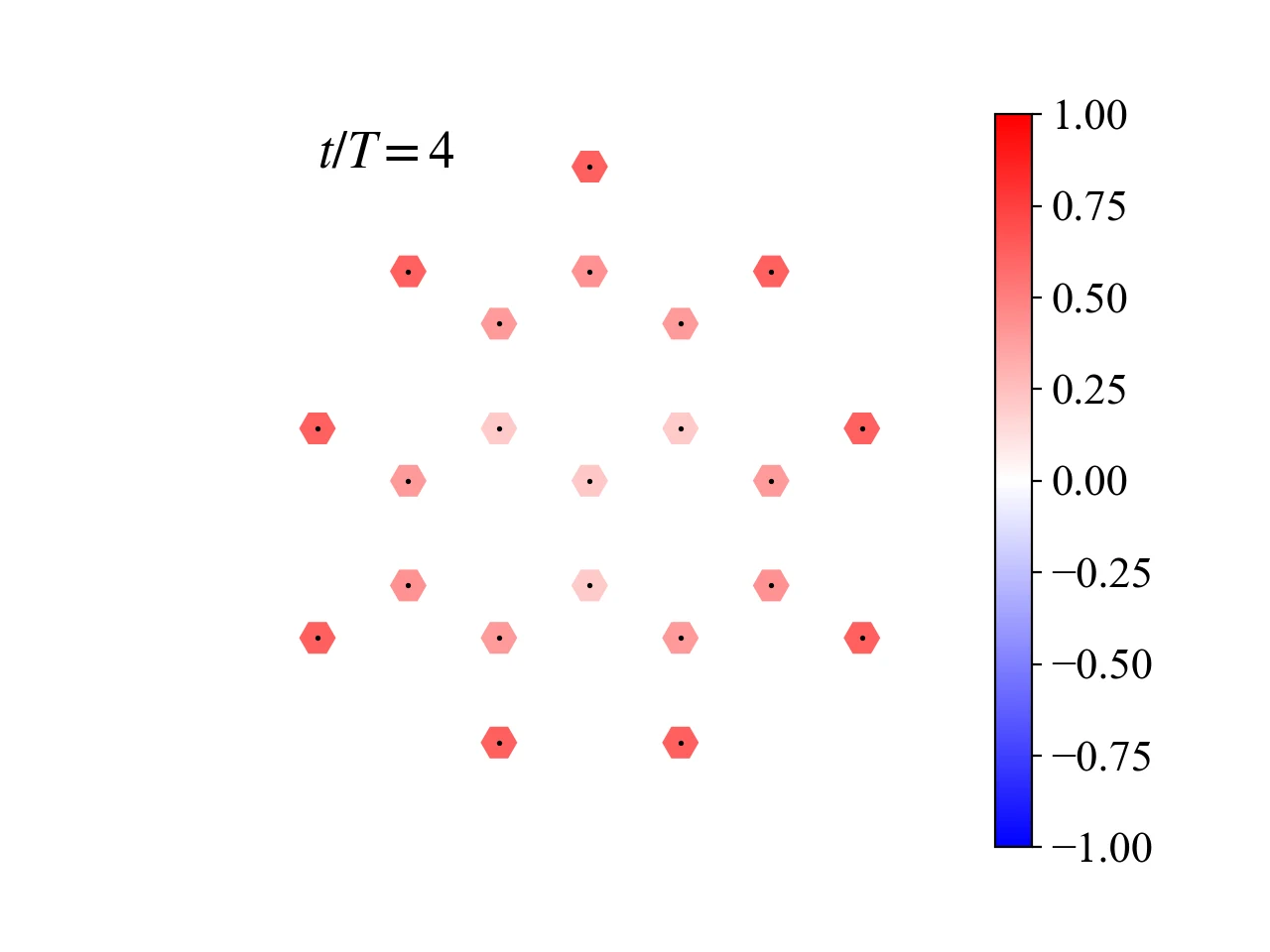
In the quantum world, noise usually destroys orderly behavior, like random jolts damping a pendulum. But on IBM quantum processors, physicists discovered the opposite: structured noise can prolong and even create rhythmic oscillations. It's like a pendulum that swings harder from seemingly chaotic yet internally synchronized pushes. This effect emerged while simulating a magnetic material on a kagome lattice — a pattern of interwoven triangles and hexagons borrowed from Japanese basket weaving. To fit this complex geometry onto a chip with fixed qubit connections, scientists added extra helper qubits. Their inevitable glitches introduce controlled disorder — random flips of magnetic interactions — preventing the system from freezing into chaos and maintaining a clear rhythm, akin to the signals of a pulsar, but born on a tabletop rather than in space. This time crystal 'ticks' at half the frequency of the external drive, without being a perpetual motion machine. Under certain conditions, the rhythm concentrated at the edges of the lattice. This principle turns errors from foes into allies, and cloud access to IBM processors opens up the experiments to many.
Original abstract
as written by the authors arXiv:2510.13577
Floquet many-body phases such as discrete time crystals (DTCs) are typically fragile to imperfections, and stabilizing them on noisy quantum hardware remains a central challenge in nonequilibrium quantum physics. Here, we use IBM Eagle and Heron superconducting processors to implement Floquet dynamics of a kicked Ising model on two-dimensional Kagome lattices, engineered via ancilla-assisted embeddings into the heavy-hex connectivity of the devices. By combining error-mitigated measurements on quantum hardware with matrix-product-state simulations incorporating an ancilla-noise model constructed from experimental device data, we observe long-lived subharmonic magnetization oscillations that are stabilized -- rather than destroyed -- by structured quantum noise. Across different two-dimensional lattice geometries, increasing cases beyond Kagome lattices, and with or without boundary symmetry-charge pumping, ancilla errors effectively act as spatiotemporal disorder that induces stochastic sign flips of the Ising couplings, providing a unified mechanism for robust period-doubling responses. When symmetry-charge pumping is present, intrinsic boundary-localized $$\pi$$ modes cooperate with this disorder to yield a boundary-assisted DTC characterized by suppressed scrambling and sharply localized dynamics. In contrast, in implementations without pumping, the noiseless dynamics rapidly thermalize and exhibit no subharmonic order, whereas the same noise process alone generates a DTC-like long-lived subharmonic response over experimentally accessible time windows. These results identify engineered ancilla noise as a practical control knob for inducing, stabilizing, and geometrically tailoring nonequilibrium dynamical order on scalable superconducting quantum processors.
The concept of time crystals was first proposed by physicist Frank Wilczek in 2012, and at first many thought it contradicted the laws of physics.
The idea of time crystals echoes sci-fi plots about time machines or perpetual motion machines, but in reality they need periodic energy input.