Noise That Helps: A Quantum 'Pendulum' on a Chip express
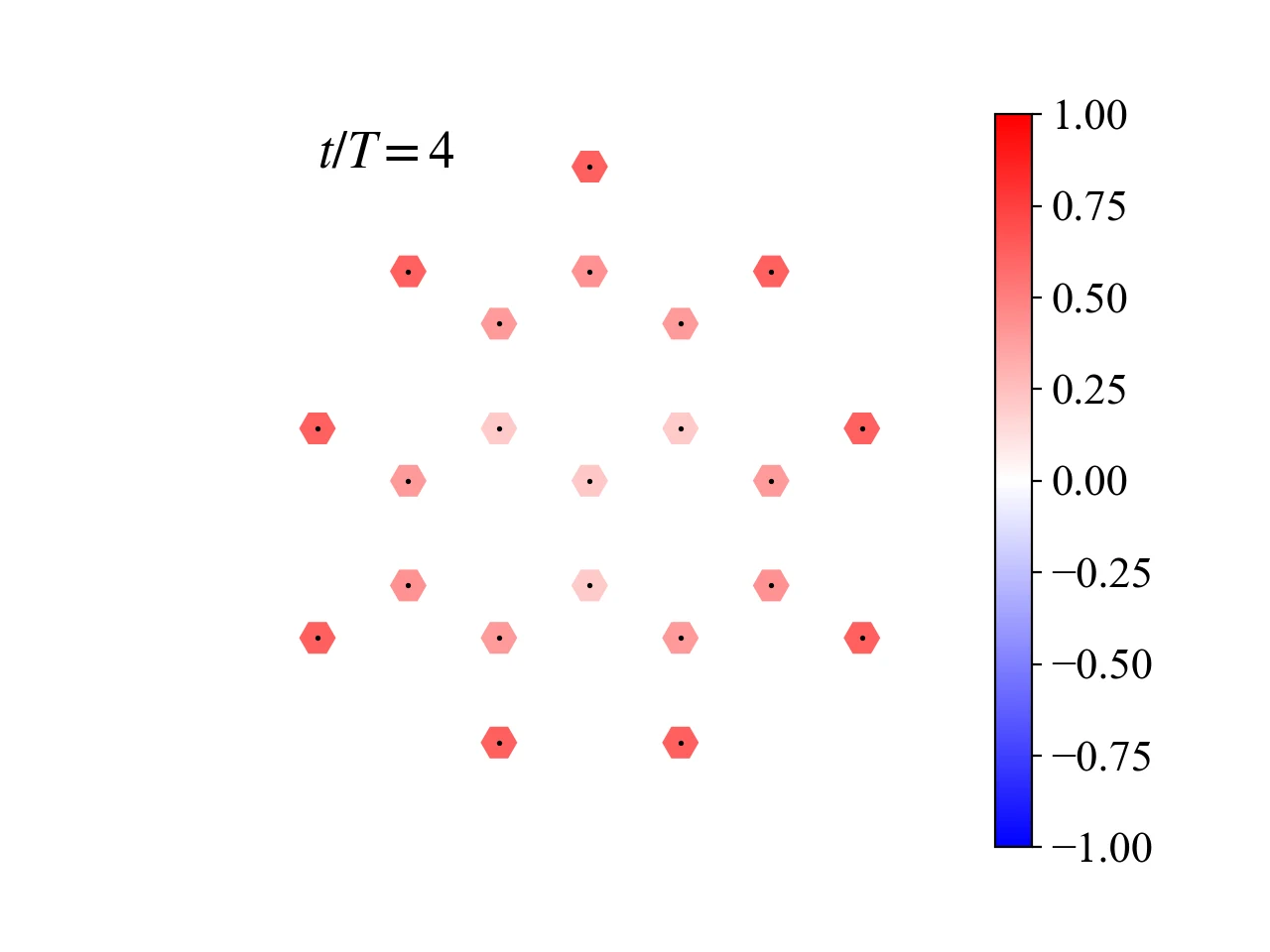
In the quantum world, noise usually destroys orderly behavior, like random jolts damping a pendulum. But on IBM quantum processors, physicists discovered the opposite: structured noise can prolong and even create rhythmic oscillations. It's like a pendulum that swings harder from seemingly chaotic yet internally synchronized pushes. This effect emerged while simulating a magnetic material on a kagome lattice — a pattern of interwoven triangles and hexagons borrowed from Japanese basket weaving. To fit this complex geometry onto a chip with fixed qubit connections, scientists added extra helper qubits. Their inevitable glitches introduce controlled disorder — random flips of magnetic interactions — preventing the system from freezing into chaos and maintaining a clear rhythm, akin to the signals of a pulsar, but born on a tabletop rather than in space. This time crystal 'ticks' at half the frequency of the external drive, without being a perpetual motion machine. Under certain conditions, the rhythm concentrated at the edges of the lattice. This principle turns errors from foes into allies, and cloud access to IBM processors opens up the experiments to many.
The concept of time crystals was first proposed by physicist Frank Wilczek in 2012, and at first many thought it contradicted the laws of physics.
The idea of time crystals echoes sci-fi plots about time machines or perpetual motion machines, but in reality they need periodic energy input.