Quantum Light Distinguishes Twin Molecules express
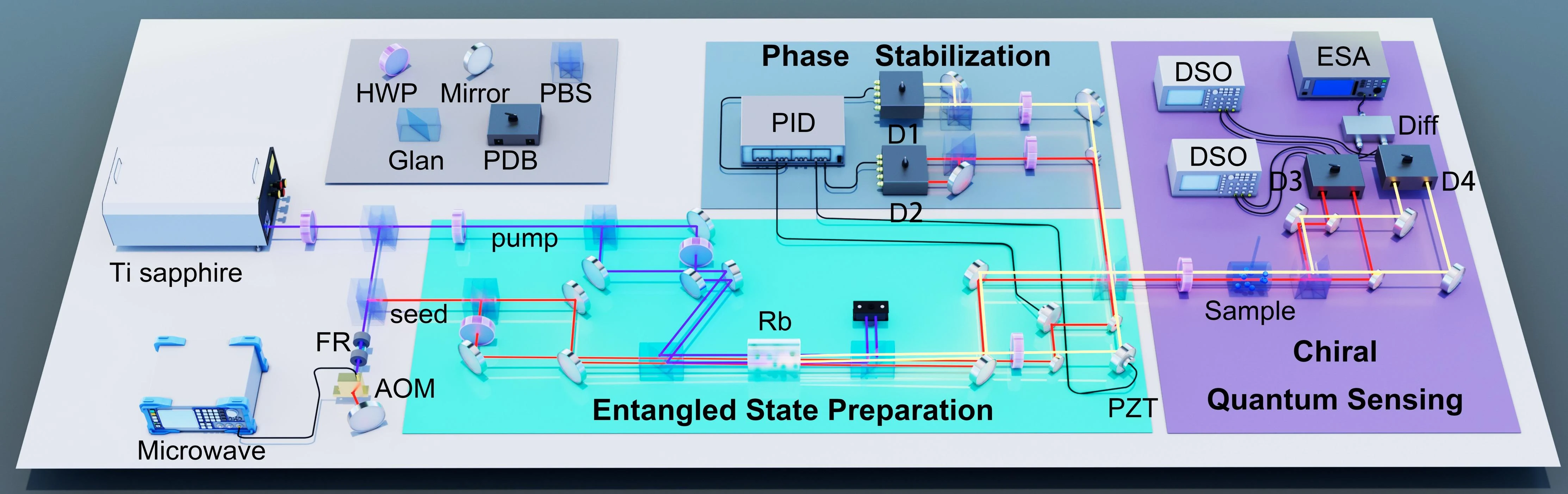
Many molecules, like amino acids, are like musical notes: their left and right versions sound almost identical, yet the difference is critical. One heals, the other is poison. Picking up this difference is hindered by inescapable noise, like in a room where a fan is loudly running. Regular spectroscopy misses the nuances.
Scientists applied a quantum trick: they squeezed the light so that the noise in one characteristic dropped sharply at the expense of others, like turning down the fan to hear a quiet ring. This method, called squeezed light, made it possible to distinguish left and right amino acids in ordinary water. Sensitivity increased by 5 decibels — akin to catching a whisper from twice the distance.
Now light measurements can check drug purity, detect diseases by molecular signatures, and even search for life on distant worlds, where the balance of mirror forms of carbon compounds will be key to the mystery.
Original abstract
as written by the authors arXiv:2511.03412
Chiral discrimination of enantiomeric biomolecules is vital in chemistry, biology, and medicine. Conventional methods, relying on circularly polarized light, face weak chiroptical signals and potential photodamage. Despite extensive efforts to improve sensitivity under low-photon exposure, classical chiral probes remain fundamentally bounded by the shot-noise limit due to quantum fluctuations. To beat these limitations, we demonstrate quantum-elevated chiral discrimination using continuous-variable polarization-entangled states as moderate-photon-flux, high-sensitivity, quantum-noise-squeezed chiral probes. We achieve a 5 dB improvement beyond the SNL in distinguishing L- and D-amino acids in liquid phase. This non-destructive, biocompatible protocol enables high-sensitivity chiral analysis, with broad implications for drug development, biochemical research, environmental monitoring, and asymmetric synthesis.
The smell of mint and caraway comes from the same molecule, but with different chirality.
In Lewis Carroll's 'Through the Looking-Glass,' the world is a reflection of ours. Chiral molecules are like messengers from that realm, and quantum light is a detector that tears off their masks.