Quantum correlated spectroscopy is a technique that uses pairs of entangled or otherwise quantum-correlated photons to probe molecules with sensitivity and resolution beyond what classical light can achieve. By exploiting the quantum statistics of light, it can extract information about molecular structure, chirality, or dynamics that would otherwise be masked by noise or classical limitations.
History
The concept emerged from quantum optics in the late 20th century, with foundational proposals in the 1990s and early 2000s, but experimental implementations have flourished only in the last decade with improved single-photon detectors and sources.
How it works
In a typical setup, a source produces pairs of correlated photons (e.g., via spontaneous parametric down-conversion). One photon interacts with the sample, while the other serves as a reference. Because the two photons share quantum correlations, measuring them in coincidence reveals interference patterns that encode the sample's properties. This allows, for instance, distinguishing left- and right-handed molecules (enantiomers) by their different response to the quantum state of light, or detecting weak signals buried in a bright background.
In practice
It is used in quantum-enhanced sensing for biomedical diagnostics, chiral molecule detection in pharmaceuticals, and in fundamental studies of light-matter interaction at the quantum level.
Fun fact
Quantum correlated spectroscopy can, in principle, detect a single molecule's chirality without destroying it, something classical circular dichroism struggles to do at low concentrations.
A single camera shot stores both a normal picture and a hidden map of how light rippled through the scene. Quantum entanglement makes this possible. Pairs of linked photons are generated: one visits the object, its twin takes a detour. Later, measuring the twin one way pulls out the brightness information.
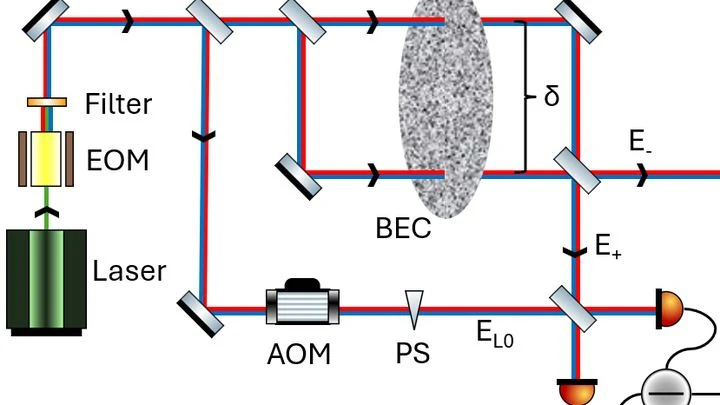
Physicists have proposed an experiment: a laser beam acts as a quantum detector and splits into two beam-ears. Each ear is directed through a tiny cloud of ultracold atoms — in this state, atoms merge into a single wave.
A flashlight beam aimed through frosted glass turns into a blurry spot with every extra millimeter of thickness. Scintillators, materials that convert X-rays into visible light, behave much the same way. They underpin medical imaging, baggage screening, and detectors at particle accelerators.
Entangled photons are like two couriers marching in lockstep: their quantum states, particularly polarization, are synchronized so that measuring one instantly determines the state of the other, even at a distance. In a material, this synchronization gets disrupted.
In a dark room, an atom and light are locked together in a mirrored box. The box is so small that the atom cannot simply release light: they constantly exchange energy, like two dancers who never let go of each other's hands.
Inside some materials, electric current flows with zero resistance. These are superconductors, and they only work when it's very cold. Copper oxides are special: they stay superconducting at somewhat higher temperatures, but why has been a puzzle for forty years.
A flashlight in thick fog is useless: the beam scatters, and the reflected light drowns in noise. But if you tie two photons with an invisible thread, one can pass through the fog and come back, while the other stays safe. This connection is called quantum entanglement — when two particles behave as a single whole, even when far apart.
Entangled photons are like twins: what affects one instantly affects the other, even if they are separated by kilometers. Until recently, observing such a connection required detectors that counted each photon individually in pitch darkness. Physicists simplified the task by swapping them out for a regular scientific camera.
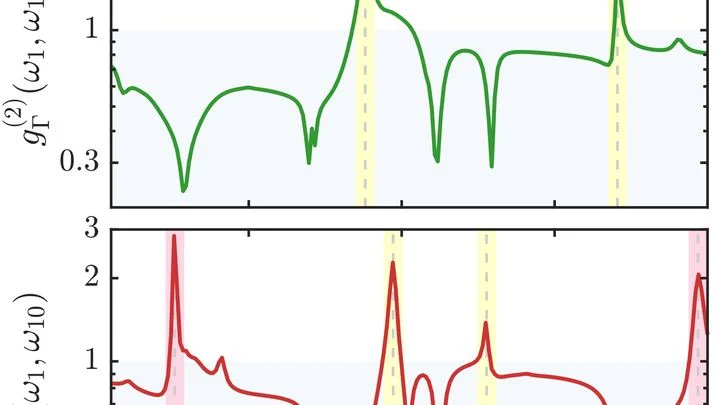
Many molecules, like amino acids, are like musical notes: their left and right versions sound almost identical, yet the difference is critical. One heals, the other is poison. Picking up this difference is hindered by inescapable noise, like in a room where a fan is loudly running. Regular spectroscopy misses the nuances.
Inside every living cell, chemical transformations are constantly taking place. Some of them create unstable particles whose electrons behave like paired magnets. Their interaction resembles a dance: each movement of the pair responds to external magnetic fields, as if to a changing rhythm.
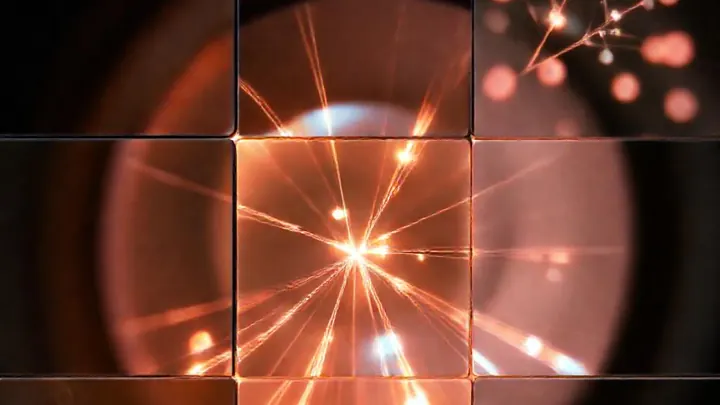
Light passing through a birefringent crystal changes its polarization depending on wavelength. This profile is like a mosaic assembled from rare flashes, where each shard hints at the shape of its neighbors.
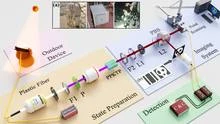
Sunlight collected by a Fresnel lens and passed through 20 meters of plastic fiber had a power of just 3 microwatts, a million times less than a typical laser pointer. That was enough to generate photon pairs correlated in position inside a nonlinear crystal. One photon from each pair passed through the object, the second was scanned by a detector, and coincidences built up the image.