The CLs method is a modified frequentist approach for setting upper limits in particle physics, particularly at colliders like the LHC. It addresses a subtle problem: when an experiment has little sensitivity to a hypothesized signal (e.g., because the expected background is huge), a naive frequentist limit might incorrectly exclude that signal even though the experiment cannot actually distinguish it from background. CLs prevents this by requiring that a model be excluded only if the data is both inconsistent with the signal-plus-background hypothesis and consistent with the background-only hypothesis. This makes the limits conservative but robust, ensuring that you never claim to have ruled out a model you had no power to test.
History
The CLs method was developed in the late 1990s by the LEP collaborations, particularly by Alexander Read and others, to handle the problem of setting limits in searches for the Higgs boson when the expected background was large. It has since become the standard for limit-setting at the Tevatron and LHC.
How it works
The method defines a test statistic, typically a likelihood ratio comparing the signal-plus-background hypothesis to the background-only hypothesis. You compute two p-values: p_sb, the probability of observing data as extreme as the actual data under the signal-plus-background hypothesis, and p_b, the same under the background-only hypothesis. The CLs value is defined as p_sb / (1 - p_b). A model is excluded at the 95% confidence level if CLs < 0.05. The division by (1 - p_b) ensures that if the experiment has no sensitivity (so p_b is close to 1), the CLs value stays large, preventing exclusion. This is a conservative correction that sacrifices some statistical power to avoid false exclusions.
In practice
Used extensively in high-energy physics to set upper limits on new particle production cross-sections, such as in searches for supersymmetry, extra dimensions, and the Higgs boson before its discovery.
Fun fact
The name 'CLs' stands for 'confidence level of the signal' — the 's' is for signal, and the method is sometimes jokingly called 'the conservative limit setter' because it is deliberately over-cautious.
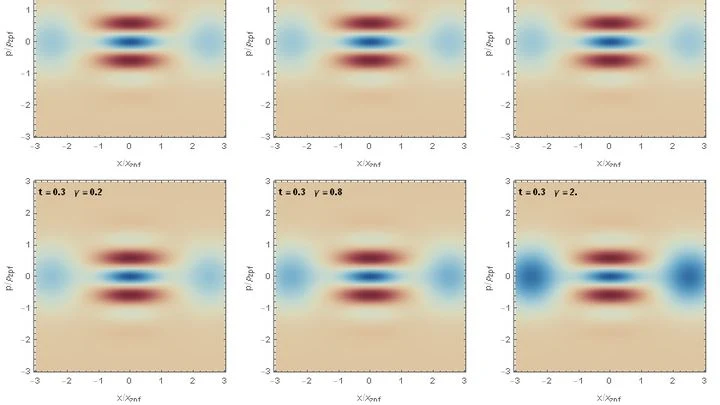
Light or sound can be confined in a tiny region of a crystal, like a pearl in a shell. Usually, two methods are used. The first is like a heavy ball in a pit: a particle with large mass simply cannot roll out. The second is a perfect cage of mirrors, where waves cancel each other everywhere except in the trap itself.
Two heavy balls orbit on the surface of a pond. Ripples spread from them: these are gravitational waves. As the balls spiral closer, the waves carry away energy, and the ripples become more frequent.
The Universe's expansion is accelerating, and maybe gravity doesn't work the way we think. Physicists come up with alternative theories, but to test them, they need to calculate how ripples after the Big Bang grew into galaxies. Such calculations involve long equations with hundreds of terms, where it's easy to get lost.
A detector that hunts for rare particles is like an ear trying to catch a whisper in a noisy room. The quieter the signal, the harder it is to tell apart from random noise. In the NUCLEUS experiment, such detectors, cryogenic calorimeters, are cooled to near absolute zero so they can pick up even a faint pulse of heat from a single particle.
Particle detectors such as resistive plate chambers (RPCs) work like sensitive traps: when a charged particle flies through, it generates an electrical signal. But sometimes the chamber fires a false hit, as if an invisible hand pressed a doorbell. These spurious signals muddy the picture and make it harder to pinpoint the particle's path.
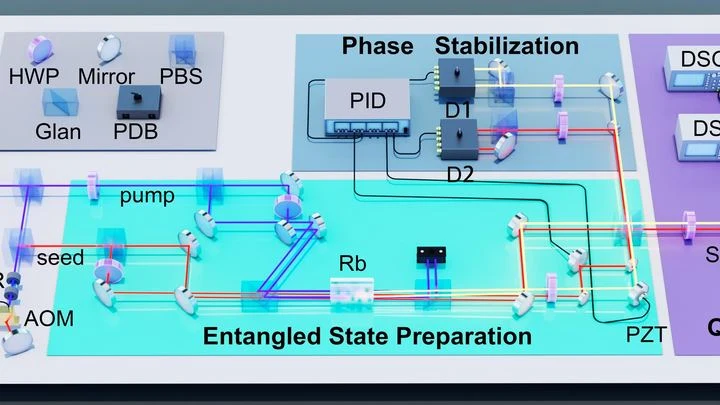
An ordinary free-electron laser is like a musical instrument with a single string: it can play only one note until you change its design. To get a different wavelength, you have to retune magnets or accelerate electrons harder. That's expensive and bulky.
Genetic diagnostics is like comparing two photos taken with different cameras. If one camera slightly shifts the colors, the image will show "defects" that don't exist in reality.
A quantum particle can be in two places at once, but large objects never are. Is it noise that creates chaos and increases entropy? Or does nature itself forbid quantum tricks in the macroworld?
One hypothesis suggests that quantum 'fuzziness' disappears on its own, and the heavier the object, the faster it goes.
Many molecules, like amino acids, are like musical notes: their left and right versions sound almost identical, yet the difference is critical. One heals, the other is poison. Picking up this difference is hindered by inescapable noise, like in a room where a fan is loudly running. Regular spectroscopy misses the nuances.
Ice clouds can masquerade as water clouds. A satellite lidar sends a short laser pulse downward and catches the reflection. If flat ice plates hang horizontally in the cloud, they act like tiny mirrors: light bounces back almost without loss. To the instrument, such a flash looks just like a reflection from water droplets.
Every winter, the Pacific Ocean warms slightly off the coast of Peru, and every summer it cools. This rhythm is set by the gears of the climate machine, but some turn fast, others slow, and still others speed up or stall. Linear inverse models have helped us glimpse these gears in data for decades, but they were blind to seasonal changes in pace.
Imagine a border river that separates two countries. On one bank live one group of people, on the other, another. The boundary between them is not always obvious: in some places the river is wide and calm, in others narrow and turbulent. But it is exactly where the current changes abruptly that the border becomes most noticeable.