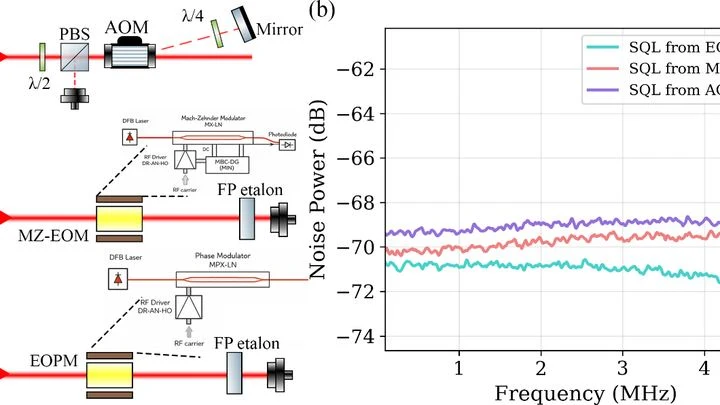
Squeezed light is a quantum state of the electromagnetic field in which the uncertainty (noise) in one quadrature — one of the two complementary components of the field's oscillation, such as amplitude or phase — is reduced below the standard quantum limit, at the cost of increased noise in the other quadrature. This is possible because of Heisenberg's uncertainty principle, which allows redistributing quantum fluctuations between complementary variables as long as their product remains above the minimum. Squeezed light matters because it enables measurements with precision beyond what classical light allows, making it a cornerstone of quantum-enhanced metrology and a key resource for quantum information technologies.
History
The concept of squeezed light was first proposed by Carlton Caves in 1981, who showed that injecting squeezed vacuum into the unused port of an interferometer could reduce the quantum noise floor. The first experimental generation of squeezed light was achieved in 1985 by Richard Slusher and colleagues at Bell Labs.
How it works
In a coherent laser beam, the quantum noise is equally distributed between amplitude and phase quadratures, setting the standard quantum limit. Squeezing is achieved by passing lightthrough a nonlinear optical medium, such as a specially designed crystal, where the interaction with the field creates correlations between photons. This process, called parametric down-conversion or four-wave mixing, effectively 'squeezes' the uncertainty ellipse of the field state: one quadrature becomes quieter (squeezed) while the orthogonal one becomes noisier (anti-squeezed). The squeezed quadrature can then be used as a low-noise probe for measuring tiny signals, such as phase shifts in interferometers, beating the classical shot-noise limit.
In practice
Squeezed light is used in gravitational wave detectors like LIGO and Virgo to enhance sensitivity, and in quantum key distribution and quantum imaging to improve signal-to-noise ratios beyond classical limits.
Fun fact
LIGO's gravitational wave detectors use squeezed light to reduce quantum noise, effectively making them sensitive enough to detect ripples in spacetime from collisions of black holes billions of light-years away.
Miners took canaries underground not for their songs. The bird would fall off its perch before the miner noticed carbon monoxide. In ultrahigh vacuum, the canary's role is played by a cloud of one hundred thousand lithium or rubidium atoms.
The quantum vacuum is not empty: it is permeated by entanglement linking distant regions. But when physicists tried to compute this entanglement, it turned out to be infinite. The culprit: particles with very low energy that can smear out over arbitrarily large volumes. They are like waves with no shores to contain them.
Light waves are never perfectly smooth — they are constantly jittered by quantum ripples. These almost invisible nudges were studied by Nobel laureate Roy Glauber, who laid the foundations of quantum optics. Now physicists have learned to freeze these ripples.
Light or sound can be confined in a tiny region of a crystal, like a pearl in a shell. Usually, two methods are used. The first is like a heavy ball in a pit: a particle with large mass simply cannot roll out. The second is a perfect cage of mirrors, where waves cancel each other everywhere except in the trap itself.
A laser isn't just about light. If you make a particle oscillate like a pendulum and those oscillations sustain themselves, you get a phonon laser. Sounds complicated, but the idea is simple: instead of light waves, the device emits orderly waves of mechanical vibrations — phonons.
Even at absolute rest, atoms emit a faint noise — unavoidable quantum jitter. In the debates between Einstein and Bohr, this noise, like an unceasing whisper, blurs the interference fringes from an atomic slit. Overcoming this limit was considered impossible.
A levitating dust grain in an optical trap is an ideal pendulum for measuring gravity. It hangs in vacuum, never touching the walls, and its motion depends only on external forces. The new work proposes an improved sensor: a mechanical 'squeezed' qubit based on a nonlinear oscillator.
Light loves symmetry: in an open channel, it flows equally both ways. To steer it one way, physicists often use magnets. A new approach does without, using rotation — just the speed of a vinyl record — and interference from two atoms. Rotation changes the “pitch” of light for different directions, just as a siren’s tone shifts when a car approaches or recedes.
A flat crystal of charged atoms suspended in an electromagnetic trap behaves like a perfectly calm pond. The slightest breeze, and ripples spread across its surface. This 'pond' catches the splashes from dark matter particles and the ripples of spacetime — high-frequency gravitational waves.
In a dark room, an invisible lamp flashes. Its light is unlike anything familiar: it has no steady brightness, only rare but powerful bursts. This is bright squeezed vacuum — a state of light with no ordinary wave but strong quantum fluctuations. It is with such light that physicists bombarded xenon atoms.
The laser based on diamond converts almost half of the pump energy into bright yellow light — an efficiency of 47.7%, a record for such devices. But the main advantage is not the power, but the exceptional purity of the color: the beam is so monochromatic that it can be compared to a musical instrument playing just one note without the slightest wavering.
The quantum world loves order, but reality often brings disorder. In this work, physicists study one-dimensional chains of spins — tiny magnetic arrows that can point up or down. Usually, topological phases (stable states protected by symmetry) are defined for pure states, where each arrow is precisely known.
A flat magnet is like a thin sheet with waves of magnetization running across it. Under normal conditions, these waves quickly die out, but when a strong magnetic field is switched on, an unexpected signal appears in the material — sharp and narrow, like a shadow cast by the main wave.
Physicists have discovered exact laws by which quantum entanglement mixes in chaotic systems. In a model with rhythmic jolts — like a baker kneading dough — they studied the growth of entropy of entanglement, a measure of quantum disorder.
A laser beam is like a taut string: even in complete silence, it trembles almost imperceptibly. This trembling is quantum noise, and it gets in the way of ultra-precise measurements. Physicists have long sought ways to calm the string, and one of them is "squeezing" light: reducing the trembling in one direction while allowing it to increase in another.
There is always noise in the microworld. Even in absolute emptiness, something trembles, and these quantum fluctuations interfere with precise measurements. But noise can be "squeezed," like a balloon: if you squeeze it from the sides, one part gets thinner while the other bulges.
A quantum dot the size of a few thousand atoms blinks like a faulty light bulb. It flashes brightly, then almost goes dark. Previously, it was thought that in dark moments it emits not only single photons but also extra pairs — a defect for quantum communication.
Light in a microscope doesn't arrive as a steady stream but like buckshot from a bag: sometimes more photons, sometimes fewer. This random scatter is the shot noise. It sets a limit: faint signals from tiny objects get lost in the ripple.
Scientists have found a way to calm this buckshot.
The light from a single molecule is like a lone voice in a vast choir. To hear it, you need not a microphone but a delicate instrument that catches each photon and notes its arrival time.
Ordinary light is a stream of photons flying every which way: sometimes more, sometimes fewer, and in that chaos, measurement precision gets lost. Physicists have learned to "tame" this stream by creating squeezed light — where the noise in one characteristic drops below the vacuum level.
A quantum sensor is like a telegraph line transmitting a hypersensitive message. The slightest disturbance distorts the signal. It used to be thought that accurate measurement required an error-free 'telegraphist' — a perfect error-correction system. But in practice, all elements are noisy. The new approach allows for errors at every step: in sending, verification, and reception.
The calm вода of a lake: the slightest ripple blurs the depth. In quantum sensors, noise — random jitters — generates энтропию (disorder) and kills precision. Physicists found a solution: scramble the order of events.
Dark matter makes up 85% of the matter in the Universe, yet remains invisible. It only reveals itself through gravity. We can catch it by its cosmic 'hum' — a faint vibration that permeates space. A single detector is powerless here: the signal is too quiet.
Physicists turn many sensors into a quantum ensemble.
The Wigner function is a kind of topographic map of probabilities: hills correspond to regions where a particle is most likely to be found, and valleys to where its appearance is practically ruled out.