A Scale-Free Fusion Boiler: The Secret's in the Walls express
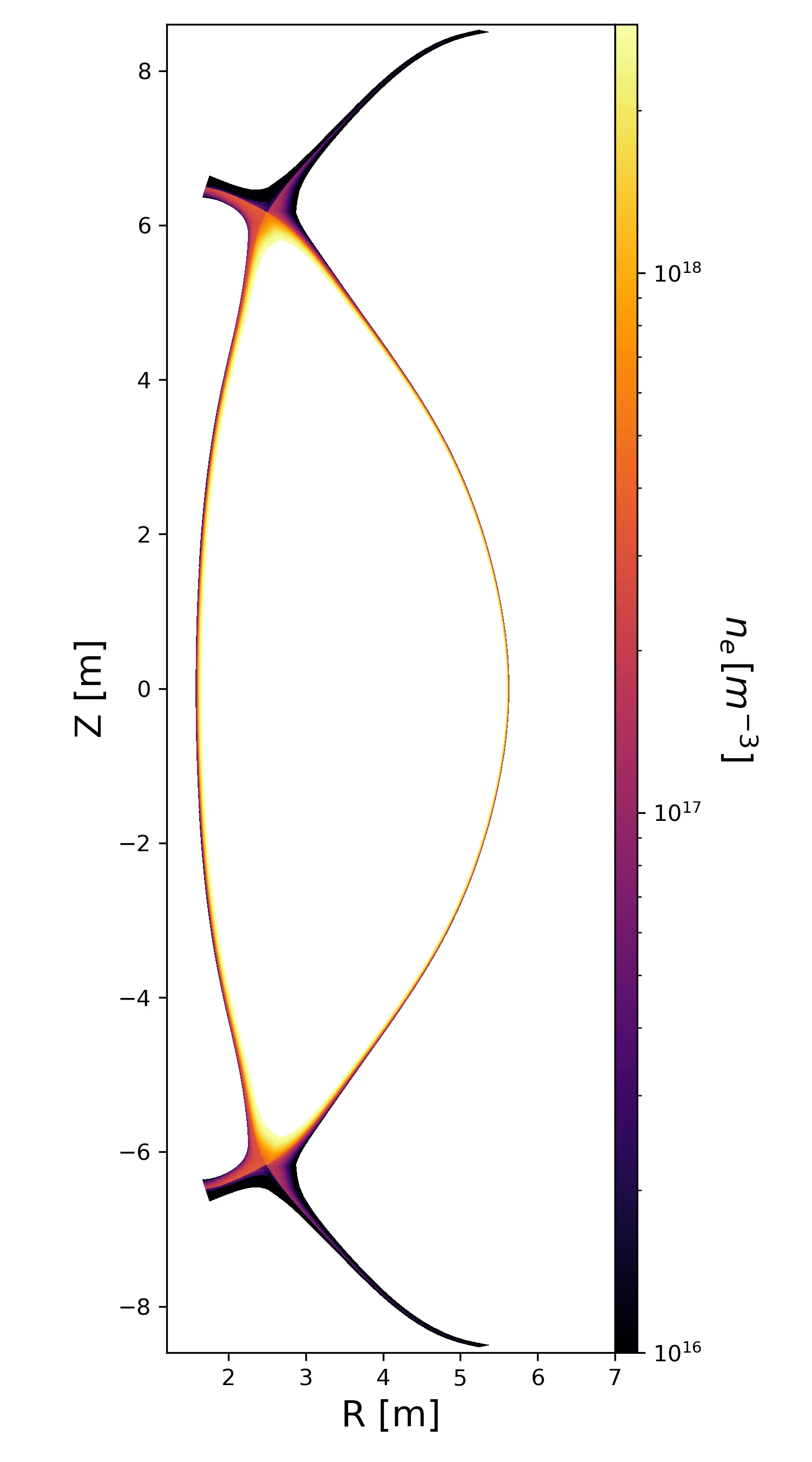
A fusion reactor resembles a giant boiler where hydrogen is 'cooked' into helium. The plasma inside is heated to 150 million degrees — ten times hotter than the Sun's core. But like any boiler, scale forms: harmful impurities that settle on the walls and quench the plasma.
Physicists have proposed making the walls from a sponge-like material that absorbs impurities and prevents them from returning to the fuel. This preserves the heat but creates severe overheating. Computer simulations have shown that if you track each particle's motion individually rather than as a continuous flow, the heavy impurities get trapped in a corner — the divertor chamber. Meanwhile, the heat spreads evenly, saving the walls from melting.
Even if the main 'pot' returns particles, absorbing panels on other walls can shift the reactor into a clean-burning mode. This brings reliable fusion power plants closer.
Original abstract
as written by the authors arXiv:2511.09437
Low-recycling regimes are appealing because they entail a high edge temperature and low edge density which are good for core confinement. However, due to considerably enhanced heat flux, the exhaust problems become severe. In addition, in the low-recycling regime, the conventional fluid simulations may not capture the physics of the Scrape-Off Layer (SOL) plasma that lies in the long mean free path regime; kinetic calculations become necessary. In this paper, by performing both Kinetic and fluid simulations, we explore the feasibility of a low-recycling regime in the magnetic geometry of the Spherical Tokamak for Energy Production (STEP); kinetic effects come out to be crucial determinants of the SOL dynamics. The simulation results indicate that a high SOL temperature and low SOL density could be achieved even when the divertor target is not made of a low recycling material. This can be done by using a low recycling material as a wall material. This is an important step towards demonstrating the feasibility of a low-recycling scenario. Lithium, a commonly used low recycling material, tends to evaporate at high heat fluxes which counteracts the desired high temperature, low density regime, and materials that can handle high heat fluxes are generally high recycling. Comparisons of gyrokinetic and fluid simulation results indicate that one can take advantage of kinetic effects to address some of the issues associated with a low-recycling SOL. Specifically, kinetic simulations show better confinement of impurities to the divertor region and greater broadening of the heat flux width due to drifts when compared with fluid simulations. Impurity confinement would help prevent core contamination from sputtering, and a broader heat flux width would help reduce the peak heat load at the target in the absence of detachment.
A single glass of water contains enough fusion energy to power a home with heat and electricity for an entire year.
In the movie 'Spider-Man 2,' Doctor Octavius launches an artificial sun — a fusion reactor that spirals out of control. The plasma containment problem that scientists are tackling today becomes a catastrophe there.