Kinetic simulation is a computational technique used to model the behavior of plasmas by tracking the motion and interactions of individual particles, such as electrons and ions. Unlike fluid models that treat plasma as a continuous medium, kinetic simulations resolve the full velocity distribution of particles, capturing phenomena like wave-particle interactions, Landau damping, and the formation of non-thermal tails. This approach is essential for understanding the complex, often nonlinear dynamics that occur in both laboratory and astrophysical plasmas.
History
The PIC method was developed in the 1950s and 1960s, with key contributions from Buneman, Dawson, and others, as computing power made it feasible to simulate many particles.
How it works
The simulation typically uses the Particle-in-Cell (PIC) method, where the plasma is represented by a large number of macroparticles, each representing many real particles. The electromagnetic fields are computed on a grid, and the particles are advanced in time using the Lorentz force law. The fields are then updated from the particle positions and velocities via Maxwell's equations, and the process repeats. This self-consistent loop allows the simulation to capture collective effects and kinetic instabilities.
In practice
Kinetic simulations are used to design fusion reactors, understand space weather, and develop plasma-based propulsion systems.
Fun fact
A single kinetic simulation of a small plasma volume can require billions of particles and days of supercomputer time.
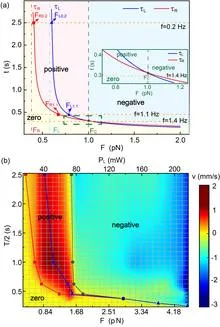
A swing that rocks on a sawtooth hill behaves strangely: without kicks, it gets stuck in the first dip, but with rhythmic pushes it can move uphill, downhill, or stay frozen in place. That is exactly what physicists saw when they placed a single dust grain in a trap with a sawtooth bottom and started pushing it alternately with laser beams.
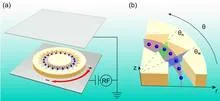
In a ring-shaped channel between two toothed rings, microspheres are suspended: some with a radius of 8 micrometers, others 14. The discharge is switched on, and the particles start moving. The small ones go one way, the large ones the other. It is like a shopping mall where escalators for people of different heights run in opposite directions.
A navigator with a paper chart plots the route before setting sail. If the ocean changes—the current shifts, the wind picks up—the chart stays the same. The ship follows an outdated path, and the crew has to correct the course by hand.
If you push water in a narrow channel too fast, a steep wave forms and breaks into foam. In the world of ultracold atoms, cooled to near absolute zero, quantum laws prevent such a wave from breaking. Physicists took a cloud of rubidium atoms stretched into a thin thread and sharply compressed it from one end with a movable wall of light.
A magnetic mirror is a tube open at both ends. The magnetic field inside is arranged so that hot plasma doesn't leak out: at the ends, the field lines bunch up like a cork in a bottle. Plasma particles flying toward the exit are repelled by these "corks" and bounce back. But some still escape: that's the classic "loss cone" argument.
Inside every cell, logistics is in full swing: tiny protein motors, like couriers, haul cargo along a network of microtubules. One of the main workhorses is kinesin, which steps using the energy of ATP (the cell's main energy currency). For a long time, researchers tried to evaluate it like a car: how much fuel it burns, how fast it gets there.
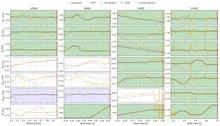
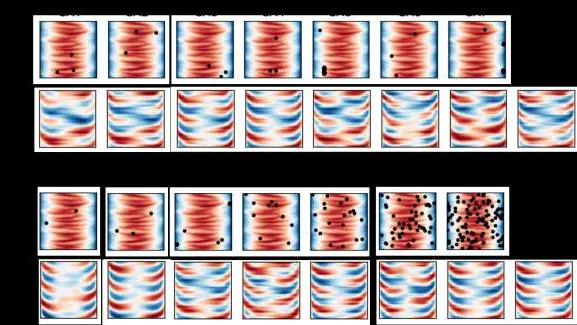
Inside a fusion reactor, plasma rages — a gas heated to millions of degrees. There are no direct windows, and cameras and sensors quickly fail. Engineers see only fragments of information: a few sensors at scattered points. It's like trying to grasp a symphony from the sound of three microphones in a vast hall.
In the vast clouds of rarefied gas that fill the space between stars, something is always churning. Supernova explosions, colliding streams — all of it shakes the plasma. And in this rippling, as it turns out, hides the mechanism that gives birth to magnetic fields.
Plasma is a gas in which electrons are stripped from atoms.
In the intricate dance of active turbulence, where invisible engines spawn chaos, a soft droplet takes on the role of a detective. Its shape is not merely an outline but a sensitive cipher: it reads the hidden signals of its environment.
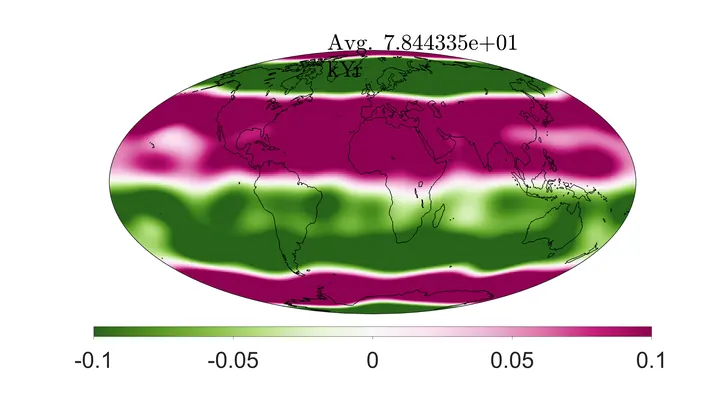
Earth's magnetic field is like an invisible shield that protects us from cosmic radiation. But if you look closely at its long-term averaged pattern, you'll notice that this shield isn't perfectly smooth: it has its own "seams" and "patches." New research using computer simulations of the geodynamo shows that…
A cell is like a library where thousands of books are copied every day. Molecular machines, polymerases and ribosomes, slide along a template chain and assemble a copy, link by link. These machines have several states: they can slow down, make mistakes, or switch. Previously, calculating such a process took hours.
Computational studies of material behavior have long suffered from two extremes: either fast but inaccurate models, or accurate but slow physical calculations. Modern programs, trained on data, have nearly resolved this dilemma — now the bottleneck is not computing power, but human routine: setting up simulations and checking results.
Paimon works like an autonomous chef.
The paradox of the young solar wind has long puzzled heliophysicists. Measurements showed that near the Sun, proton beams aren’t smeared out but sharply compressed, as if someone had neatly hammered them into the shape of a hammerhead.
Space is full of invisible sprinters — particles racing nearly at the speed of light. They are caught in the solar wind, near neutron stars, and even in the intergalactic void between galaxies. But what accelerates them where there are no shock waves or magnetic reconnections?
Many chemical transformations resemble assembling furniture in complete darkness: you see the starting parts and the finished cabinet, but the assembly itself remains a mystery. The intermediate states, like awkward positions of the craftsman's hands, vanish too quickly to be discerned.
Imagine a powerful hair dryer that blows not warm air but white-hot plasma, such devices are called plasma wind tunnels. They are used to test on Earth how a spacecraft will enter the atmosphere.
When many excited atoms are gathered together, they often fire light in concert, like a crowd clapping in rhythm. This well-known phenomenon is called Dicke superradiance. But the authors of the new study asked: what happens if the atoms are not identical and each one feels its neighbors?
Sugar dissolves in tea, and then with a single motion gathers back into the spoon. In an ordinary kitchen, you won't see that — viscosity and disorder get in the way. But in the world of ultra-slow motions, where inertia vanishes, such tricks become reality.
In the first moments of the universe's existence, space was filled with hot plasma, where particles emerged and disappeared like bubbles in a boiling pot. The traces of these processes, stretched to gigantic sizes by expansion, are preserved in the cosmic microwave background — ancient light that has reached us across billions of years.
When water boils in a kettle, waves of steam ripple through the kitchen. A similar process happens in space, in plasma — gas so hot that electrons are stripped from atoms. Around black holes and neutron stars, this plasma isn't just hot: its particles zip around at nearly the speed of light.
Space plasma is not a calm gas but a boiling soup of charged particles threaded with magnetic fields. These fields behave like stretched rubber bands: sometimes they snap and immediately reconnect, but in a different configuration. This process, called magnetic reconnection, releases enormous energy.
Plasma is a gas in which electrons are stripped from atoms, behaving like a soup of charged particles. To predict how such a soup flows and heats up, you need to know how particles collide and exchange energy.
Strike a tuning fork, and it rings with a single pure note. But if the fork is trembling and people are chattering nearby, the sound won't be perfect. Same with molecules: each one absorbs light of a specific color, but due to its own vibrations and the jostling of neighbors, that color gets smeared out.
The authors of the paper figured out how to show this to students without complex formulas.
A laser beam holds a single ion in a vacuum, and that ion behaves like a ball trapped between two cups. The cups aren't pits in the ground but regions where the ion energetically prefers to be. In the classical world, a ball would roll into one cup and stay there.
A handful of sand on a vibrating table is like a crowd on a dance floor that still holds the rhythm of the old song for a second after the DJ has switched to a new one. Scientists made a thin layer of grains bounce on a vertically shaking platform and abruptly changed the shaking intensity.
A pot of water on the stove is just water, but inside each molecule, a continuous dance goes on. Hydrogen and oxygen atoms jitter, even at absolute zero, because that's how the quantum world works. These jitters change how much heat water stores and how it flows.
Plasma is a gas in which electrons are stripped from atoms, and it conducts electricity. In space, such gas is often so rarefied that particles rarely collide, and its behavior is described by the equations of motion for each particle. The computer method Particle-in-Cell (PIC) does exactly that: it tracks millions of particles and the electric fields they create.
Your back hurts, and the doctor asks you to bend forward and backward to see how your vertebrae move. Usually, this means a series of X-rays: they show motion, but only in a plane, like a shadow on a wall. And volumetric methods like CT scans can't keep up with movement.
Engineers proposed a different approach: a robot sweeps an ultrasound probe over your back while you bend.
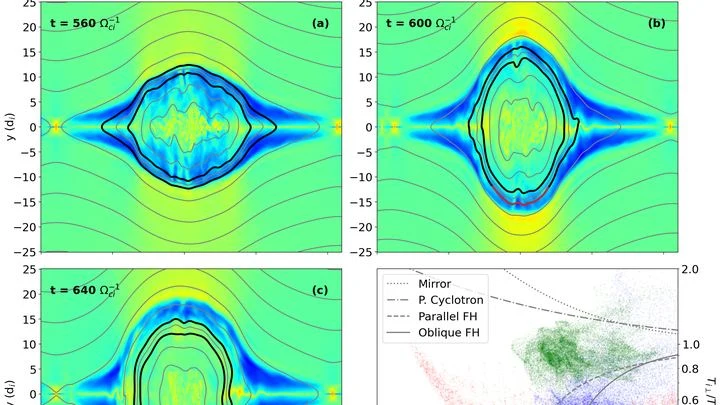
Hot plasma is like a swarm of frantic fireflies darting around in a jar. Keeping it confined in an open magnetic trap is like trying to keep those fireflies from touching the glass. A new computer model shows how to do it more precisely.
Ions and electrons in plasma constantly collide, exchanging energy.
A sheet of paper released from a window flutters, tumbles, and sometimes pauses flat for a second. Until now, to honestly predict such behavior, you had to run millions of equations on supercomputers for every drop of air. That's like simulating every atom of a cash register to count change at a store.
The new approach is smarter.
Water swirls into a ring, and that ring flies through the bulk without breaking apart. Such vortex rings, from smoke rings to underwater currents, follow laws that are hard to capture on paper. Usually, the flow is divided into millions of cubic cells, and each one is tracked.
Data from the DESI galaxy survey hint: dark energy was more powerful in the past than today. This 'phantom' behavior threatens the Universe with a Big Rip — a finale where even atoms disintegrate. But the KMIX model explains this as an illusion. Two fundamental fields — like a distorting mirror — warp our picture: constant energy appears variable.
A fusion reactor resembles a giant boiler where hydrogen is 'cooked' into helium. The plasma inside is heated to 150 million degrees — ten times hotter than the Sun's core. But like any boiler, scale forms: harmful impurities that settle on the walls and quench the plasma.
A supercomputer simulating laser plasma is like a kitchen where hundreds of chefs are preparing a single dish. If ten people crowd around one stove while another stands empty, the work grinds to a halt. The same happens in simulations: plasma particles bunch up in certain regions of space, leaving others nearly empty.