Worlds with Eternal Magma Oceans express
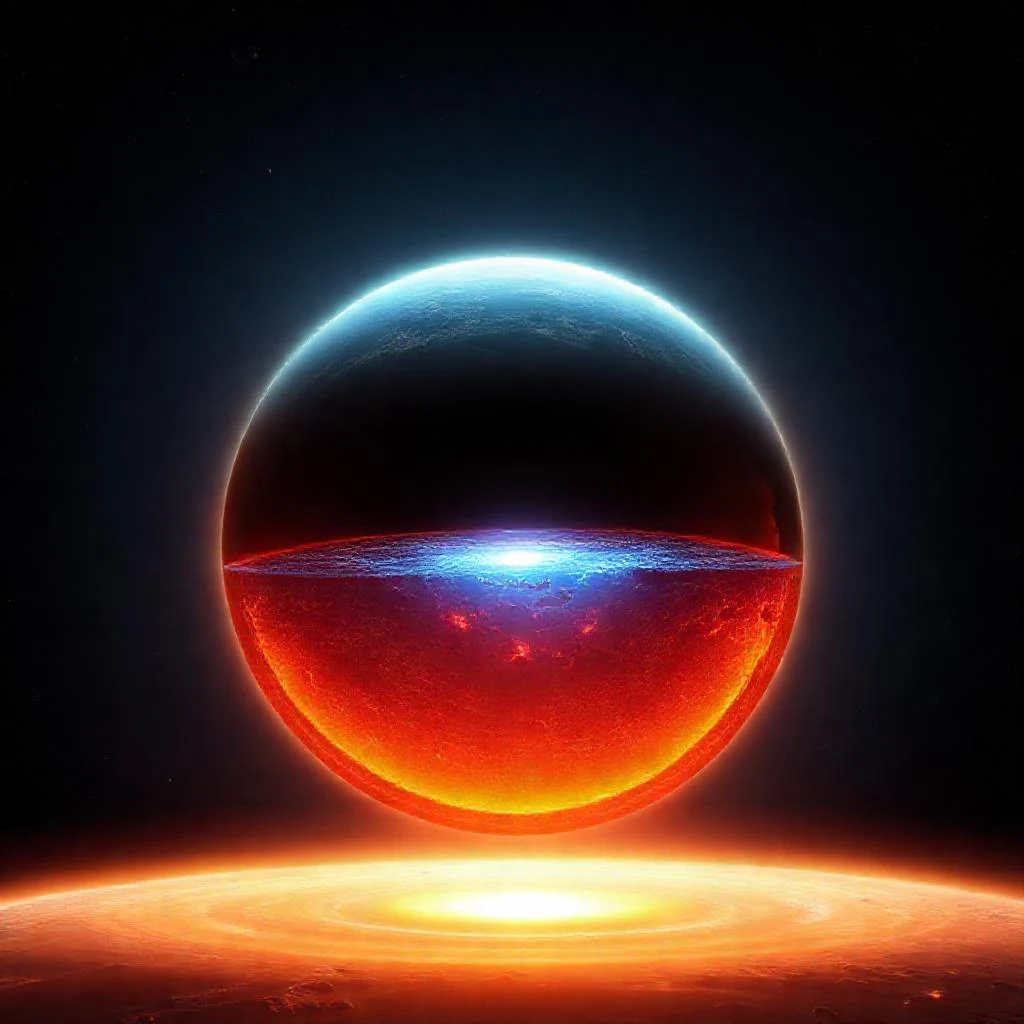
A star warms its planet like an oven warms a kettle. For most sub-Neptunes (worlds larger than Earth but smaller than Neptune), the heat is enough to keep an ocean of molten rock eternally churning beneath a hydrogen sky. A computer model revealed that 98% of such known planets remain molten inside — provided they truly resemble gas dwarfs with a light atmosphere of hydrogen.
If a planet has a lot of oxygen inside and carbon outside, its atmosphere gets heavier and cools faster. But for most worlds, the internal fire hasn’t gone out. This flips our understanding upside down: we used to think such bodies freeze solid over billions of years, but it turns out their interiors are still blazing.
Original abstract
as written by the authors arXiv:2512.05816
Sub-Neptunes are the most common type of detected exoplanet, yet their observed masses and radii are degenerate with several interior structures. One possibility is that sub-Neptunes have silicate/iron interiors and H$$_2$$-dominated atmospheres ($$\mu$$<3.8 g mol$$^{-1}$$), i.e., they are 'gas dwarfs'. If gas dwarfs have molten interiors, interactions between their magma oceans and atmospheres will produce distinct observational signatures. These signatures may break the degeneracy in interior structure, while providing insight into their interior processes, history, and population trends. We expect all such planets are born molten, but under what conditions do they remain molten today? We use the coupled interior-climate evolution model, PROTEUS, to estimate the 'solidification shoreline': the instellation flux boundary (as a function of stellar $$T_{\rm eff}$$) that separates molten gas dwarfs from solidified ones. Our results show that 98% of detected sub-Neptunes occupy a region of parameter space consistent with their having permanent magma oceans, if they are gas dwarfs. While mantle $$f{\rm O}_2$$ and bulk volatile C/H ratio both influence magma ocean cooling, planets with oxidising mantles and carbon-rich atmospheres are likely to have high mean-molecular weight atmospheres ($$\mu$$>3.8 g mol$$^{-1}$$) and are thus outside the scope of this study. Therefore, most detected sub-Neptunes, if they are gas dwarfs, have permanent magma oceans. This result motivates further research into the interactions between molten interiors and overlying atmospheres, and campaigns to identify unambiguous signatures of these interactions.
Sub-Neptunes are the most common planet type in our galaxy, yet none exist in our Solar System.