Neutron stars are the collapsed cores of massive stars, packing more mass than the Sun into a sphere the size of a city. Their interiors are the densest matter in the observable universe, far beyond what we can create in laboratories. The seed definition points to a key open question: at these extreme densities, does matter remain composed of neutrons and protons, or does it transform into more exotic states, such as hyperons (particles containing strange quarks), a quark-gluon plasma, or even a condensate of kaons or pions? The answer determines the star's structure, cooling rate, and maximum mass.
History
The concept of exotic states in neutron star interiors was proposed in the 1960s and 1970s, with early work by theorists like V. Ambartsumyan and G. Saakyan on hyperon cores. The idea gained more traction in the 1980s with the development of quantum chromodynamics and the possibility of quark matter.
How it works
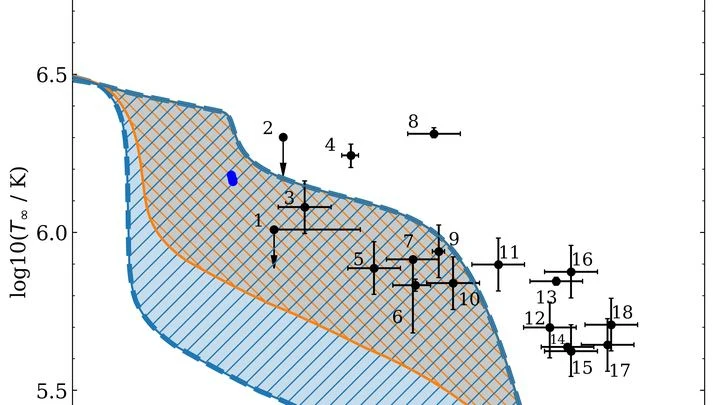
The pressure and density inside a neutron star increase toward the center. In the outer crust, nuclei are embedded in a sea of electrons. Deeper, neutrons drip out of nuclei, and the core may reach densities several times that of an atomic nucleus. At such densities, it becomes energetically favorable for nucleons to convert into hyperons or for nucleons to dissolve into their constituent quarks. These phase transitions would soften the equation of state, affecting the star's radius and how it cools via neutrino emission. Observations of rapidly cooling neutron stars, such as the one described in the title 'Стремительное остывание нейтронной звезды', provide indirect evidence for these processes, because exotic particles open new cooling channels.
In practice
Understanding neutron star interiors helps constrain the equation of state of dense matter, which is essential for interpreting gravitational wave signals from neutron star mergers and for modeling supernova explosions.
Fun fact
A teaspoon of neutron star material would weigh about a billion tons on Earth.
The map of dense nuclear matter resembles a road map: lines of phase transitions cross at critical points, like highways at intersections. Until now, only two intersections were known on such a map: the nuclear liquid-gas and deconfinement, where hadrons dissolve into quarks.
A neutron star is what remains after a massive star explodes. Its matter is compressed so tightly that a teaspoonful would weigh billions of tons. Under such conditions, protons and neutrons can rearrange, and new particles (hyperons, similar to neutrons but containing a 'strange' quark) can appear.
A cosmic "caliper" will soon measure a neutron star to within a hundred meters. For an object a couple dozen kilometers across, that's like measuring the thickness of a human hair from a kilometer away.
A neutron star is the remnant of an exploded supernova.
A handful of sand in your fist: the grains press against each other, and your hand can't squeeze any further. Ordinary matter behaves similarly. But in a neutron star, compression is billions of times stronger — atoms are crushed, electrons are squeezed into protons, and nearly all space is filled with neutrons.
At the centers of many galaxies, not only supermassive black holes lurk, but also vast clouds of invisible matter. If this matter consists of ultralight particles, it can gather into dense clumps — a kind of 'star' made of dark matter.
A neutron star is a gravitational lens that focuses our attempts to glimpse dark matter. Through its ultra-dense matter, like exotic glass, we search for the axion — an elusive particle that could explain the hidden mass of the universe.
Neutron stars are cosmic 'ice cubes' of unimaginable density: a tablespoon of their material would outweigh Mount Everest. It was a mystery what lay in their cores: ordinary neutron matter (a giant atomic nucleus) or exotic quark matter, where particles are not bound into neutrons.
Among the hundreds of moons in the Solar System, Nereid dances the most desperate dance: diving toward Neptune as close as 1.4 million kilometers, then soaring away to 9.7 million — all within less than an Earth year. An eccentricity of 0.75 — the brand of a captured wanderer.
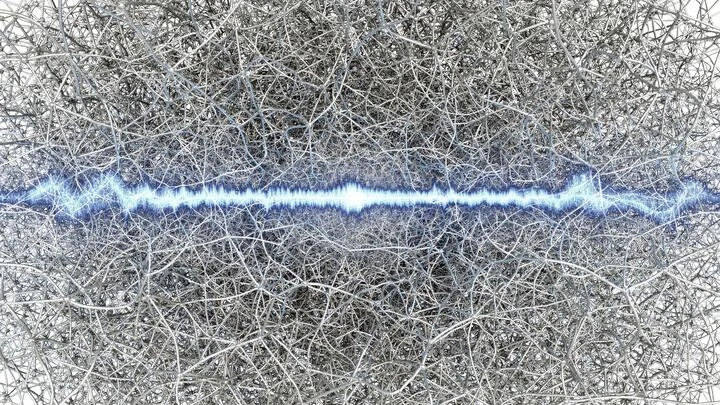
The core of a neutron star can be likened to a taut string of super-nuclear density. Sound traveling along it is the oscillation of pressure, whose speed $$c_s$$ betrays the stiffness of matter. New research shows that this cosmic string does not hum monotonically.
If you squeeze a handful of sand in your fist, it first compacts, but then starts to resist — the grains have nowhere left to go. In the depths of a neutron star, something similar happens, except instead of sand grains, you have elementary particles, and instead of your hand, you have monstrous gravity.
A neutron star is the remnant of an exploded star, compressed to the size of a city. In its core, matter is packed so densely that a teaspoon of such material would weigh as much as a mountain. At such densities, as predicted by the theory of strong interactions, particles acquire 'twins'—parity partners.
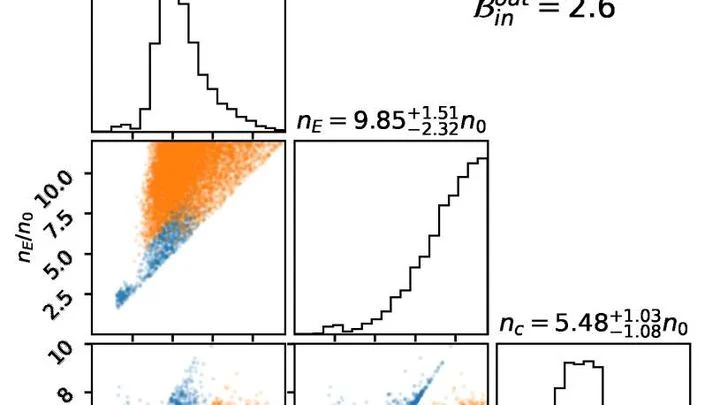
Inside a neutron star, matter is compressed to unimaginable densities. Previously, scientists speculated about its exact makeup, cycling through possible equations linking pressure and density. The new method tosses out guesswork: it directly ties the measurable mass and radius to the internal structure.
Short gamma-ray bursts are colossal explosions that release, in a fraction of a second, energy comparable to what our Sun will emit over billions of years.
A star warms its planet like an oven warms a kettle. For most sub-Neptunes (worlds larger than Earth but smaller than Neptune), the heat is enough to keep an ocean of molten rock eternally churning beneath a hydrogen sky.