Sulfur dioxide (SO2) is a colorless gas with a pungent odor, naturally produced by volcanic eruptions and industrial processes. In the context of exoplanet atmospheres, SO2 is a key tracer of photochemical reactions—it forms when ultraviolet radiation from a host star breaks down other sulfur-bearing molecules like hydrogen sulfide. Detecting SO2 in an exoplanet's atmosphere provides evidence of active chemistry and can reveal the planet's composition and temperature structure.
History
The first unambiguous detection of SO2 in an exoplanet atmosphere was reported in 2023 by a team using the James Webb Space Telescope, observing the hot Saturn-mass exoplanet WASP-39b. This marked a milestone in atmospheric chemistry studies of exoplanets.
How it works
In exoplanet atmospheres, SO2 is typically produced when UV light photolyzes hydrogen sulfide (H2S) or sulfur dioxide itself, leading to a chain of reactions that create and destroy SO2. Its presence is detected via absorption features in the planet's transmission spectrum—when the planet passes in front of its star, gases in its atmosphere absorb specific wavelengths of starlight, leaving a fingerprint. The abundance of SO2 depends on the balance between photochemical production and destruction, which is influenced by temperature and the intensity of stellar radiation.
In practice
SO2 detection is used to characterize exoplanet atmospheres, helping scientists understand planetary formation, atmospheric dynamics, and the potential habitability of worlds beyond our solar system.
Fun fact
On Earth, SO2 is a major air pollutant that causes acid rain, but in exoplanet atmospheres, it can be a sign of a planet's active volcanic activity or photochemical processes.
A filament of the cosmic web stretches through the young universe, and strung along it like beads on a necklace are galaxies. In the core of the SSA22 protocluster, which in a few billion years will become the center of a massive cluster, these beads are still hot and dusty: stars are being born inside them, and cold gas serves as fuel.
In the depths of sub-Neptunes, the most common type of planet in the Galaxy, though not one you could stand on, silicate magma and hydrogen mix into a single supercritical cocktail. Previously, it was thought that beneath the dense hydrogen atmosphere lay a sharp boundary with molten silicate, like oil on water.
In the coldest, darkest corners of space, dust grains get covered in ice, like a window on a frosty day. This ice isn't just frozen water: it also contains carbon monoxide and carbon dioxide. From such ice, comets and planets may eventually assemble. But until now, it was unclear how the dust grain itself affects the ice that forms on it.
In dark interstellar clouds where new stars are born, chemistry starts with a tiny particle — the trihydrogen ion (H₃⁺). It collides with other atoms and sets off a cascade of reactions that build ever more complex molecules. For a long time, it was thought that the main reaction producing it, H₂⁺ colliding with H₂, only happens in the gas phase.
The star AB Aur is young, about 4 million years old. Around it swirls a dense disk of gas and dust. Recently, a long gas stream, a flow of material from the surrounding cloud, crashed into it.
Water comes in different varieties. Not just fresh or salty, but also "heavy"—when one of its hydrogen atoms is replaced by deuterium, its heavier cousin. Such water is called HDO, and it's a true cosmic passport: the amount of deuterium in water reveals where and when that water was born.
Among the scorching exoplanets that circle perilously close to their stars lies the secret of their birth. Nearly three decades ago, Michel Mayor and Didier Queloz discovered the first such world, and since then astronomers have been tormented by the question: how does a gas giant end up pressed against…
When the JWST telescope breaks the light of a distant exoplanet into a spectrum, it reads a chemical chronicle. But this chronicle is not a monolithic truth; it's an atmosphere constantly rewritten by the star's radiation.
The mystery of the radius valley — a sharp drop in the number of exoplanets with radii ~1.8 Earth — haunts astronomers. JWST, transit surveys like Kepler and TESS draw a clear gap: rocky super-Earths and gaseous sub-Neptunes are separated by almost a chasm.
Ever since Voyager 2 raced past Uranus in 1986, the planet's icy moons have kept a mystery: where does the carbon dioxide on their surfaces come from? The spectrometers of that era only hinted at the presence of CO₂, but couldn't say anything about its origin.
Massive stars are cosmic titans, living under the sign of indomitable energy. When such a star enters the B[e] supergiant phase, its radiation is so powerful that it would seemingly pulverize any molecule into atoms. The spectral lines, once systematized by Johann Balmer, blaze here with particular fury.
Like an exquisite clockwork mechanism, a multi-planet system responds sensitively to the slightest nudge. And when the star at the heart of this mechanism dies, shedding its envelope and turning into a white dwarf, even a modest kick at a speed of 0.75 km/s can trigger a cascade of events, flinging entire worlds into interstellar emptiness.
Hundreds of light-years away, there's a planet that looks like a giant mirror. LTT9779b reflects most of the light that hits it — far more than you'd expect from a Neptune-sized body. Astronomers have long debated what makes it so shiny: a thick carbon-rich haze or a layer of clouds.
The James Webb Space Telescope has helped settle the debate.
Massive gas outflows from active galactic nuclei are a key regulator of galactic evolution. They sweep out the interstellar medium, quench star formation, and dictate the growth of supermassive black holes.
A world where a year lasts just one and a half Earth days, and the star in its sky is hundreds of times larger than our Sun. This is KELT-9 b — a gas giant heated to temperatures at which iron vaporizes. Its atmosphere is not just hot; it is literally boiling away into space, like steam rising from a giant cauldron.
WASP-121 b is not just a hot ball. It's a world where iron vaporizes and the sky glows with its own heat. A fresh look at it has revealed what 'ingredients' went into making it.
The James Webb Space Telescope has for the first time clearly detected vaporized silicon monoxide in its atmosphere — a refractory substance usually locked inside dust grains.
A scorching rocky planet is like a pot of boiling soup, except its lid is the atmosphere. Gases escape from the magma, wrap the world in a thick blanket, and in turn influence how quickly the celestial body cools. For GJ 1132 b, which orbits so close to its star that a year lasts just one and a half Earth days, this connection is especially important.
In the orchestra of interstellar life search, every note counts. And the score here is dictated not by man, but by a distant star. For the planet TRAPPIST-1 e, one of seven in the system of an ultracool red dwarf, the conductor's baton is harsh ultraviolet light.
The young super-Jupiter TWA5B, a scorching ball 25 times Jupiter's mass, floats just fifty light-years away. Its faint infrared glow long hid its chemical makeup. Now, high-resolution spectroscopy with CRIRES+ has registered the ghostly trace of SiO — silicon monoxide.
A kindergarten where some kids are busy making sandcastles while others are already assembling building blocks. That's roughly what the V1298 Tau system looks like: it's only 20 million years old — by cosmic standards, it just left the nursery. Several planets orbit it, and two of them, b and e, turned out to be surprisingly different.
Imagine a packed orchestra, each musician playing their own part, while you try to pick out the quiet voice of a rare flute: its melody drowns in the sound of violins and trumpets. That's what hunting for molecules in interstellar clouds is like: telescopes pick up the 'radio voices' of countless substances, and picking out the signal you want from the noise is no easy task.
When a planet slips behind the edge of its star, the star backlights the planet's atmosphere, just as a setting sun illuminates clouds on the horizon. This brief moment, lasting only minutes, carries the imprint of the gases through which the starlight has passed.
Astronomers aimed JWST at the rocky exoplanet LHS 3844 b — a world orbiting another star, where a year lasts just 11 hours. The planet is tidally locked: one side always faces the star, with a permanent scorch of 770°C, while the night side is plunged into icy darkness.
A giant planet hangs in space in complete solitude, separated from its star by a distance 160 times greater than the path from the Sun to Pluto. The light from its parent star arrives so faintly that the surface temperature barely exceeds 200 degrees Celsius — about as warm as a well-heated sauna.
Chondrules look like frozen raindrops made of stone. They're about the size of a grain of sand, but they record the history of the first few million years of the Solar System. Once, these droplets floated in the scorching gas around the young Sun, then clumped into asteroids and fell to Earth as meteorites.
Around small, cool, but extremely restless red dwarfs, planets the size of Earth often orbit. Such a star is like a temperamental stove that intermittently erupts flares: powerful streams of light and particles batter the planet's atmosphere, as if someone splashed fire into a simmering soup pot.
Titan is a cold world with methane lakes and a dense orange atmosphere. But beneath the icy crust, warm puddles may hide, formed after meteorite impacts. In such a puddle, like a chemical flask the size of Selk Crater, simple gases from the air, hydrogen cyanide and acetylene, mix.
A world that for years refused to show its face. Planet GJ 1214 b is exactly such a case. It is larger than Earth but smaller than Neptune, and its dense envelope made the atmosphere invisible to telescopes: starlight passed through it without leaving clear traces. But astronomers' persistence and a new sensitive instrument provided the first clue.
Around young stars, flat clouds of gas and dust swirl, like pizza dough from which planets will eventually be shaped. This cloud contains various chemical elements, and sulfur is one of the most elusive: it's hard to catch with telescopes because it hides in solid grains or escapes as gas.
Light from a distant star, passing through the atmosphere of planet K2-18b, left unusual "fingerprints" in its spectrum. Astronomers spent 420 hours collecting this light with the James Webb Space Telescope and split it into colors, like a rainbow.
Dirty water laced with antibiotics isn't just waste: it's a hidden energy source. Chemists built a material from two components: titanium oxide nanorods (the white pigment in paints and sunscreens) and carbon nitride nanosheets.
A telescope stares at a planet 124 light-years away and sees gases in its atmosphere that on Earth are produced by microbes. The immediate thought: life. But it's not that simple.
Planet K2-18b is a sphere wrapped in a thick layer of hydrogen. In such a layer, like in a giant chemical flask, reactions take place.
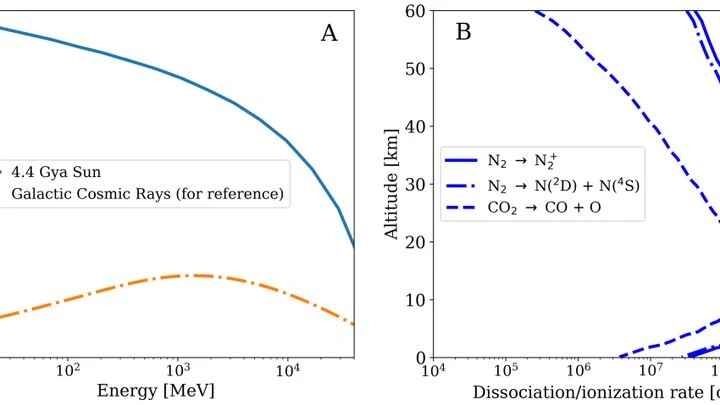
In its youth, our Sun radiated about 30% less energy than it does today: this faint young Sun paradox long troubled planetary scientists: with such a heat deficit, Earth's oceans should have frozen, yet geological evidence says otherwise.
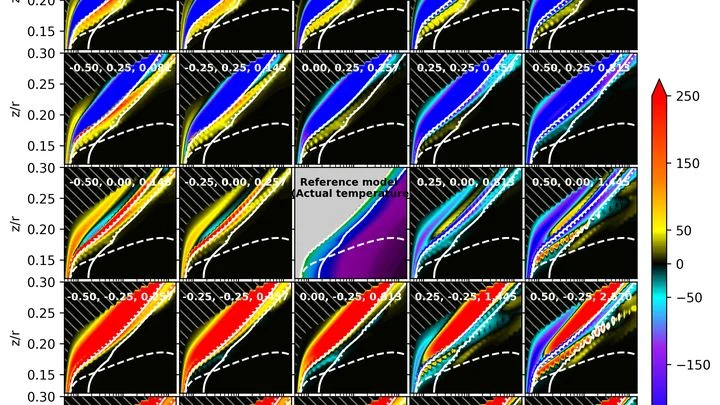
Gas is nearly invisible, but it has a temperature, and you can read it from how the gas 'shadows' the thermal background. In the experiment, a camera looks at a warm screen through a jet of carbon dioxide. If the gas is cooler than the background, it appears as a dark spot; if warmer, it appears bright.
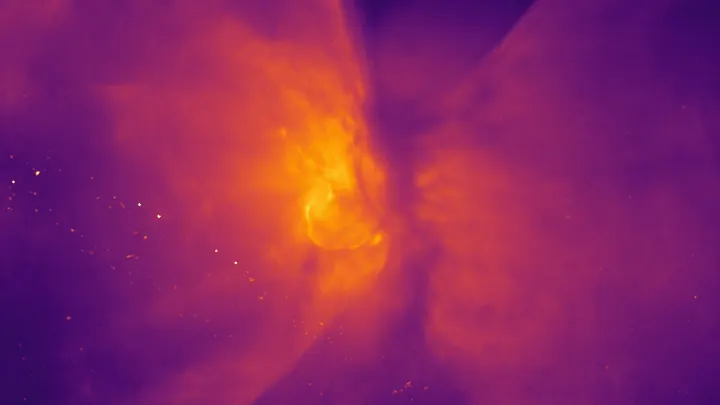
In a blazing foundry, any ice cube would vanish instantly. But tucked inside a thick mitten, it survives. Nature pulled a similar trick in the planetary nebula NGC 6302.
When a chef prepares a dish, not only the proportions of ingredients matter but also their total amount. Two pies with the same sugar-to-flour ratio but made from different batch sizes will turn out differently. So it is with disks around young stars: carbon and oxygen are the key 'spices,' and their absolute amounts change the look of the cosmic 'kitchen' no less than their ratio.
The young star PDS 66 is surrounded by a flat disk of gas and dust — the cradle of future planets. In the cold outer regions of such a disk, silicon and sulfur are usually hidden inside dust grains, but astronomers spotted a bright patch of gas at about 60 astronomical units from the star.
The young star B335, which hasn't grown up yet, suddenly sneezed, and that sneeze is still going on. Astronomers spotted the outburst in the scattered light from its outflow cavity, and it offered a rare chance to see how such an energy release affects a jet — a stream of gas shooting out…
In a cloud where massive stars are being born, there is a hot, dense core. Like a crowded kitchen where the heat of the stove makes smells evaporate, here the warmth from young stars evaporates molecules from the surface of cosmic dust grains.