Popular

Worlds with Eternal Magma Oceans ⚡ экспресс

Original: "Most Rocky Sub-Neptunes are Molten: Mapping the Solidification Shoreline for Gas Dwarf Exoplanets"
arXiv:2512.05816 · 2025-12-05 · CC BY 4.0 · ⏱ 1 min · Exoplanets
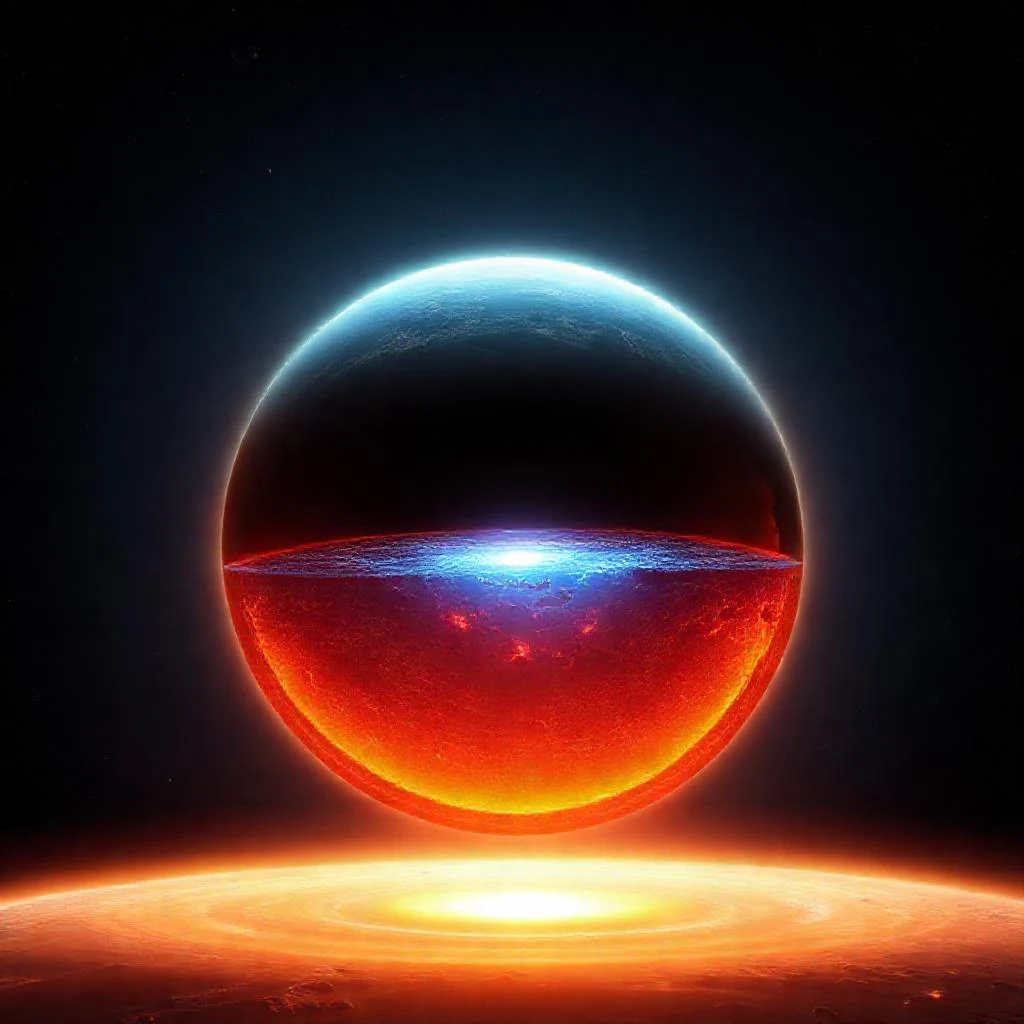
Beneath the hydrogen envelope of most known sub-Neptunes, an eternal ocean of liquid magma likely churns.
Abstract

Sub-Neptunes—the most common type of exoplanet found—might have an uncertain internal structure. One idea: they're gas dwarfs (rocky cores wrapped in hydrogen atmospheres). Calculations using the PROTEUS climate model reveal that if this is true, 98% of known sub-Neptunes lie in a zone where their interiors stay molten—a magma ocean—like giant lava lamps, forever boiling from within. It's fascinating that even today Earth has a solid crust, while these distant worlds may be locked in their fiery youth forever. Understanding how magma interacts with the atmosphere will help unlock their secrets.

Links in the knowledge graph 1

📄 Showing the "Simple" version — "Popular" is not ready yet. Add it to favorites to help prioritize it.

A star warms its planet like an oven warms a kettle. For most sub-Neptunes (worlds larger than Earth but smaller than Neptune), the heat is enough to keep an ocean of molten rock eternally churning beneath a hydrogen sky. A computer model revealed that 98% of such known planets remain molten inside—provided they truly resemble gas dwarfs with a light atmosphere of hydrogen.

This heat leaves distinctive chemical fingerprints. We can spot them with spectroscopy—breaking a distant planet’s light into a rainbow to read its makeup. These fingerprints will provide direct evidence of hidden magma oceans.

If a planet has a lot of oxygen inside and carbon outside, its atmosphere gets heavier and cools faster. But for most worlds, the internal fire hasn’t gone out. This flips our understanding upside down: we used to think such bodies freeze solid over billions of years, but it turns out their interiors are still blazing.

🎯 Sub-Neptunes are the most common planet type in our galaxy, yet none exist in our Solar System.

Scientists
Christian DopplerD. B. McLaughlinDidier QuelozMichel MayorR. A. RossiterDavid Charbonneau
Tags
exoplanet hydrogen spectroscopy
Laws
Doppler effectKepler's third lawCoulomb's lawMaxwell's equationsPlanck's lawPlanck–Einstein relation
Original: arXiv:2512.05816 · CC BY 4.0 · bridge42worlds