How a Neural Network Hunts El Niño: A Map of Key Ocean Regions ✛
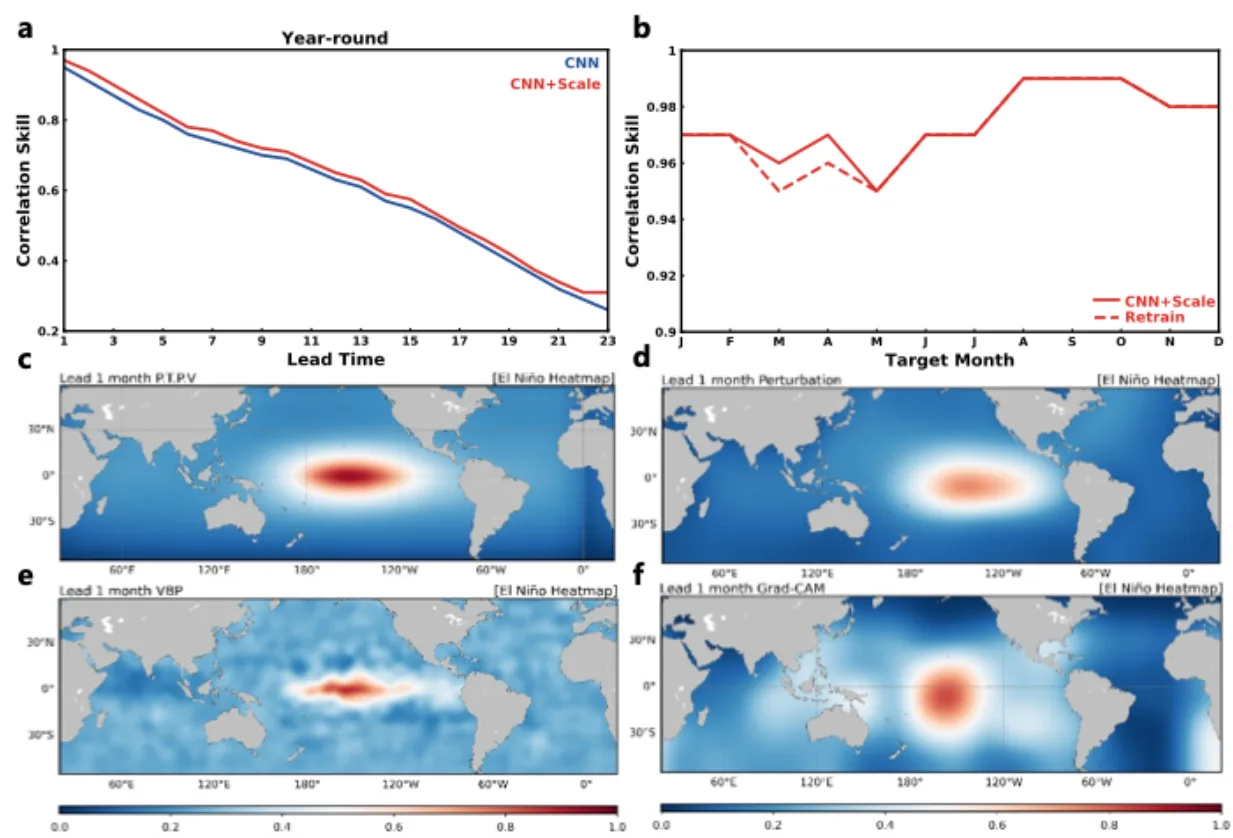
In the tropical Pacific, ocean waters warm and cool, influencing weather across the globe. This phenomenon is known as El Niño. Predicting it months ahead is notoriously difficult. Neural networks outperform older methods, but they act like a black box: it is unclear what goes on inside. Scientists have now devised a way to look inside that box and see which data the network pays attention to.
The method, called practical partial full variation, works like this: if you slightly alter one input, say the water temperature in a specific region, and the forecast shifts dramatically, that input matters. This lets you build a map of important regions. It turns out that for one-month-ahead forecasts, nearly all attention is focused on the tropical Pacific. For year-ahead forecasts, the network also looks at the Indian and Atlantic Oceans.
To improve forecasts, more information is needed: for example, wind or salinity data. Then the network could pick up new cues and make more accurate predictions even in spring.
The PPTV method is based on the concept of total variation of a function, which traces back to the work of Henri Lebesgue and is used in image processing for noise reduction. Here it is applied for the first time to explain neural networks in climatology.