Deep Learning Ideology in El Niño Forecasts ✛
Context
El Niño–Southern Oscillation (ENSO) affects weather worldwide, making its long-term forecast critically important. Deep neural networks have already surpassed classical models, but their internal logic is hidden. Without understanding what the model relies on, scientists cannot trust its outputs or improve it. Existing interpretation methods, designed for image classification tasks, are poorly suited for regression of climate indices. This work fills that gap by proposing a method specifically developed for ENSO forecast models. It stands alongside studies that also apply machine learning to climate data but differs in mathematical rigor and focus on explainability.
Methods
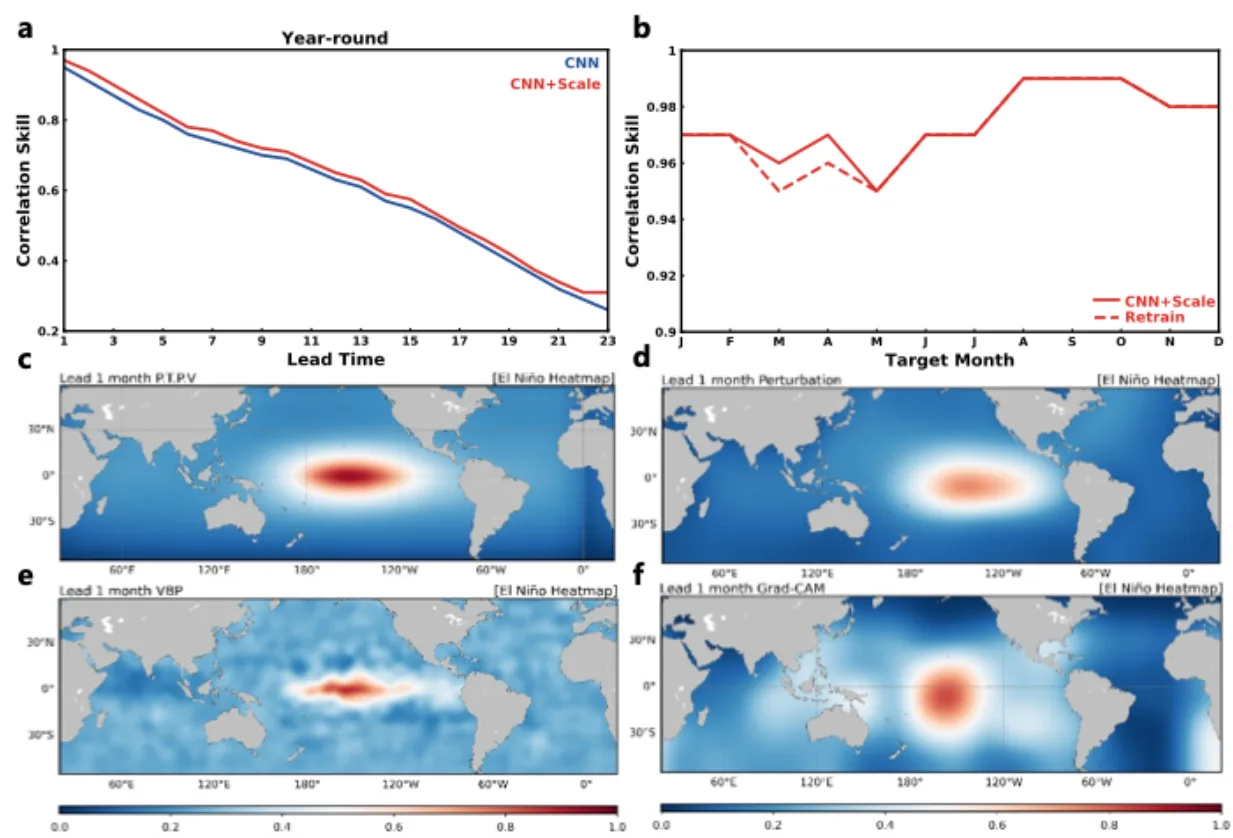
The authors took a convolutional neural network trained on three months of sea surface temperature and ocean heat content data to predict the Niño-3.4 index up to 23 months ahead. First, they found that the model suffered from vanishing gradients: many neurons were in the saturation zone of the activation function. To fix this, they inserted trainable parameters before the activation function that adaptively calibrate the features. Then they proposed the practical partial total variation (PPTV) method. It treats the model as a function of bounded variation and estimates the contribution of each input variable via the mean absolute value of the partial derivative over the training set. For comparison, they used Perturbation, VBP, and Grad-CAM methods. Validation was performed by retraining the model only on data from regions that PPTV flagged as important.
Results
The PPTV method yielded the most concentrated distribution of important regions compared to other approaches. For a one-month lead forecast, the tropical Pacific proved key. Retraining only on those data produced nearly the same correlation as on the full set, confirming the significance of the highlighted regions. As lead time increases, the model's attention first spreads along latitude to tropical regions of the Indian and Atlantic Oceans, then becomes more diffuse. Meanwhile, areas south of 40°S always receive the least attention. Channel-wise analysis showed that at short leads, sea surface temperature (SST) matters more, while at long leads, ocean heat content (OHC) does. In spring, the model expands its attention zone to all three tropical oceans, but forecast accuracy still declines, indicating limited input data.
Implications
This work stands apart from neighboring studies by offering not just another neural network for forecasting but a tool to uncover its internal logic. The PPTV method has a rigorous mathematical foundation and requires no model modification, making it applicable to a broad class of regression problems in Earth sciences. The resulting importance maps align with physical understanding of ENSO, strengthening trust in deep learning for climatology. Furthermore, the identified link between attention dispersion and the spring predictability barrier offers a new hypothesis about the nature of this phenomenon.
Future development
The PPTV method can be applied to analyze other climate models and regression tasks where understanding input variable contributions is needed. In the long run, it may help uncover unknown physical processes affecting long-term ENSO predictability. To overcome the spring predictability barrier, the authors suggest adding more ocean and atmosphere variables, such as wind or salinity. The method itself could also be improved, for example, by accounting for nonlinear interactions between variables.
Impact
The method could be used by meteorological agencies to increase trust in neural-network-based forecasts. It is also useful in oceanography and climatology for identifying key regions and variables that drive predictability.
Next steps
The immediate next step is to apply PPTV to models with additional input variables to test whether it helps overcome the spring barrier. It is also worth exploring how the method performs on other datasets and neural network architectures.
Key open problems
In climatology, the spring predictability barrier of ENSO remains unsolved: why forecasts starting in spring lose accuracy. This work links that barrier to a lack of information in the input data, rather than to internal model limitations. This opens the way to search for new predictors that could improve long-term forecasts.
The knowledge machine's view
This section is addressed to the author of the paper and their colleagues. Neighbouring works were found by meaning-based search across our archive, not by word overlap. We do not review: we show the field around the work.
What the work does
The authors applied a convolutional neural network to forecast the Niño-3.4 index up to 23 months ahead using sea surface temperature and ocean heat content data. They introduced a method called practical partial total variation (PPTV) to assess the contribution of input variables, and showed that key information is concentrated in the tropical Pacific, while with longer lead times the model also draws on data from the Indian and Atlantic Oceans.
Where its strength is
The strength of the work lies in a mathematically grounded interpretation method specifically adapted for regression of climate indices, which requires no model modification and yields concentrated importance maps confirmed by retraining.
Where it could go next
- It might be interesting to compare the proposed interpretation method with approaches used in related fields, such as data analysis in neutrino experiments, where interpretability of deep models is also crucial.based on: The Earth’s Neutrino Confession: IceCube Reads the Planet in the Language of Weak Interactions arXiv:2607.02644
- A related line of work uses neural networks to predict drought months ahead by reading weather backward; perhaps a similar time-reversed approach could improve long-term ENSO forecasts and overcome the spring predictability barrier.based on: How a neural network, reading weather backwards, warns of drought months in advance arXiv:2607.00331
- It would be interesting to see how PPTV could be applied to analyze models predicting other climate indices, such as solar cycles, where physical interpretability is also important.based on: Solar Cycles: How Magnetic Swings Sway the Future arXiv:2602.16656
Worth trying
- Try adding extra variables (e.g., wind, pressure) to the model and see whether the importance patterns and accuracy change in spring.
- Apply PPTV to an ensemble of models trained with different random initializations to assess the stability of the importance maps.
- Use the method to analyze forecast errors in specific seasons, for example, identify regions whose insufficient attention leads to errors.
Why this may matter
Understanding which data the ENSO forecast model relies on can increase trust in neural network forecasts and point the way to their improvement, which is important for climate science and practical applications.
Nearby works in our archive
- El Niño Can Be Predicted a Year and a Half in Advancesimilarity 0.57
- Peeking Inside the Mind of a Weather AIsimilarity 0.50
- Echo in the Labyrinth: Why Machine Learning Only Hears Echoessimilarity 0.50
- Solar Cycles: How Magnetic Swings Sway the Futuresimilarity 0.49
- Neural Networks vs. Dark Matter: A New Method for Analyzing Weak Lensingsimilarity 0.49
- How a neural network, reading weather backwards, warns of drought months in advancesimilarity 0.49
- The Earth’s Neutrino Confession: IceCube Reads the Planet in the Language of Weak Interactionssimilarity 0.49
The archive is sparse around this work: the closest review is only 0.57, against a usual 0.64. It looks like few have drilled nearby.
The PPTV method is based on the concept of total variation of a function, which traces back to the work of Henri Lebesgue and is used in image processing for noise reduction. Here it is applied for the first time to explain neural networks in climatology.
Key numbers
- forecast lead time: up to 23 months
- number of input data channels: 6 (3 months of SST and 3 months of OHC)
- PPTV threshold for selecting important regions: 0.5
- latitude boundary for minimal attention: 40°S
- GODAS data period for analysis: 1984–2017