The Neural Network's Treasure Map: Where El Niño Hides Its Predictability ✛
The tropical Pacific Ocean heats and cools like a giant battery, and its rhythm affects weather from India to Canada. This rhythm is called El Niño–Southern Oscillation, or ENSO for short. Forecasting it months ahead is like predicting when a pot will boil without knowing the strength of the flame. Neural networks have learned to do this better than classical models, but their internal logic was hidden, like a map without labels. Now researchers have found a way to illuminate the places on that map where the network seeks predictive power.
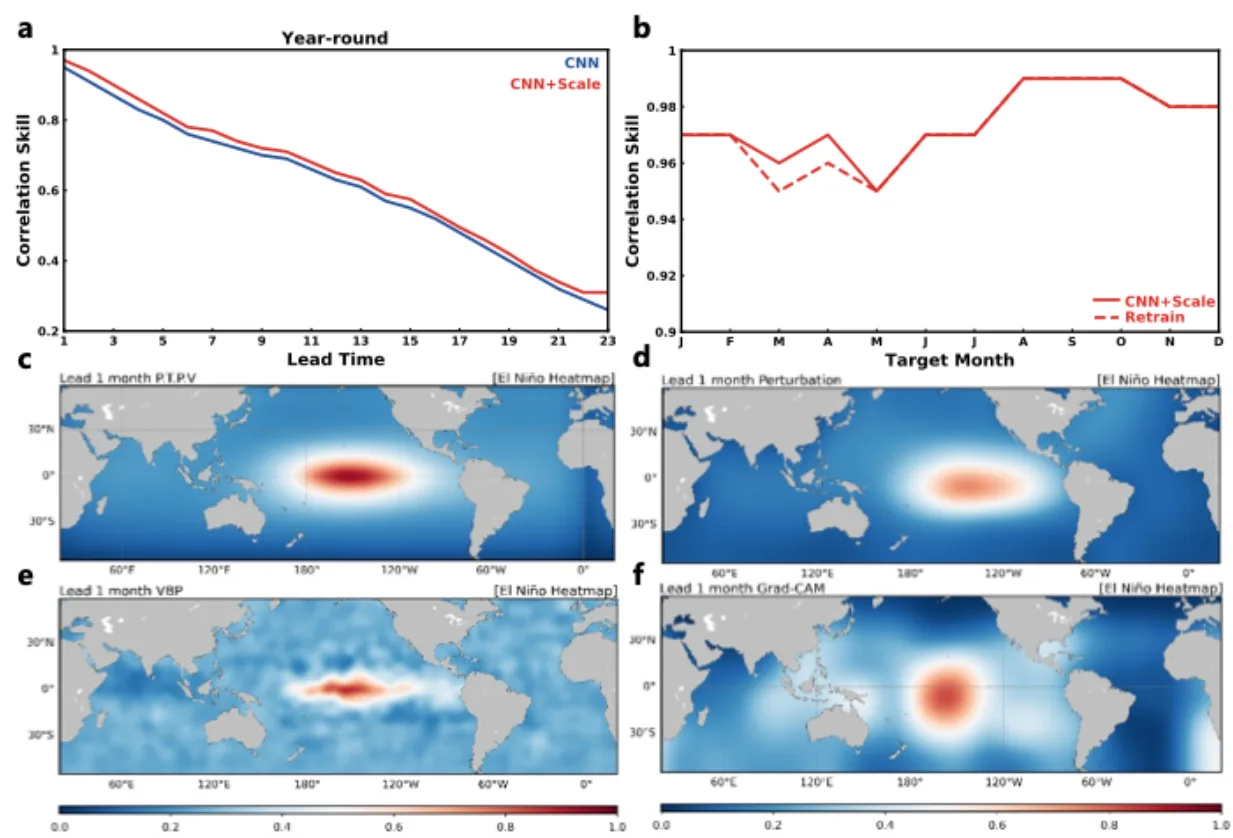
For a forecast, the model receives data on sea surface temperature and heat content over three months. The task is to predict the Niño-3.4 index, that is, the average temperature in a specific region of the Pacific Ocean, up to 23 months ahead. First, the authors noticed that the network suffers from the 'vanishing gradient': many of its neurons get stuck in a state where training barely changes their behavior. To fix this, they inserted trainable parameters before the activation function, which calibrate the features, like a tuner adjusting strings before a concert.
Applying PPTV, the scientists obtained an importance map. For a one-month forecast, almost all attention is concentrated in the tropical Pacific. If the model is trained only on these data, accuracy barely drops. This confirms that the method indeed finds key regions. As lead time increases, attention spreads: first along latitude to tropical regions of the Indian and Atlantic Oceans, then becomes more diffuse. Regions south of 40°S always receive the least attention.
Channel-wise analysis showed that at short lead times, sea surface temperature is more important, while at long lead times, heat content, that is, heat stored in the upper ocean layers, matters more. In spring, the model expands its attention zone to all three tropical oceans, but forecast accuracy still declines. This points to limitations in the input data, not model errors. Such a conclusion links the spring predictability barrier to a lack of information.
The treasure map is now illuminated, but the treasure is not fully found. The spring barrier remains, and the authors suggest adding more ocean and atmosphere variables: wind, salinity. Perhaps then the network will find new landmarks, and forecasts will become more accurate even in the most capricious season.
The PPTV method is based on the concept of total variation of a function, which traces back to the work of Henri Lebesgue and is used in image processing for noise reduction. Here it is applied for the first time to explain neural networks in climatology.