How to Catch a Neutron in a Gas Chamber express
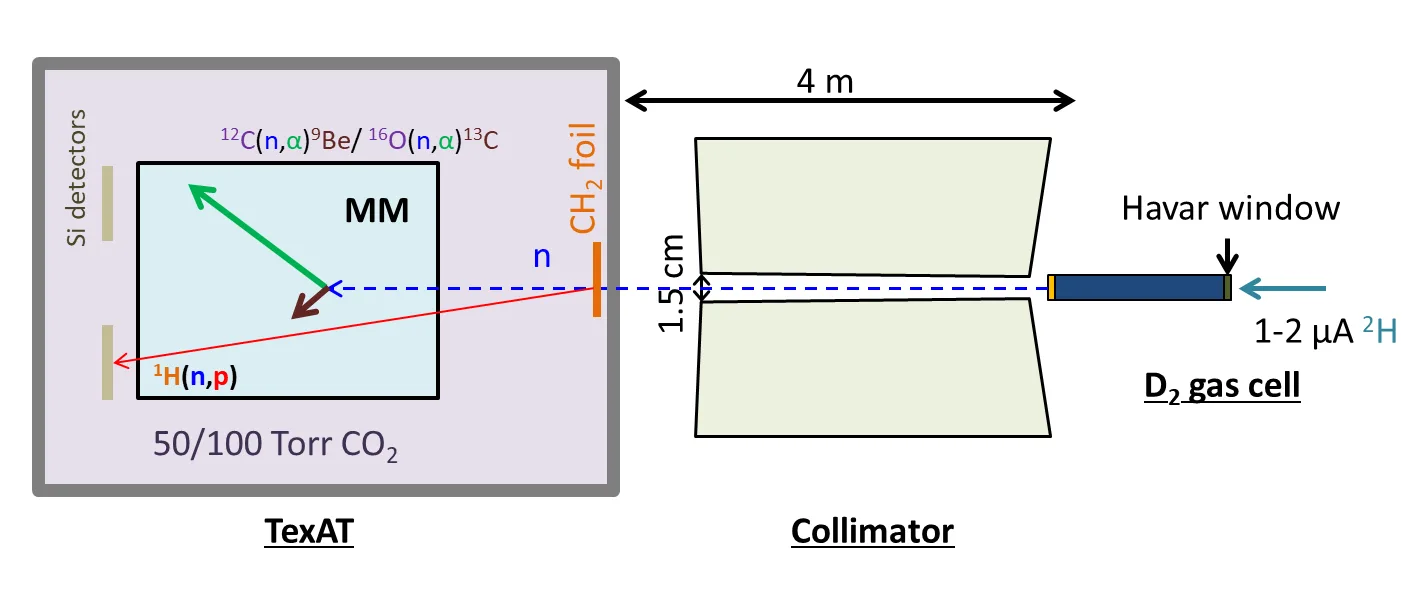
When a neutron slams into a nucleus, it can knock out a chunk — an alpha particle, which is a helium nucleus. Such collisions happen all the time in nuclear reactors, but they are hard to measure precisely: a neutron leaves no track in a regular detector, and you can only catch it by its aftermath.
In this work, physicists filled a chamber with carbon dioxide gas and sent a neutron beam through it. The chamber itself was both target and detector: when a neutron hit a carbon or oxygen nucleus, the knocked-out alpha particle ionized the gas, and from that track they reconstructed the angle and energy. This approach is called an active target.
The measurements were done with a neutron beam of about 14 MeV — roughly a million times the energy of a chemical bond, but thousands of times less than particles in the Large Hadron Collider. Comparison with previous data showed good agreement for carbon, but for oxygen-16 the total cross section came out noticeably lower than the estimates from the ENDF library. That means earlier calculations may have overestimated the rate of helium buildup in reactor materials.
The active target method allowed them to get data over a wide range of angles even with a weak beam: there weren't many neutrons, but every other one left a useful track. This trick will come in handy for studying other reactions that require high precision.
The carbon dioxide in the chamber is not just the target but also the detector itself: the knocked-out alpha particle leaves a chain of ions in the gas, like a bullet leaving a trail in fog.