Cosmic Whirlpool: How Voids Reveal the Universe's Secrets ✛ ✦
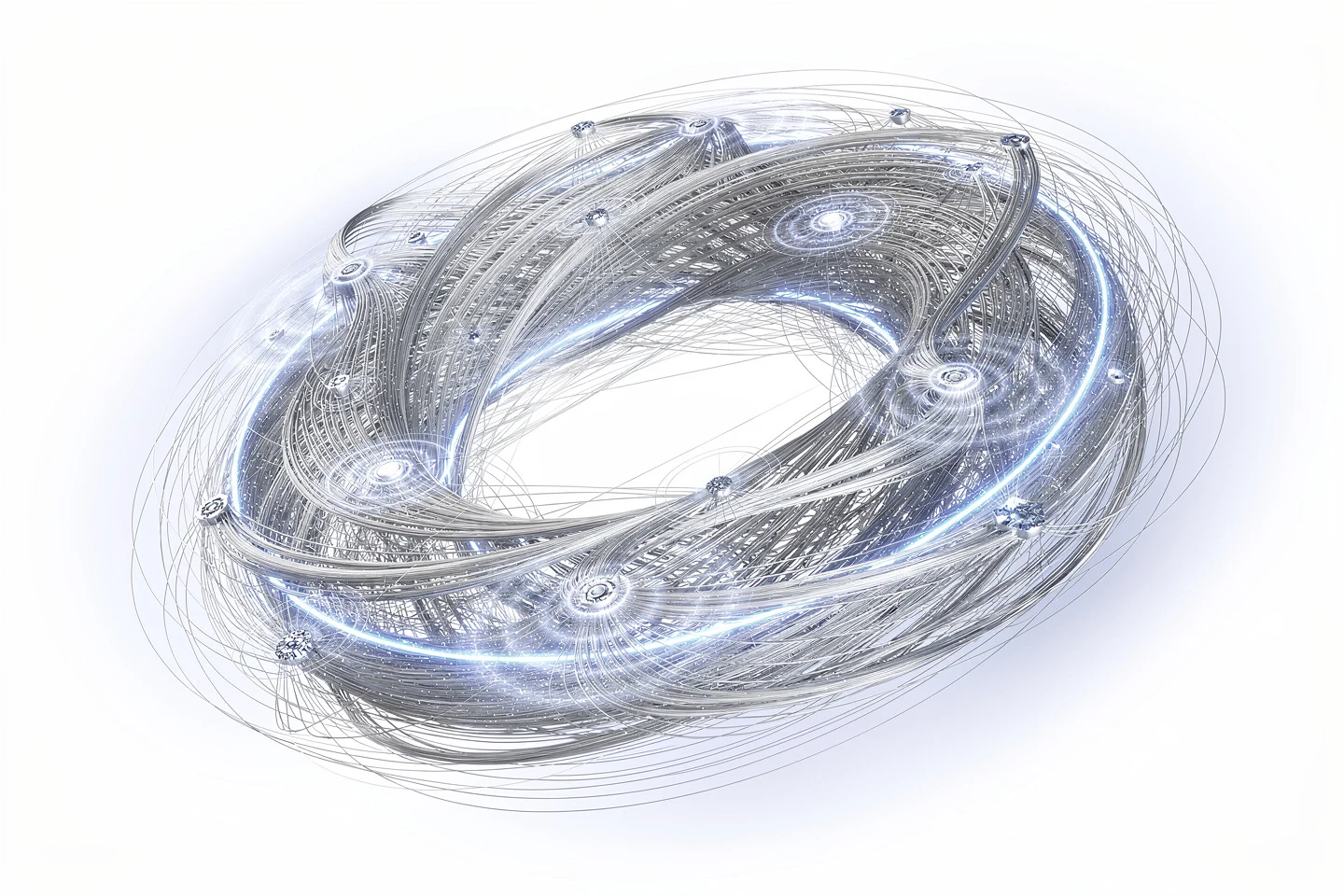
In an ocean of galaxies, gigantic funnels gape open — voids, regions where almost nothing exists. Such a void can span hundreds of millions of light-years across. But these chasms aren't silent: they slowly rotate, as if an invisible current were twisting them. Light from galaxies on opposite rims of a void gets stretched by different amounts. This redshift reveals how fast each wall is moving. The rotation patterns turned out identical for any conceivable universe — from nearly empty to filled with invisible matter (dark matter). Only the amplitude changes. It's set by two numbers: the fraction of invisible mass and the clumpiness of the primordial stuff. Computer simulations of 33 different worlds yielded a simple formula that barely depends on dark energy — the mysterious force accelerating the expansion. Now, by examining a real void, we can measure both of these keys to the cosmos in one shot. Long ago, Lemaître proposed expansion, Hubble confirmed it, and Rubin showed how much of the Universe is invisible. Next-generation telescopes are already aiming at these cosmic funnels to read the universe's recipe in their swirling motion.
The shape parameter of void rotation is remarkably similar across universes with any amount of dark energy: nature seems to dictate a universal swirl pattern.