Cosmological homogeneity is the assumption that the universe, when viewed on sufficiently large scales, is statistically uniform: every region looks roughly the same in terms of matter density, galaxy distribution, and other properties. This principle, combined with isotropy (the universe looks the same in every direction), forms the cosmological principle, which is a foundational assumption of the standard model of cosmology. It allows cosmologists to describe the universe with simple, uniform solutions to Einstein's equations, such as the Friedmann-Lemaître-Robertson-Walker metric, which underpins our understanding of the expanding universe and the Big Bang.
History
The cosmological principle was articulated in its modern form by Albert Einstein in 1917, when he applied his general theory of relativity to the universe as a whole, assuming a homogeneous and isotropic model. The observational confirmation of homogeneity came much later, with the discovery of the cosmic microwave background in 1965 and subsequent large-scale galaxy surveys.
How it works
Homogeneity is not an exact property but a statistical one: on scales of hundreds of millions of light-years, the distribution of galaxies and matter becomes smooth, with fluctuations averaging out. This is tested by mapping the large-scale structure of the universe, for example through galaxy surveys or measurements of the cosmic microwave background. The observed near-uniformity of the cosmic microwave background radiation, with temperature variations of only one part in 100,000, is strong evidence for homogeneity on the largest scales. However, the assumption is not universally accepted, and some studies explore whether significant inhomogeneities could affect cosmological observations, such as the apparent acceleration of the universe's expansion.
In practice
Homogeneity is used to simplify cosmological models, enabling predictions of the universe's evolution, the formation of large-scale structure, and the interpretation of dark energy and dark matter observations.
Fun fact
The largest known structure in the universe, the Hercules-Corona Borealis Great Wall, spans about 10 billion light-years, yet even it is still smaller than the scale at which the universe becomes homogeneous.
A drop of ink spreads in a glass of water: its edges move faster than its center, and the drop's shape changes. Likewise, a clump of dark matter collapsing under its own gravity expands unevenly, with different shells flying apart at different speeds. Previously, astrophysicists could accurately describe only the simplest case, a uniform sphere with a sharp boundary, which has a single expansion rate.
Stare long enough into the night sky, and sooner or later your gaze hits a blackness beyond which nothing is visible. This is not just a distant fence: it is the edge of the universe accessible to us, the cosmic horizon. Light from more distant stars simply hasn't had time to reach us.
A spotlight beam fades into the darkness, but if you trace it backward, you hit the lamp. The history of the universe might be the same: tracing its expansion backward, we run into a beginning.
Physicists took the simplest model — a universe that stretches equally in all directions, like a cube with all sides growing.
In the first instants after the Big Bang, the universe expanded faster than light could cross it. Like an inflating balloon, but instead of rubber, it was space itself. On this balloon, ripples inevitably formed — tiny compressions and rarefactions from which all galaxies and stars later grew.
A pendulum in a noisy room is constantly jostled by people passing by. Its motion is a mix of regular swings and random jerks. Something similar happens with weak gravitational waves against the backdrop of an expanding universe. In Einstein's general relativity, these waves are tiny ripples in spacetime.
The Standard Model of particle physics is a catalog of all known building blocks of the universe: electrons, quarks, and others. But it is silent about dark matter and doesn't get along with gravity.
The first three minutes after the birth of the world are a cosmic kitchen where nature cooked the lightest atomic nuclei. The recipe is set by gravity: it controls the cooling rate of the hot 'broth' of particles. If gravity worked differently than we are used to, the dish would have turned out different — with different amounts of helium and deuterium.
A quantum wave is like a long-exposure photograph: everything’s blurred, but the blur itself reveals motion. Usually these frozen waves are treated as convenient abstractions. Yet if at each point in the image you estimate, by brightness, the moment on the particle’s internal clock it landed there, flat space suddenly acquires curves.
A runner on the middle of a track suddenly switches to a walk — not speeding up or slowing down, but maintaining a constant pace. Something similar may have happened to the universe itself shortly after the Big Bang.
In mathematics there is a sieve that sifts not dust, but infinity itself. It’s called a Q-space: here any subset turns out to be a Gδ set — a countable intersection of open sets, as if sifted through an unimaginably fine mesh.
The cosmological principle – the notion that the Universe is homogeneous and isotropic on large scales – has guarded our understanding of the world since the time of Edwin Hubble and Georges Lemaître, whose ideas formed the basis of the Big Bang model.
From childhood, we're used to thinking of space as infinite and isotropic. But Einstein and Lemaître were already asking: could the Universe be closed in on itself, like a Möbius strip or a 3-torus?
A builder checks the strength of an arch not by running through all possible shapes in their head, but by mentally nudging it and seeing how much force is expended. That's essentially how the principle of virtual work works in mechanics. The authors of a new study have applied this approach to the very geometry of spacetime.
They constructed a covariant framework of virtual work for the metric.
In the early 20th century, Einstein showed that gravity is the curvature of space and time. A bit earlier, Maxwell had unified electricity and magnetism into a single theory.
The Universe resembles a dense forest: up close, individual galaxy-trees are visible, gathered into groves, but from a distance everything merges into a solid green canopy. The boundary beyond which the cosmos becomes homogeneous is called the angular scale of homogeneity: it's the size of a patch of sky from which galaxies are distributed evenly.
You can zoom into a high-resolution photo for a long time — until suddenly a smooth face dissolves into individual pixels. Something similar, according to a new study, happens to spacetime itself. The authors propose that tiny intervals of length are not pre-existing 'parts' of the universe but results of measurements.
In the very beginning, moments after the Big Bang, the universe was ridiculously symmetric: particles and antiparticles in equal measure. But a tiny imbalance occurred, like one extra grain of sugar in a kilogram, and the entire familiar world, stars, planets, people, arose from that surplus. How nature created this imbalance remains a mystery.
A hot coffee on the table cools down: heat spreads from the hot center to the edges. The authors suggest that the universe behaves in a similar way, just on scales of billions of light-years. Their model describes not the usual dark energy, but a smooth redistribution of energy within the cosmos, akin to the slow flow of heat from denser regions to rarefied ones.
A drop of honey spreads slowly across a table, while water spreads quickly. The resistance to flow, viscosity, differs from one fluid to another. But what if the viscosity changes on the fly, as the substance compresses or expands?
When two dead stars collide in a distant galaxy, two messengers bring us the news: a shiver in space, a gravitational wave, and a flash of light. Both messengers race toward us across the entire Universe, but their paths can differ slightly. Light sometimes gets delayed by cosmic dust, while gravitational waves pass through everything almost without noticing obstacles.
When a massive star exhausts its fuel, the core collapse can spawn a supernova and a neutron star, but with enough mass, nothing halts the crush — a black hole is born.
In physics, there's an old ache. General relativity paints the beginning of the universe as a point — a singularity where equations break down and volume shrinks to zero. Quantum mechanics hints that at the most critical moment, something goes differently than classical physics predicts.
A rubber band stretched in different directions behaves differently from a whole sheet of paper. If you pull on an edge, the deformation does not spread evenly but seems to linger in certain spots.
A stone drops into a pond. Ripples spread, fade, and soon the surface is smooth again. But what if the pond has no shores, no bottom, and no characteristic ripple size? That is the world, a scale-free world, where quantum systems live when surrounded by an environment that picks out no particular length or energy.
The night sky looks as smooth as the surface of a calm lake. But if you look at gamma-ray bursts (brief, blinding explosions visible across the entire universe) you'll find ripples in that smoothness.
Scientists took a catalog of such bursts and divided the sky into two hemispheres. In the southern one, they found a tiny group: 4–5 bursts huddled together.
In an orchestra where every musician plays the same note, the sound merges into a powerful unison. This is how a Bose–Einstein condensate is born: many boson particles at extremely low temperatures behave as a single entity.
The equations of Einstein and the model of Lemaître led to the conclusion that the Universe began from an infinitely dense point — the singularity of the Big Bang. At that point, familiar physics broke down, leaving the mystery of the first moment.
If you look at a map of distant galaxies, it is not perfectly uniform: on one side of the sky there are slightly more, on the other — slightly fewer. This lopsidedness has been noticed in several sky surveys, and it does not look like a random fluke. Usually, it is explained by the fact that our Galaxy itself is flying somewhere, making distant objects appear shifted.
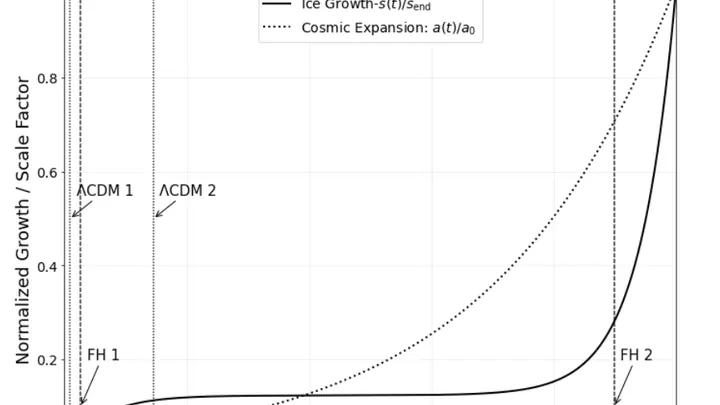
In winter, a lake freezes over, and this simple process turns out to be a living model of an expanding universe. Ice thickness grows according to the same mathematical law as the distances between distant galaxies.
The secret lies in the movement of water beneath the ice crust.
In one hospital ward it's +40°C, in another +10°C, and on average it's +25°C. If temperature affected something nonlinearly (say, the rate of bacterial growth) the average would give a wrong prediction. The same problem arises when cosmologists describe a universe where galaxies are packed into clusters and voids yawn between them.
The birth of the Universe is usually associated with the Big Bang — a point of infinite density. But at that point, the laws of physics break down, which bothers scientists. Stephen Hawking and James Hartle back in the 1980s proposed a different view: time has no boundary, like the surface of a globe.
The world of physics works like a music box: there's a speed knob. Turn it slowly, and the melody is strict — balls roll along trajectories (classical mechanics). Speed it up — the notes blend into a chord: a particle is in many places at once, all probabilities (quantum regime).
The secret of switching is in the parameter κ.
In the nearly empty regions of space, galaxies spin in unison, like dancers in the same troupe. This dance creates a difference in light from opposite sides: on one side stretching, on the other compression. This optical shift has become a probe of the first moments after the Big Bang.
Galaxies in the Universe are not scattered randomly: neighboring ones move in the same direction, like a school of fish, while distant ones each go their own way. Where the boundary between 'together' and 'apart' lies has been unclear until now.
The early universe was far from perfect: some regions stretched faster than others, creating folds and warps. But a quantum bounce — the transition from contraction to expansion, driven by the laws of the microworld — fixes everything.
In the first moments after the Big Bang, space expanded at an incredible rate. A tiny quantum ripple, embedded in the uncertainty principle itself, pushed matter apart more strongly than any known force. This ripple is the generalized uncertainty principle, or GUP.