Cosmic Vortex: How Void Rotation Reveals the Universe's Composition ✛ ✦
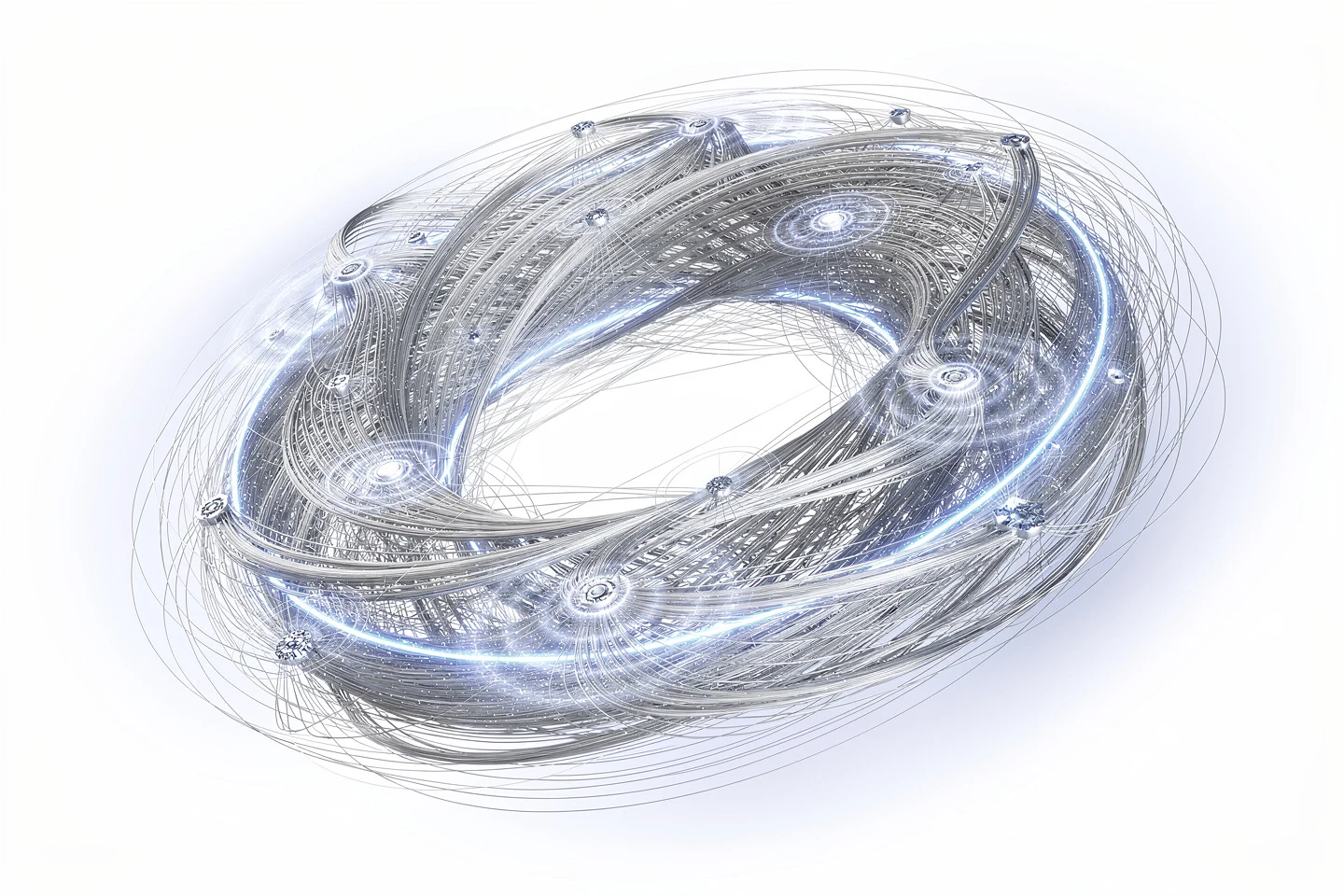
330 billion dark matter particles move in a cube 8 h⁻³ Gpc³ across — the arsenal of the AbacusSummit simulations, recreating the evolution of an expanding universe. In this digital universe, a familiar picture emerges: bright filaments of galaxies and gaping voids — up to half a billion light-years wide, where density drops tenfold. These colossal empty regions are not static. Tidal forces from the large-scale structure spin them into a slow vortex — the very dance that opens a new way to weigh the cosmos. (The concept of expansion was introduced by Georges Lemaître and later confirmed by Edwin Hubble.)
Inside each void, they measured the asymmetry of line-of-sight velocities: galaxies on opposite sides of the spin axis move ever so slightly differently. This is captured through redshift — light stretched by expanding space. For every void, they pinpointed the direction with the maximum asymmetry, Δz_max. The difference is minuscule. But it was detected. Pooling data from 33 models, the scientists saw that the distribution of Δz_max perfectly fits a generalized gamma distribution with two parameters. The shape parameter k = 6.551. It is rock-solid — unchanged even in a universe with evolving dark energy. Meanwhile, the scale parameter θ sensitively distinguishes the composition.
This behavior turns voids into a precision tool. Standard probes (gravitational lensing, cosmic microwave background) rigidly bind Ωm and σ8 into a single combination, S8. Tearing them apart was impossible. Voids can do it. The scale parameter θ depends linearly on Ωm and σ8 independently. Dark energy is irrelevant to it. The researchers derived a bilinear model: \(10^5 \theta = 9.12 \, \Omega_m + 2.72 \, \sigma_8 - 1.69\). It holds to fractions of a percent even in worlds with different equations of state. Now, measuring θ in real voids lets us simultaneously compute both fundamental numbers — the amount of dark matter and the strength of primordial ripples, first observed by Vera Rubin.
That same vortex, spun over billions of years, becomes a calibrated speedometer. The LSST on the Vera Rubin Telescope and the DESI spectroscopic program promise thousands of new voids with measured redshifts. If the model holds, the emptiness will speak: its swirling dance will tell the story of its own birth.
The shape parameter k = 6.551 stayed identical for all 33 cosmologies studied — from models lacking dark energy to those where it evolves. The universe seems to impose the same spin 'geometry' on voids regardless of its composition.