statistics

five sigma

The Hubble tension is quantified as a 5 sigma discrepancy between expansion rate measurements.
33 related articles

Description

Five sigma (5σ) is a statistical significance threshold used in particle physics to claim a discovery. It means that the probability of the observed result occurring by random chance alone is less than about 1 in 3.5 million (corresponding to a p-value of 0.0000003). In the context of the Hubble tension, the discrepancy between measurements of the Universe's expansion rate from the early universe (cosmic microwave background) and the local universe (Cepheid variables and supernovae) is quantified as a 5 sigma deviation. This indicates that the two sets of measurements are extremely unlikely to be consistent with each other under the standard cosmological model, suggesting either new physics or unknown systematic errors.

History

The 5σ convention was established in particle physics in the 1960s and 1970s, particularly with the discovery of the J/ψ particle in 1974, and became standard practice for the Large Hadron Collider experiments. The Hubble tension itself was first noted in the 2010s as measurements improved.

How it works

The significance is calculated by comparing the difference between two measurements to their combined uncertainties. If the difference is large relative to the uncertainties, the significance in sigma units is high. For a normal distribution, 5σ corresponds to a probability of about 0.0000003 that the difference is due to random fluctuations. In practice, physicists use this threshold to avoid false claims, as many systematic effects can mimic small deviations. Reaching 5σ requires extremely precise measurements and careful control of systematic errors.

In practice

The 5σ threshold is used in high-energy physics experiments (e.g., CERN) to announce discoveries like the Higgs boson. In cosmology, it is used to assess the significance of tensions like the Hubble constant discrepancy, guiding whether new physics models are needed.

Fun fact

The 5σ threshold is so strict that, in a typical physics experiment, you would need to run the experiment about 3.5 million times to expect one false positive by chance.
Concept graph →

Related articles · 33

Cosmology2026-08-072 minarXiv:2608.07470express
Cosmology2026-08-062 minarXiv:2608.06247
A Tailwind for Six Runners: How Peculiar Velocities Skewed the Hubble Constant
Six runners sprint down the track, and officials time their speed without noticing a tailwind. The wind blows at their backs, and the stopwatches show a better result than the truth. Roughly this is how six megamasers — natural cosmic lasers in distant galaxies — misled astronomers measuring the expansion rate of the universe.
General Relativity2026-07-082 minarXiv:2607.07741express
Cosmic Mirage: How the Solar Bubble Is Reshaping the Map of the Universe
The cosmological debate is like two craftsmen measuring the same wall but getting different lengths. One uses a tape measure, applying it to nearby landmarks — Cepheids (pulsating beacon stars) and Type Ia supernovae (flashes of dying stars). He finds the wall is stretching at 73.5 arbitrary units.
Cosmology2026-07-065 minarXiv:2607.05044
Symphony of Dark Energy: From Heavy Adagio to Explosive Allegro
A drama is brewing in cosmology: two principal musical instruments, the orchestra of the early Universe and the chamber ensemble of the modern cosmos, play the same symphony of expansion at different tempos.
Cosmology2026-07-033 minarXiv:2607.03569
Dancing Shadow: How Kinetic Quintessence Reconciles the Universe's Epochs
Imagine a cosmic orchestra performing a symphony from the Big Bang to the present day. The conductor, dark energy, long seemed an impassive metronome: the cosmological constant Λ motionless, like a baton frozen in mid-air.
Cosmology2026-06-301 minarXiv:2606.31362
Stumbling Over Hubble Tension: How Primordial Black Holes Lose the Race for Dark Matter
In a recent study, astrophysicists showed how pre-recombination physics, particularly early dark energy, affects the spectral running $$α_s$$ and, consequently, the viability of scenarios forming primordial black holes from an ultra-slow-roll (USR) phase during inflation.
Cosmology2026-06-291 minarXiv:2606.30903express
A Cosmic Compromise: One Number Settles Three Disputes
Cosmology is like an orchestra where different sections suddenly start playing out of sync. Measurements of the universe's expansion rate (the Hubble constant) from the early and late universe give different numbers.
math.GM2026-06-292 minarXiv:2607.01265
λ∞: The Tuning Fork for Prime Numbers
Strike a tuning fork. The frequency is 440 Hz. That's the note A — the standard of sound. In the world of numbers, there's a standard too. It's tuned not to sound, but to prime numbers. Though their distribution seems random, it obeys strict laws. All primes resonate together. There's just one value: λ∞ ≈ 0,674036.
Cosmology2026-06-253 minarXiv:2606.26831
The Cosmic Tuning Fork: Why the Universe Plays Two Different Notes
The cosmological orchestra doesn't tune to a single tuning fork. There are two groups of instruments: one listens to the hum of the young universe — the cosmic microwave background, while the other reads notes from mature galaxies and supernovae.
General Relativity2026-06-202 minarXiv:2606.22262express
The Universe Refuses to Agree on the Numbers
The Universe has a rate at which it expands — called the Hubble constant. The problem is that the two most precise ways to measure it give different numbers. One method, using the early light of the Universe (the cosmic microwave background), gives one value.
Cosmology2026-06-112 minarXiv:2606.12822express
Why Cosmic Data Refuse to Converge
Two rulers show slightly different lengths for the same table. That's roughly the situation in cosmology with the Hubble constant — the number that tells how fast the universe is expanding.
Cosmology2026-06-041 minarXiv:2606.06495express
Cosmology2026-06-032 minarXiv:2606.05358
Cosmology2026-06-023 minarXiv:2606.03634
Cosmic Detective: Two Independent Clues Against the Main Cosmological Debate
Cosmology resembles a courtroom where two witnesses give irreconcilable testimonies. The first — the analysis of the cosmic microwave background by the Planck satellite — claims: the expansion of the universe proceeds at 67 (km/s)/Mpc.
Cosmology2026-06-013 minarXiv:2606.02097
Light Leaks into Darkness: How Photons Become Dark Matter
Cosmology is experiencing a tectonic rift. Cepheid-calibrated supernovae, measured by Adam Riess’s team, point to a rate of about 73 km/s per megaparsec.
Cosmology2026-05-262 minarXiv:2605.27227express
Gravitational waves measure the expansion rate of the universe
Imagine a giant inflatable balloon with galaxies painted on it. As it inflates, the pattern stretches and neighboring dots move apart. The rate of that stretching is the Hubble constant. Astronomers usually catch light from distant stars and see how much it has reddened due to the stretching of space.
Cosmology2026-05-252 minarXiv:2605.26050express
Dark Matter Decays, the Universe Smooths Out
On the kitchen counter, there's a flour scale and a measuring cup for water. Individually, they're precise, but when you bake bread, the recipe calls for the perfect ratio. Astronomers have a similar dispute about the universe's expansion rate.
Cosmology2026-05-033 minarXiv:2605.01904express
A Dark Deal: How the Universe Reconciles Its Clocks
Two clocks tell different times. One sits on our desk, the other lies far in the past, in the glow left over from the Big Bang. The first, looking at nearby galaxies, ticks off the expansion rate of the universe — about 73 kilometers per second per megaparsec of distance. The second, peering into ancient light, gives a noticeably lower value — roughly 67.
Cosmology2026-04-292 minarXiv:2604.26541express
Dark Radiation and the Run of Inflation: What Hubble Is Hiding
The cosmological dispute resembles two craftsmen measuring the same room with different tape measures. One, looking at distant galaxies, gets one number. The other, peering into the ancient glow (the cosmic microwave background, the cooled light of the Big Bang) gets another, smaller number.
Dynamical Systems2026-04-192 minarXiv:2604.17528express
Five Faces of the Same Randomness
In a big city after rain, water collects in the same low spots no matter where the first drops fall. An hour later, the pattern of puddles hardly depends on where the downpour started. That is equilibrium — the outcome a system reaches regardless of its start, once the details are forgotten.
Cosmology2026-04-151 minarXiv:2604.13535express
Two Flavors of Early Dark Energy Ease Cosmic Tension
Cosmologists faced a recipe problem: the universe's expansion rate measured nearby didn't match the rate deduced from the Big Bang's afterglow — the cosmic microwave background.
Instrumentation2026-04-141 minarXiv:2604.13145express
Starlink and OneWeb Satellites: An Unexpected Swap in Brightness
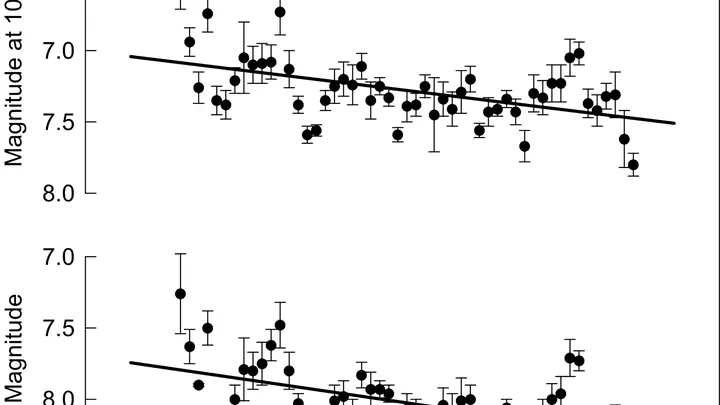
For five consecutive years, the automated MMT9 observatory measured the brightness of Starlink and OneWeb satellites using photometry (precise light measurement). The results were surprising: VisorSats, equipped with visors to reduce glare, became brighter by 0.6 magnitudes, while OneWeb, on the contrary, dimmed by 0.4.
Cosmology2026-04-061 minarXiv:2604.04408express
The Universe Breathes Unevenly
Cosmologists have measured how fast distant galaxies are receding in different parts of the sky. To do this, they used two kinds of "cosmic rulers": galaxy clusters and a certain type of supernova explosion. Both methods showed the same thing: in one direction, the Universe is expanding slightly faster than in the opposite direction.
Cosmology2026-04-041 minarXiv:2604.03769express
Radio bursts help measure the expansion of the Universe
The Universe is expanding, but at what speed? Astronomers have been arguing for decades about the precise value of the Hubble constant. Two classic methods give slightly different results. Now there's a third — using mysterious radio bursts.
Cosmology2026-03-312 minarXiv:2603.29879express
The Universe in Meters: How Units of Measurement Set Astronomers at Odds
Two astronomers look at the same universe but see it differently. One measures the expansion rate using ancient light that has been traveling toward us for nearly 14 billion years. The other uses recent stellar explosions in nearby galaxies. The first gets 67 kilometers per second per megaparsec, the second gets 73.
Cosmology2026-02-251 minarXiv:2602.21890express
Where Stars Are Born: The Threads of the Universe
The Universe looks like a giant spiderweb: galaxies aren't scattered randomly but are gathered into knots and along filaments. Inside the filaments, there's plenty of gas, and that's where new stars most often flare up. But how has this changed over time? Scientists compared data from a computer model with real observations of thousands of galaxies.
Cosmology2026-01-292 minarXiv:2601.22043express
A Cosmic Ruler Without a Ruler
The universe is expanding, but at what rate is a question that has been troubling astronomers for decades. Two methods of measurement give different answers, and this discrepancy is called the Hubble tension. Some look at the early universe through the cosmic microwave background, others at nearby supernovae and Cepheid variables.
Cosmology2026-01-251 minarXiv:2601.17938express
Lack of Information Accelerates the Universe
The visible edge of the universe is a holographic screen that, like a black hole, obeys laws discovered by Bekenstein and Hawking. Normally, information is preserved on it, but calculations show that if a few bits are lost, energy is released that accelerates expansion.
Cosmology2026-01-101 minarXiv:2601.06589express
Galaxy Rotation in Voids Tests Inflation
In the nearly empty regions of space, galaxies spin in unison, like dancers in the same troupe. This dance creates a difference in light from opposite sides: on one side stretching, on the other compression. This optical shift has become a probe of the first moments after the Big Bang.
Cosmology2026-01-081 minarXiv:2601.04774express
Gravitational waves refine cosmic expansion rate
Measuring the universe’s expansion is like timing a race when the track stretches. Neutron star mergers act as standard sirens: their gravitational waves ring out with a known “volume,” so fainter signals mean greater distance.
Cosmology2025-12-171 minarXiv:2512.15380express
Gravitational waves and galaxy maps measure the expansion of the Universe
The Universe is expanding, and every galaxy cluster takes part in a grand dance. The tempo of this dance is set by the Hubble constant, first measured by Edwin Hubble nearly a century ago. Pinpointing the number is tough because you need a ruler that spans billions of light-years.
Cosmology2025-12-022 minarXiv:2512.02391express
Refining the Expansion Rate of the Universe with 'Twins' Among Type Ia Supernovae
Type Ia supernovae are the 'standard candles' of cosmology: their peak luminosity is nearly identical, allowing distances to be determined from apparent brightness — the fainter the object, the farther away it is.
Cosmology2025-09-113 minarXiv:2509.09665
A Ladder with No Top Rung: Cepheids vs. Supernovae
The cosmological community has been living in a state of quiet civil war for several years. Two camps measure the expansion rate of the Universe and get different answers. Planck, peering at the cosmic microwave background, says 67.4 km/s/Mpc. SH0ES, climbing the distance ladder from Cepheids to supernovae, insists on 73.2.