A Drop Squeezed by Flow Tells Its Story express
A microscopic gel bead or a tiny oil droplet squeezes through a narrow channel whose walls rhythmically contract and relax. The particle flattens and then recovers its shape, and by how quickly it does so, you can infer its internal elasticity and viscosity. That's how Rheofluidics works: a new method that measures the mechanical properties of individual micro-objects, not their aggregates.
Previously, scientists would take a whole test tube with millions of particles and spin it in a special instrument. That gave an average over the whole population: if one particle was stiffer than another, that difference was lost. Rheofluidics passes each particle one by one through a channel with corrugated walls, like a marble rolling over a washboard. The deformation under oscillating pressure reveals how the material responds to different frequencies, from slow compressions to rapid vibrations.
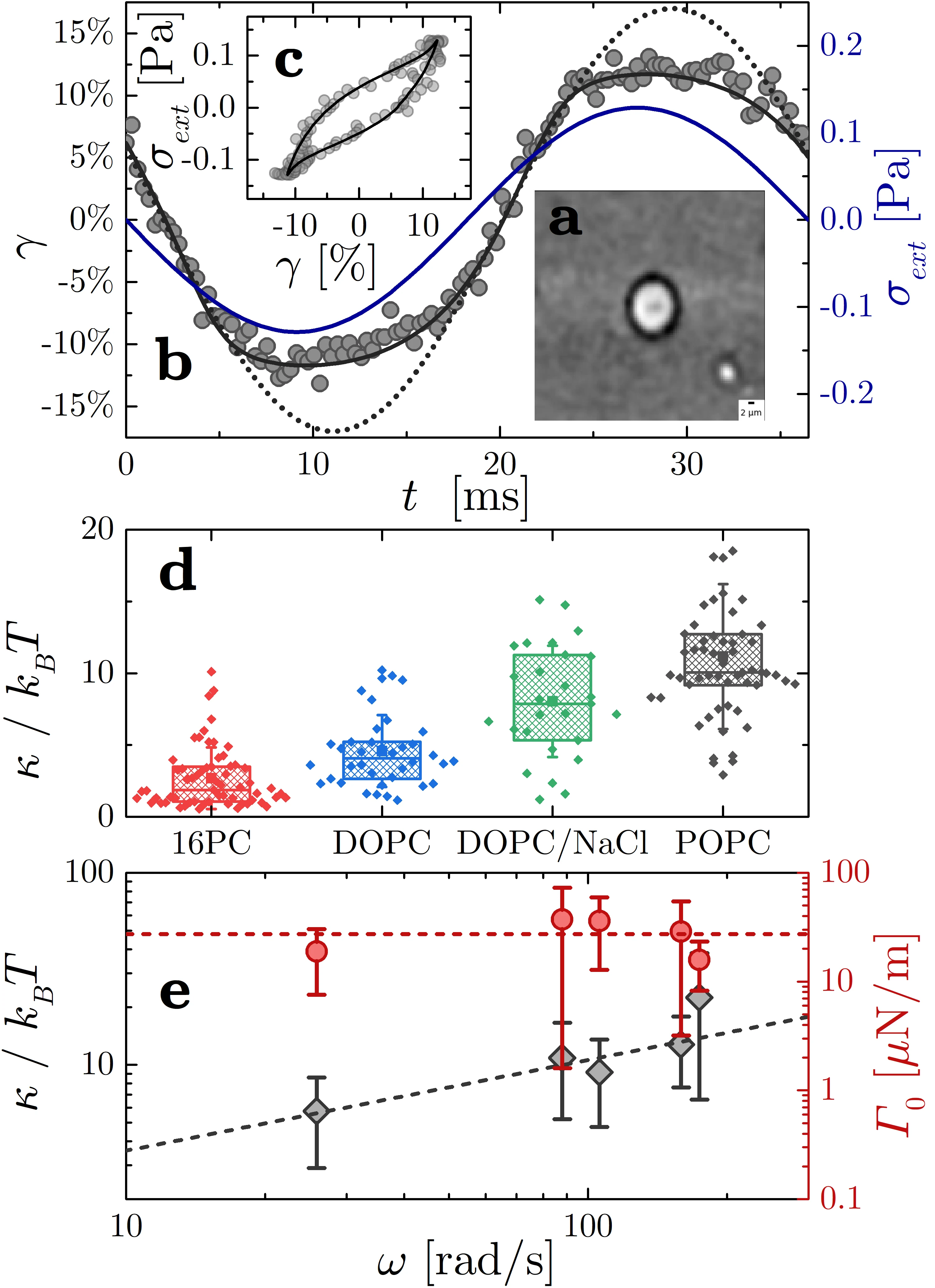
The authors applied Rheofluidics to three types of objects: droplets with surfactants (soap films), microgels (tiny pieces of gel), and vesicles — artificial bubbles with a membrane resembling a cell membrane. For vesicles, they found an unexpected dependence of membrane stiffness on bending frequency. This matters for biology: cells in our bodies are constantly deformed, and their response to different compression rates could influence health and disease.
Original abstract
as written by the authors arXiv:2601.07461
We present Rheofluidics, a microfluidic technique that measures the frequency-dependent rheology of individual micron-scale objects. We apply oscillatory hydrodynamic stresses by flowing them through channels with modulated constrictions, and measure their deformation. Unlike bulk rheology, which measures collective properties, Rheofluidics provides heretofore unattainable measurements of individual particles. We apply Rheofluidics to discover frequency-dependent surface tension of surfactants, very high-frequency viscoelasticity of microgels and unexpected frequency-dependent bending modulus of vesicles.
Microgels are tiny pieces of gel that can absorb water and swell to hundreds of times their size. They are used in diapers, contact lenses, and even drug delivery.